Over 10,000+ customers' choice, Focus on screening industry 40+ years
Dust generation during pharmaceutical excipient screening depends on several factors, including particle size, moisture content, flowability, feeding methods, and equipment operating conditions.
As the Rotary Vibratory Sieve operates, material moves and separates across the screen surface. Some fine particles may become airborne due to material movement or airflow.
Three areas deserve particular attention:
Feeding: Material Drop Height and Impact
When powder enters the screening machine from a hopper or conveying system, excessive drop height or inconsistent feeding may cause material impact and generate airborne dust. This should be carefully evaluated when handling fine pharmaceutical excipients with good flowability.
Screening: Sealing at Equipment Connections
The screen body vibrates continuously during operation. If connection structures, sealing components, or installation points are not properly configured, fine powder may escape through gaps or joints. Equipment design must therefore consider both screening performance and connection integrity.
Discharge: Powder Collection and Transfer
After screening, different particle fractions are discharged separately. If there are gaps between discharge outlets and collection containers, or if open transfer methods are used, material may generate additional dust during discharge.
Effective dust management should therefore cover the entire material handling process, including feeding, screening, discharge, and downstream transfer.
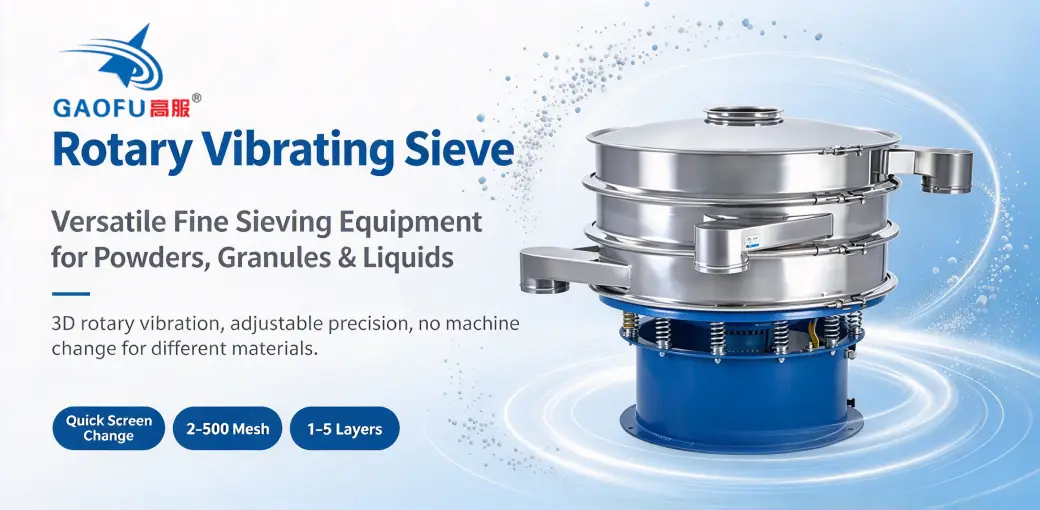
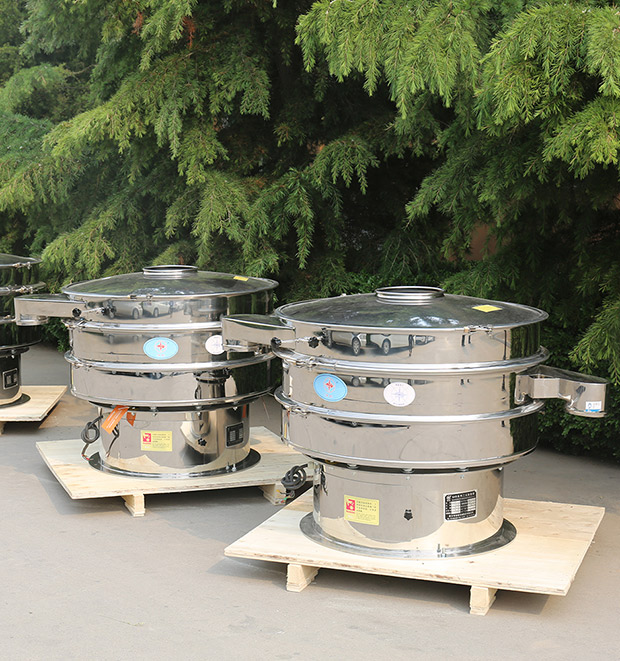
For pharmaceutical excipient screening applications, Gaofu Machinery's Rotary Vibratory Sieve can be configured with enclosed structures and compatible connection solutions according to site requirements. These configurations help reduce direct exposure of powder to the surrounding production environment.
Enclosed Screen Body and Sealed Connections
A suitable combination of screen body structure, sealing components, and connection points can help reduce the likelihood of powder escaping during operation.
When handling fine pharmaceutical powders, the sealing arrangement should be selected according to material characteristics. Regular inspection of sealing components and their installation condition is also important.
Properly Integrated Feed Connections
The feed inlet can be configured to suit the upstream feeding method, including hoppers, conveying pipelines, or other feeding equipment.
A well-matched connection can help reduce material exposure associated with open feeding and support better dust management around the feeding area.
Compatible Discharge and Collection Arrangements
After screening, material leaves the machine through separate discharge outlets. Depending on the production line layout, these outlets can be connected to enclosed collection containers or downstream conveying equipment.
This arrangement can reduce open exposure during material transfer and help limit secondary dust generation.
It is important to understand that an enclosed structure helps reduce dust release but does not guarantee completely dust-free operation. Where stricter dust control is required, suitable local exhaust ventilation or a centralized dust collection system should also be considered.
In addition to dust management, stable screening operation is important for maintaining an orderly pharmaceutical excipient processing workflow.
Gaofu Machinery's Rotary Vibratory Sieve uses a vertical vibration motor as its excitation source. Upper and lower eccentric weights generate a combined vibration force, causing the screen body to move horizontally, vertically, and at an inclined angle.
As material enters the screen surface, vibration helps distribute and stratify the particles. Particles that meet the specified aperture requirements pass through the mesh, while other size fractions are discharged through the corresponding outlets.
This screening principle is suitable for pharmaceutical excipient particle size classification and the separation of certain oversized particles. Depending on material characteristics and production requirements, the machine can be selected with appropriate screen mesh specifications, deck configurations, and equipment dimensions.
A suitable screening configuration can also contribute to dust management in several ways:
Controlled feeding: Adjust the feeding method according to equipment capacity to avoid excessive material accumulation and unnecessary powder disturbance.
Appropriate screen selection: Choose suitable mesh specifications based on the target particle size to help reduce repeated processing caused by an unsuitable screening setup.
Optimized discharge connections: Coordinate collection containers and downstream equipment to reduce open discharge and manual material transfer.
Routine equipment inspection: Regularly check the screen mesh, sealing components, and connection points to identify wear, looseness, or sealing problems.
Combining appropriate equipment configuration with standardized operating practices can help maintain orderly screening operations and support powder handling management.
Pharmaceutical excipients cover a wide range of materials. Their particle size, bulk density, flowability, moisture sensitivity, and dust characteristics can vary considerably. Even when using the same model of Rotary Vibratory Sieve, different materials may require different equipment configurations.
For example, when processing fine powders with good flowability, particular attention should be paid to feeding drop height, connection sealing, and discharge collection.
For materials that are prone to moisture absorption or agglomeration, additional evaluation may be required regarding screen selection, screening conditions, and equipment cleaning and maintenance.
When selecting a Rotary Vibratory Sieve, Gaofu Machinery can assess the following information to help determine a suitable configuration:
Pharmaceutical excipient name and basic material characteristics
Raw material particle size range and target screening requirements
Required processing capacity and production cycle
Feeding method and downstream collection arrangement
Existing workshop ventilation, local exhaust, and dust collection conditions
Material compatibility of product-contact components and cleaning requirements
For materials that may generate combustible dust, additional precautions should be evaluated based on the material safety data and a professional risk assessment. These may include static electricity control, equipment grounding, and appropriate explosion protection measures. A standard enclosed structure should not be considered equivalent to an explosion-protected design.
Dust control in pharmaceutical manufacturing is a system-level responsibility. A Rotary Vibratory Sieve can help reduce material exposure and powder release around the screening process, but overall workshop conditions are also influenced by upstream feeding, downstream conveying, equipment cleaning, airflow, and dust collection facilities.
Gaofu Machinery's Rotary Vibratory Sieve can be configured around pharmaceutical excipient screening requirements, with consideration given to enclosed screening, feed and discharge connections, and compatible collection arrangements. This provides equipment support for powder handling operations within pharmaceutical production lines.
In practical applications, manufacturers should also establish procedures for checking equipment seals, maintaining dust collection systems, managing material transfer, and carrying out routine cleaning. Coordinating equipment configuration with on-site operating procedures helps create a more comprehensive dust management approach.
Conclusion
Pharmaceutical excipient screening involves more than particle size classification. Dust management during powder handling is also an important consideration for production environments.
With a suitable screening structure, enclosed connections, and compatible feeding and discharge arrangements, Gaofu Machinery's Rotary Vibratory Sieve can help reduce powder exposure and the potential for dust release, supporting more organized powder processing conditions in pharmaceutical workshops.
For different pharmaceutical excipients and production requirements, Gaofu Machinery can provide equipment selection and configuration recommendations to help integrate screening operations and dust management into the overall manufacturing process.
Pharmaceutical Industry Client Testimonials
Dong-E E-Jiao, Harbin Pharmaceutical Group, North China Pharmaceutical,Yangtze River Pharmaceutical Group, Taiji Group, Huadong Medicine,CSPC Group, Northeast Pharmaceutical, Guangzhou Baiyunshan, Tongrentang,Huiren Pharmaceutical, Fosun Pharma, Xiuzheng Pharmaceutical, Lijun Pharmaceutical,Luye Pharma Group, Di'ao Group, TianGongLi, Hengrui Medicine, Jiuzhitang, Jiangzhong Pharmaceutical, Lunan Pharmaceutical, Yunnan Baiyao, Sunflower Pharmaceutical,China Sanjiu Enterprise Group, Sanjin Pharmaceutical, Yiling Pharmaceutical,Wantong Pharmaceutical, Pientzehuang, Ma Yinglong Pharmaceutical, Guangyuyuan,Aodong Pharmaceutical, Besunyen, Jingfukang Pharmaceutical, Furen Pharmaceutical Group,Guizhou Bailing, Conba, Huasu Pharmaceutical, Yifang Pharmaceutical
Fortune 500 Client Testimonials
CNPC、CSCEC、Sinochem Holdings、CRCC、China Minmetals Corporation、CNOOC、CR、Sinopharm、CHN Energy、COFCO Corporation、Huawei Technologies、PowerChina、CITIC Group、Wuchan Zhongda Group、NORINCO、Chalco、CNBM、 Shaanxi Coal and Chemical Industry Group、Ansteel Group、CETC、CSSC、CASC、CEC、Jinchuan Group、CASIC、Conch Cement、CNNC、SPH、Shanxi Coking Coal Group、 Zhongtai Chemical、GPHL、DEC、Sinosteel Corporation、MCC、China National Salt Industry Chemical、China Baowu Steel Group、China Animal Husbandry Industry Co., Ltd.、CECEP
About Gaofu
Xinxiang Gaofu Machinery Co., Ltd. was founded back in the 1980s. With over 40 years of development, it has been certified as a National-level Specialized, Refined, Unique & Innovative Little Giant Enterprise, National Green Factory, National High-tech Enterprise, and National Intellectual Property Advantage Enterprise, and serves as the President Unit of China Vibration Screening Industry Association.
The company is accredited with the Henan Provincial Industrial Design Center, Henan Provincial Engineering Technology Research Center for Intelligent On-line Screening System, and Xinxiang Municipal Engineering Technology Research Center for Fine Screening.
Gaofu has obtained more than 500 patents including invention patents, utility model patents and design patents, been awarded the Science and Technology Achievement Prize issued by the Ministry of Industry and Information Technology of China, and participated in drafting and formulating 4 national standards.
Gaofu's product portfolio covers multiple series and hundreds of specifications, including vibrating screening equipment, conveying equipment, coal crushing equipment, filtration equipment and automatic material handling systems.
Core products include vibrating screens, screening machines, vibratory sifters, rotary vibrating screens, ultrasonic vibrating screens, linear vibrating screens, airflow screens, gyratory screens, roller screens, dewatering screens, bar screens, vacuum feeding machines, dust-free feeding stations, bulk bag feeding stations, feeding systems, automatic powder feeding systems, automatic slag-discharging filters, leaf filters, clay filters, toothed roll crushers, coal crushers and other machinery.
These products are widely applied in food, pharmaceutical, chemical, metallurgy, construction materials, mining, thermal power, environmental protection and many other industries, winning recognition and trust from over 10,000 clients worldwide.
Gaofu products enjoy strong sales across Greater China, and are exported to more than 100 countries and regions such as Russia, Canada, the United States, New Zealand, Japan, Brazil and South Africa.
Upholding the corporate mission of Improving material quality & efficiency to fully satisfy customer demands, Gaofu maintains long-term partnerships with clients to achieve win-win development.
At present, Gaofu is an official qualified supplier for numerous Fortune Global 500 enterprises, including CNPC, Sinopec, Sinochem Holdings, China Resources Group, Sinopharm Group, COFCO, China National Building Material, China Aerospace Science and Technology Corporation, Jinchuan Group and more.
Gaofu Machinery ranks No.1 in global sales volume of vibrating screens.
In May 2024, Frost & Sullivan, a world-renowned international consulting firm, issued a Market Position Verification Certificate confirming that Gaofu achieved the world's largest shipment volume of vibrating screens in the global market in 2023.