Over 10,000+ customers' choice, Focus on screening industry 40+ years
Caking in coconut powder does not necessarily indicate a problem with the milling process. Production conditions, raw material characteristics, and storage methods can all affect powder flowability.
Changes in ambient humidity
When coconut powder is transferred or temporarily stored in an open environment, it may come into contact with moisture in the air. For moisture-sensitive materials, changes in moisture content can increase adhesion between particles, gradually forming small agglomerates.
Oil adhesion and reduced powder flowability
The oil content of coconut powder varies depending on the raw material and processing method. Some oil-containing powders may develop particle adhesion during temperature fluctuations or prolonged storage, making them more difficult to disperse during screening.
Compaction during storage and transfer
While stored in hoppers, bags, or conveying equipment, powder may be subjected to its own weight and external pressure. This can create agglomerates with different degrees of compaction. Once the material enters the screening machine, these lumps may not immediately break apart.
Therefore, improving coconut powder screening uniformity requires more than simply changing the screen mesh. Manufacturers should also consider moisture content, storage conditions, feeding characteristics, and the movement pattern of the screening equipment. A coordinated approach from upstream handling to final screening is often more appropriate.
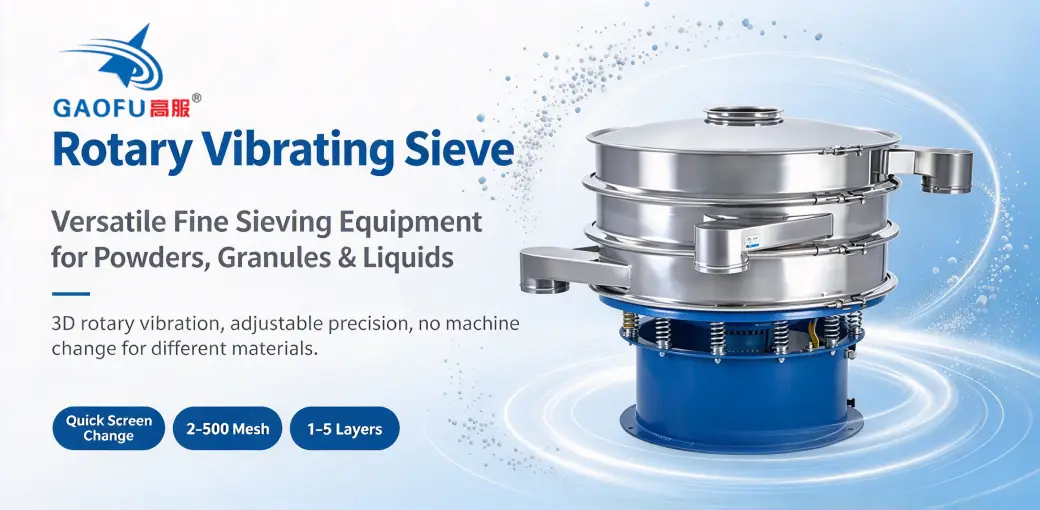
For agglomerated powder applications, Gaofu Machinery's rotary vibratory sieve uses a vertical vibration motor to generate excitation forces. The upper and lower eccentric weights produce combined movements, causing the screen body to vibrate horizontally, vertically, and at an inclined angle.
After entering the screening surface, coconut powder moves, rolls, and redistributes under the combined vibration forces. This multi-directional motion helps increase contact between the material and the screen mesh, allowing particles that meet the selected aperture requirements to pass through.
For loose agglomerates, collisions between particles and interaction with the vibrating screen surface may help disperse some of the material, allowing the finer particles within the agglomerates to pass through the mesh.
It is important to note that a rotary vibratory sieve is not a dedicated crushing machine. Hard lumps formed by moisture exposure or strongly adhesive agglomerates may not be effectively dispersed by vibration alone. Depending on the material, additional pretreatment, drying, or suitable deagglomeration equipment may be required before screening.
Coconut powder particle size uniformity depends not only on the screening machine but also on the mesh aperture and the way material moves across the screen surface.
Gaofu Machinery's rotary vibratory sieve can be configured with suitable screen mesh specifications according to the target particle size. By selecting an appropriate aperture, manufacturers can allow the desired powder fraction to pass through while retaining oversized particles and incompletely dispersed agglomerates for separate discharge.
Screen selection needs to balance two considerations.
If the aperture is too large, some coarse particles and agglomerates may pass through with the finished powder. If the aperture is too small, screening capacity may be reduced and the load on the screen surface may increase.
The relative angle of the upper and lower eccentric weights can also be adjusted to change the material's movement path and residence time on the screen. For coconut powder with good flowability and rapid screen passage, the movement pattern can be adjusted as required. For material that tends to accumulate in certain areas, the feeding rate, screen distribution, and mesh specifications should be evaluated together.
This configuration flexibility allows manufacturers to adjust the screening process according to different coconut powder particle size requirements rather than relying on one fixed operating setup for every product.
When moisture-affected coconut powder enters the screening machine, concentrated feeding may create a thick layer of material in one area. This can prevent some particles from making sufficient contact with the mesh.
Gaofu Machinery's rotary vibratory sieve can be evaluated with suitable feeding and discharge arrangements based on the production line layout. Proper feeding helps distribute material more evenly across the screen surface.
For fine coconut powder that tends to adhere to the mesh, auxiliary screen-cleaning devices can also be considered according to the screen structure and material characteristics.
For example, bouncing balls may be installed in compatible configurations. Repeated impacts during vibration can help dislodge some material adhering to the underside of the screen mesh and improve screen aperture availability.
However, auxiliary cleaning devices cannot guarantee that screen blinding will never occur. For coconut powder with higher oil content, elevated moisture levels, or significant agglomeration, the appropriate configuration should be determined through material testing. Regular screen inspections and cleaning are still necessary.
Manufacturers can also reduce the risk of caking at the source by controlling moisture conditions after drying, minimizing unnecessary exposure during temporary storage, and maintaining suitable packaging and storage environments.
Different coconut powder applications do not necessarily require the same particle size range or distribution.
For coconut powder used in bakery ingredients, manufacturers may place greater emphasis on particle uniformity and the removal of oversized lumps. Powder intended for beverages or other food formulations may have different requirements for fineness and subsequent dispersion.
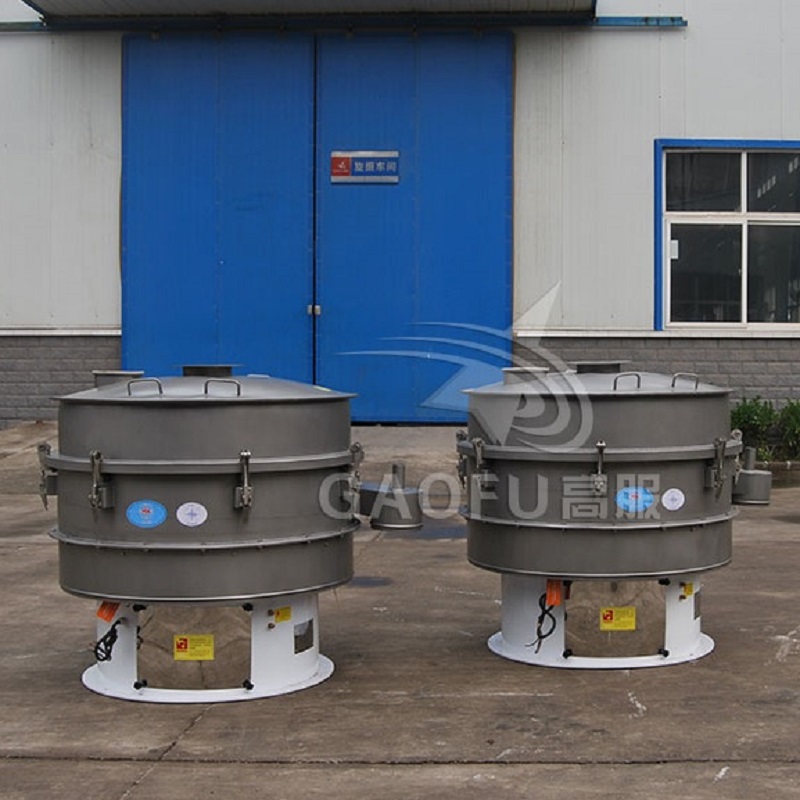
Gaofu Machinery's S49 series rotary vibratory sieve supports configurations with 1 to 5 screen layers, depending on process requirements. It can be used for single-stage screening or multi-stage particle size classification with different mesh apertures.
For example, a production process that requires the removal of coarse agglomerates followed by further particle classification may use a multi-layer screen configuration. Different particle fractions can then be discharged through their corresponding outlets.
More screen layers do not automatically mean better screening performance. As the number of layers increases, manufacturers also need to consider material passage, the load on each screen, cleaning arrangements, and maintenance accessibility.
The appropriate configuration should be selected according to actual material testing and production targets.
A rotary vibratory sieve performs physical screening and particle size classification, but maintaining consistent finished powder quality also requires coordination across the production process.
After milling, manufacturers can introduce an appropriate screening stage to separate oversized particles and agglomerates that do not meet the product requirements.
Before screening, it is important to monitor coconut powder moisture content, storage time, and feeding condition. Material that has become significantly damp or compacted should not be fed directly into the screening machine without evaluating whether pretreatment is needed.
During screening, the feeding rate should remain appropriate for the equipment configuration. Excessive feeding may overload the screen surface and reduce the opportunity for particles to pass through the mesh. Regular inspections of the screen mesh, connecting components, and screen-cleaning devices can also help identify issues that may affect screening performance.
For products with tighter particle size requirements, manufacturers can take samples before and after screening and compare the particle size distribution. This helps determine whether the selected mesh specifications and operating parameters are suitable for the current material.
Gaofu Machinery can evaluate rotary vibratory sieve models, screen layers, and auxiliary configurations according to coconut powder oil content, moisture conditions, particle size range, target throughput, and installation requirements. This helps manufacturers develop a screening solution suited to their specific production conditions.
Moisture-related caking in coconut powder can make material dispersion more difficult and may affect the particle size distribution during screening. Addressing this issue requires attention to material conditions, screen mesh specifications, feeding methods, and equipment operating parameters.
Gaofu Machinery's rotary vibratory sieve uses horizontal, vertical, and inclined three-dimensional vibration to help disperse and move coconut powder across the screen surface. Combined with multi-layer screen configurations, it can support particle size classification and the separation of oversized agglomerates that meet the screening criteria.
From equipment configuration to upstream material management, Gaofu Machinery provides screening solutions based on actual production conditions, helping coconut powder manufacturers improve powder classification and support more consistent particle size control.
Food Industry Client Testimonials
Nestlé, CP Group, Haitian Flavour & Fragrance, Yihai Kerry, Yili, Mengniu,Shuanghui, Wahaha, Master Kong, Want Want, Anjoy Foods, Angel Yeast,Yangyuan Foods, Uni-President Enterprises, Qiaqia Food, Luhua Group,Alpenliebe, Golden Monkey, Orion, Xizhilang,Sanquan Foods, Synear Food, Oishi, Wong Lo Kat, Yanjing Beer, Seamild,Jinpai, Chubang, Hengshun Vinegar Industry, Longda Group, Beijing Daoxiangcun, Anhe Dairy,Weiwei Group, Xiangpiaopiao, Maiquer, Tianbing, Binqi Food, Ligao Okun
Fortune 500 Client Testimonials
CNPC、CSCEC、Sinochem Holdings、CRCC、China Minmetals Corporation、CNOOC、CR、Sinopharm、CHN Energy、COFCO Corporation、Huawei Technologies、PowerChina、CITIC Group、Wuchan Zhongda Group、NORINCO、Chalco、CNBM、 Shaanxi Coal and Chemical Industry Group、Ansteel Group、CETC、CSSC、CASC、CEC、Jinchuan Group、CASIC、Conch Cement、CNNC、SPH、Shanxi Coking Coal Group、 Zhongtai Chemical、GPHL、DEC、Sinosteel Corporation、MCC、China National Salt Industry Chemical、China Baowu Steel Group、China Animal Husbandry Industry Co., Ltd.、CECEP
About Gaofu
Xinxiang Gaofu Machinery Co., Ltd. was founded back in the 1980s. With over 40 years of development, it has been certified as a National-level Specialized, Refined, Unique & Innovative Little Giant Enterprise, National Green Factory, National High-tech Enterprise, and National Intellectual Property Advantage Enterprise, and serves as the President Unit of China Vibration Screening Industry Association.
The company is accredited with the Henan Provincial Industrial Design Center, Henan Provincial Engineering Technology Research Center for Intelligent On-line Screening System, and Xinxiang Municipal Engineering Technology Research Center for Fine Screening.
Gaofu has obtained more than 500 patents including invention patents, utility model patents and design patents, been awarded the Science and Technology Achievement Prize issued by the Ministry of Industry and Information Technology of China, and participated in drafting and formulating 4 national standards.
Gaofu's product portfolio covers multiple series and hundreds of specifications, including vibrating screening equipment, conveying equipment, coal crushing equipment, filtration equipment and automatic material handling systems.
Core products include vibrating screens, screening machines, vibratory sifters, rotary vibrating screens, ultrasonic vibrating screens, linear vibrating screens, airflow screens, gyratory screens, roller screens, dewatering screens, bar screens, vacuum feeding machines, dust-free feeding stations, bulk bag feeding stations, feeding systems, automatic powder feeding systems, automatic slag-discharging filters, leaf filters, clay filters, toothed roll crushers, coal crushers and other machinery.
These products are widely applied in food, pharmaceutical, chemical, metallurgy, construction materials, mining, thermal power, environmental protection and many other industries, winning recognition and trust from over 10,000 clients worldwide.
Gaofu products enjoy strong sales across Greater China, and are exported to more than 100 countries and regions such as Russia, Canada, the United States, New Zealand, Japan, Brazil and South Africa.
Upholding the corporate mission of Improving material quality & efficiency to fully satisfy customer demands, Gaofu maintains long-term partnerships with clients to achieve win-win development.
At present, Gaofu is an official qualified supplier for numerous Fortune Global 500 enterprises, including CNPC, Sinopec, Sinochem Holdings, China Resources Group, Sinopharm Group, COFCO, China National Building Material, China Aerospace Science and Technology Corporation, Jinchuan Group and more.
Gaofu Machinery ranks No.1 in global sales volume of vibrating screens.
In May 2024, Frost & Sullivan, a world-renowned international consulting firm, issued a Market Position Verification Certificate confirming that Gaofu achieved the world's largest shipment volume of vibrating screens in the global market in 2023.