Over 10,000+ customers' choice, Focus on screening industry 40+ years
Coconut powder production typically involves raw material preparation, drying, milling, and screening. The natural fibrous structure of coconut material, together with particles generated during pretreatment and milling, can result in variations in particle size.
Common materials that may require screening include:
Long plant fibers
Some fibers may not be sufficiently reduced during processing and can remain as elongated or thread-like particles. When their dimensions are significantly larger than the target powder size, an appropriately selected screen mesh can help retain them.
Fiber agglomerates and oversized lumps
Fibers may become entangled, while powder can form agglomerates due to moisture, natural oil content, or storage conditions. These materials may have a larger particle size than the finished product specification allows.
Other oversized foreign particles
During raw material handling and transfer, larger particles may occasionally enter the production process. If their dimensions differ sufficiently from those of the coconut powder, screening may help separate them.
It is important to understand that a rotary vibratory sieve separates materials primarily according to particle size in relation to the screen aperture. Fine fibers with dimensions similar to the coconut powder particles may not be effectively separated by screening alone. Therefore, the screening process should be considered alongside raw material pretreatment, manual inspection, and other appropriate measures, such as magnetic separation or metal detection.
Fibers in coconut powder may be elongated, intertwined, or agglomerated. If the material accumulates in one area of the screen, some particles may not make sufficient contact with the mesh, affecting the screening process.
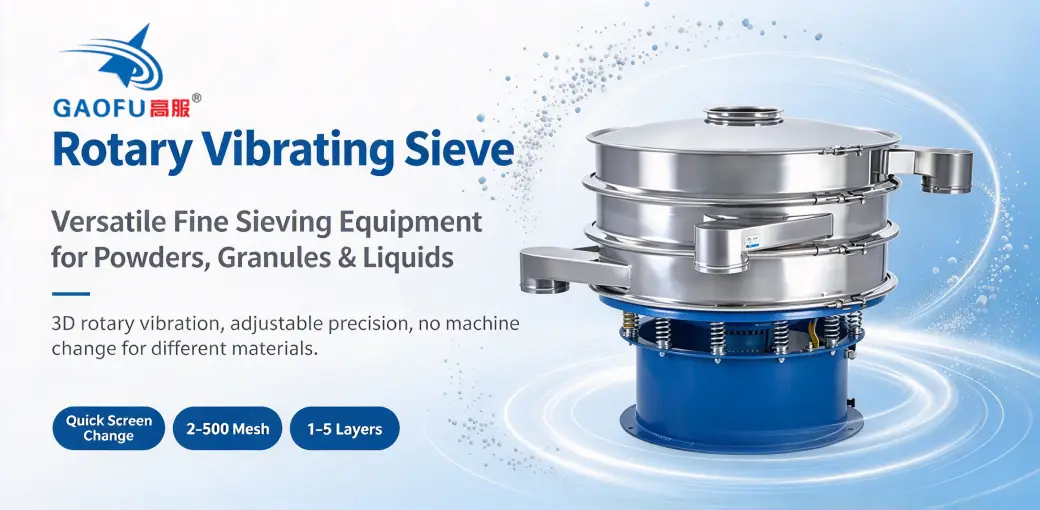
Gaofu Machinery's rotary vibratory sieve uses a vertically mounted vibration motor as its excitation source. The upper and lower eccentric weights generate combined vibration forces, producing horizontal, vertical, and inclined movements of the screen body.
After entering through the feed inlet, the material moves across the screening surface under the combined vibration forces. Smaller particles have repeated opportunities to contact the mesh. Coconut powder that meets the selected aperture requirements passes through to the lower screen or collection area, while larger fiber agglomerates, coarse particles, and lumps remain on the screen and move toward the corresponding discharge outlet.
This three-dimensional motion helps improve material distribution across the screening surface rather than relying on movement in a single direction.
The angle between the upper and lower eccentric weights can also be adjusted according to material characteristics, changing the material's travel path and residence time on the screen. For coconut powder with different particle sizes, flow characteristics, and fiber contents, suitable vibration settings and screen configurations can be established through testing.
For fine impurity removal, a smaller screen opening is not necessarily better.
If the aperture is too small, some coconut powder that meets the finished product requirements may also be retained, increasing material loss. If the aperture is too large, certain oversized fiber agglomerates and lumps may pass through with the finished powder.
Screen mesh selection should therefore take into account the target particle size, impurity dimensions, and actual material test results.
Gaofu Machinery's S49 series rotary vibratory sieve supports different screen mesh specifications and configurations with 1 to 5 screen layers, depending on process requirements.
A single-layer screen can separate the main product stream from oversized material. With multiple screen layers, the equipment can classify materials into different particle size ranges according to the selected apertures.
For example, a coconut powder production line that needs to remove larger fiber agglomerates before further particle classification may consider using an upper screen to retain coarse impurities and a lower screen to separate the desired particle size range.
The exact combination of screen apertures should be determined according to the actual particle size distribution and fiber dimensions of the coconut powder, rather than relying on a fixed mesh specification.
Combining impurity removal and particle classification in one screening process may also reduce unnecessary material transfers between separate stages. Whether multiple screening stages can be completed in a single machine depends on material flow characteristics, screening performance, and individual discharge requirements.
Screening area affects the available space for material distribution and is an important parameter when selecting a rotary vibratory sieve.
For example, Gaofu Machinery's S49 series includes several models with different screen dimensions:
The S49-800 has a screen diameter of φ760 mm and a screening area of approximately 0.42 m². The S49-1000 has a screen diameter of φ930 mm and a screening area of approximately 0.64 m², while the S49-1200 features a φ1130 mm screen diameter and approximately 0.95 m² of screening area.
For production lines requiring a larger screening surface, the S49-1500 offers approximately 1.61 m² of screening area. The S49-2000, with a screen diameter of φ1920 mm, provides approximately 2.90 m².
These models offer different screening area options, ranging from approximately 0.42 m² to 2.90 m². However, screening area should not be directly interpreted as processing capacity.
Actual coconut powder throughput depends on several factors, including moisture content, oil content, fiber proportion, bulk density, feeding rate, and screen mesh size.
Equipment selection should therefore involve more than comparing model dimensions. For coconut powder with a relatively high fiber content, a wide particle size distribution, or specific throughput requirements, it is advisable to conduct screening tests using representative material samples. Fiber retention, product passage, and material loss can then be evaluated before finalizing the machine size.
Coconut powder properties vary depending on the product and processing method. Some varieties contain a certain amount of natural oil, which may cause fine particles to adhere to the screen surface. Higher moisture levels or agglomeration during storage can also affect material passage through the mesh.
For these applications, Gaofu Machinery's rotary vibratory sieve can be evaluated with suitable screen specifications, screen-cleaning structures, and feeding and discharge arrangements.
For compatible screen configurations, bouncing balls or other auxiliary screen-cleaning devices may be considered. Repeated impacts during vibration can help dislodge some material adhering to the mesh and reduce certain types of screen blinding.
However, auxiliary cleaning devices cannot guarantee that screen blinding will never occur. For coconut powder containing long fibers, intertwined particles, or significant oil adhesion, the suitability of the cleaning structure should be verified through material testing. Regular screen inspections, cleaning, and maintenance remain important for reliable operation.
Appropriate raw material pretreatment can also help reduce large agglomerates and obvious oversized impurities before screening, potentially reducing the load on the screen surface.
Finished coconut powder quality is not determined by a single screening operation. Raw material inspection, pretreatment, milling, screening, collection, and packaging should be considered as interconnected stages.
Within this process, a rotary vibratory sieve performs physical screening. It uses the selected mesh aperture to retain oversized fiber impurities, agglomerates, and coarse particles while supporting particle size classification according to production requirements.
For production lines that need to control metal contamination, appropriate magnetic separation or metal detection equipment should also be considered based on a risk assessment.
For fine fibers whose dimensions are similar to those of the finished powder, manufacturers may need to combine raw material processing with other suitable separation methods.
Gaofu Machinery can evaluate rotary vibratory sieve models, screen layers, and related configurations according to coconut powder particle size, fiber characteristics, target throughput, and available installation space. This helps manufacturers select screening equipment that better fits their actual production processes.
Conclusion
Fine impurity removal in coconut powder processing starts with a clear understanding of material characteristics and the correct selection of screen mesh and screening methods.
Gaofu Machinery's rotary vibratory sieve uses three-dimensional vibration to help disperse material across the screen surface. It can be used to separate oversized fiber agglomerates, lumps, and other screenable impurities while supporting multi-stage particle size classification.
From screen area selection and auxiliary screen cleaning to integration with the overall production process, Gaofu Machinery can provide equipment selection support based on actual operating conditions, helping coconut powder manufacturers improve their screening and impurity removal processes.
Food Industry Client Testimonials
Nestlé, CP Group, Haitian Flavour & Fragrance, Yihai Kerry, Yili, Mengniu,Shuanghui, Wahaha, Master Kong, Want Want, Anjoy Foods, Angel Yeast,Yangyuan Foods, Uni-President Enterprises, Qiaqia Food, Luhua Group,Alpenliebe, Golden Monkey, Orion, Xizhilang,Sanquan Foods, Synear Food, Oishi, Wong Lo Kat, Yanjing Beer, Seamild,Jinpai, Chubang, Hengshun Vinegar Industry, Longda Group, Beijing Daoxiangcun, Anhe Dairy,Weiwei Group, Xiangpiaopiao, Maiquer, Tianbing, Binqi Food, Ligao Okun
Fortune 500 Client Testimonials
CNPC、CSCEC、Sinochem Holdings、CRCC、China Minmetals Corporation、CNOOC、CR、Sinopharm、CHN Energy、COFCO Corporation、Huawei Technologies、PowerChina、CITIC Group、Wuchan Zhongda Group、NORINCO、Chalco、CNBM、 Shaanxi Coal and Chemical Industry Group、Ansteel Group、CETC、CSSC、CASC、CEC、Jinchuan Group、CASIC、Conch Cement、CNNC、SPH、Shanxi Coking Coal Group、 Zhongtai Chemical、GPHL、DEC、Sinosteel Corporation、MCC、China National Salt Industry Chemical、China Baowu Steel Group、China Animal Husbandry Industry Co., Ltd.、CECEP
About Gaofu
Xinxiang Gaofu Machinery Co., Ltd. was founded back in the 1980s. With over 40 years of development, it has been certified as a National-level Specialized, Refined, Unique & Innovative Little Giant Enterprise, National Green Factory, National High-tech Enterprise, and National Intellectual Property Advantage Enterprise, and serves as the President Unit of China Vibration Screening Industry Association.
The company is accredited with the Henan Provincial Industrial Design Center, Henan Provincial Engineering Technology Research Center for Intelligent On-line Screening System, and Xinxiang Municipal Engineering Technology Research Center for Fine Screening.
Gaofu has obtained more than 500 patents including invention patents, utility model patents and design patents, been awarded the Science and Technology Achievement Prize issued by the Ministry of Industry and Information Technology of China, and participated in drafting and formulating 4 national standards.
Gaofu's product portfolio covers multiple series and hundreds of specifications, including vibrating screening equipment, conveying equipment, coal crushing equipment, filtration equipment and automatic material handling systems.
Core products include vibrating screens, screening machines, vibratory sifters, rotary vibrating screens, ultrasonic vibrating screens, linear vibrating screens, airflow screens, gyratory screens, roller screens, dewatering screens, bar screens, vacuum feeding machines, dust-free feeding stations, bulk bag feeding stations, feeding systems, automatic powder feeding systems, automatic slag-discharging filters, leaf filters, clay filters, toothed roll crushers, coal crushers and other machinery.
These products are widely applied in food, pharmaceutical, chemical, metallurgy, construction materials, mining, thermal power, environmental protection and many other industries, winning recognition and trust from over 10,000 clients worldwide.
Gaofu products enjoy strong sales across Greater China, and are exported to more than 100 countries and regions such as Russia, Canada, the United States, New Zealand, Japan, Brazil and South Africa.
Upholding the corporate mission of Improving material quality & efficiency to fully satisfy customer demands, Gaofu maintains long-term partnerships with clients to achieve win-win development.
At present, Gaofu is an official qualified supplier for numerous Fortune Global 500 enterprises, including CNPC, Sinopec, Sinochem Holdings, China Resources Group, Sinopharm Group, COFCO, China National Building Material, China Aerospace Science and Technology Corporation, Jinchuan Group and more.
Gaofu Machinery ranks No.1 in global sales volume of vibrating screens.
In May 2024, Frost & Sullivan, a world-renowned international consulting firm, issued a Market Position Verification Certificate confirming that Gaofu achieved the world's largest shipment volume of vibrating screens in the global market in 2023.