Over 10,000+ customers' choice, Focus on screening industry 40+ years
Dust generation during screening is not abnormal in itself. Excipient fines have small particle sizes and large specific surface areas, and detachment from the material bed under mechanical action is a natural result of the physical process. The problem is that when this fines fraction crosses the boundary between the equipment and the workshop environment, it changes from a process variable into an environmental variable: adhering to walls, equipment exteriors, and return-air filters, entering the operator breathing zone, or becoming a difficult-to-locate residue source during the next batch changeover.
Therefore, the first level of significance of enclosed operation is not “sealing up the equipment,” but retaining the fines that would otherwise escape into the workshop environment within an internal path inside the equipment where they can be collected and controlled. Dust is kept on the “material side” rather than the “environment side,” and the subsequent cleaning target converges from the entire cleanroom surface to the limited area inside the equipment and replaceable collection components. For shared-line excipient production requiring frequent batch changes, the clarity of this boundary directly affects the feasibility of changeover cleaning and the sampling coverage pressure of validation.
An easily overlooked fact is that the amount of dust that an enclosed structure can retain depends on how much escapable fines are generated during screening. If the equipment itself performs work through high-frequency impact, with particles repeatedly thrown and colliding on the screen surface, fines generation increases significantly. Even if the equipment is fully enclosed, the internal fines load, mesh-cleaning frequency, and seal wear pressure will all increase accordingly.
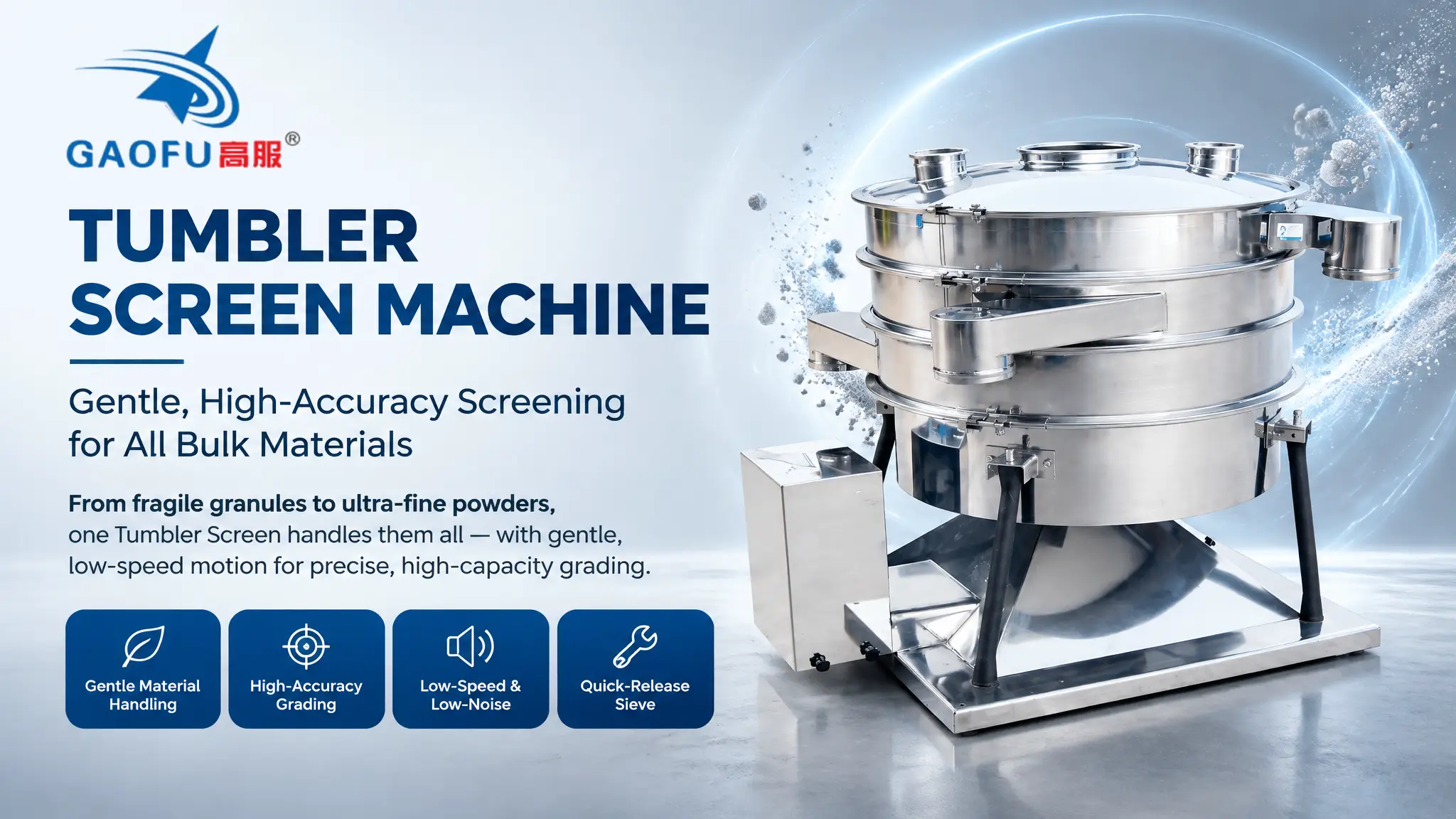
The motion principle of the tumbler screen machine provides upstream coordination at this stage. Its manual-sieving-inspired three-dimensional spiral tumbling causes particles to move on the screen surface in a “surface-contact sliding” manner, with operating acceleration far lower than high-frequency vibrating equipment. The micro-fines generated by impact fracture of crystalline excipients are therefore at a lower level at the source. This means that the total amount of escapable fines entering the internal gas space of the equipment is itself smaller, and the enclosed structure is tasked with “retaining existing fines” rather than “countering continuously generated large quantities of fines.” The effectiveness of enclosure depends not only on the grade of the seals, but also on how the equipment mechanically treats the material. In fines-sensitive scenarios such as excipient screening, the relationship between the two is closer to the essence of the problem than discussing “whether the sealing is good” in isolation.
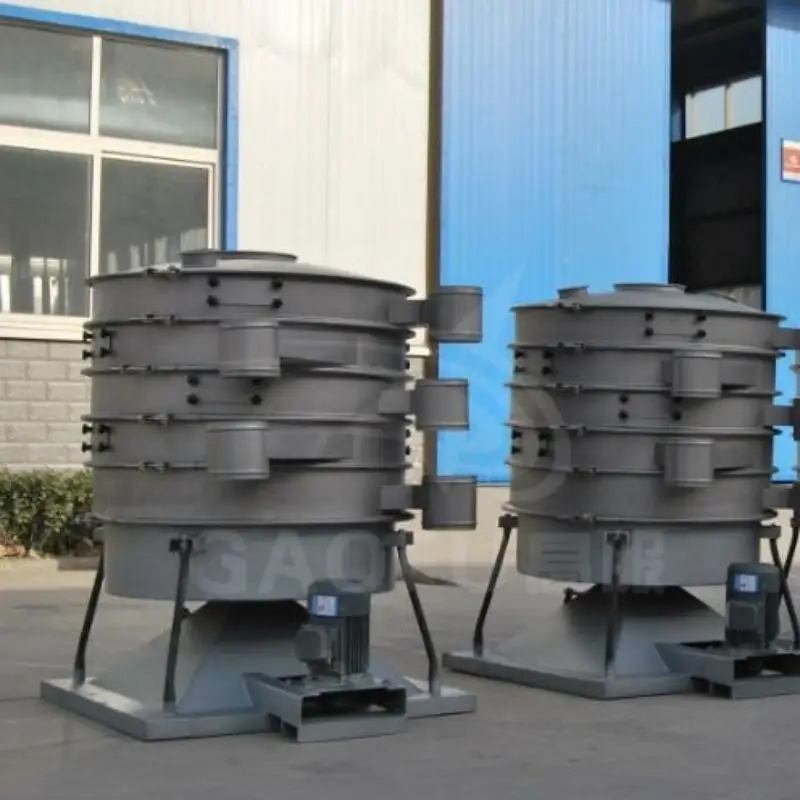
At the structural level, Gaofu tumbler screen machines use a fully enclosed structure with airtight design. During operation, material completes grading within a closed cavity, and dust escape to the workshop environment can be controlled without additional large-scale auxiliary dust collection equipment. The engineering meaning of this statement needs to be unpacked: full enclosure defines the physical isolation between the material path and the workshop air; airtight design addresses whether this isolation can be maintained under operating conditions—including feed/discharge connections, sieve frame mating surfaces, and observation windows—rather than merely “closing the lid” during static assembly.
At a quantifiable reference level, Gaofu pharmaceutical excipient screening equipment can achieve dust escape rates as low as 0.1 mg/m³ under specific model and test conditions. This value should not be generalized as a “guaranteed value” for all excipient scenarios independent of material, air volume, and measurement location, but the direction it points to is clear: the goal of enclosed operation is not “no visible dust,” but controlling escape to a level that can be compared against environmental monitoring data and cleanroom airborne particle standards.
It should be distinguished that excipient screening and high-potency API screening occupy different ranges of containment requirements. Materials at OEB 4 and above (OEL < 10 μg/m³) typically require isolator or glovebox-level high-containment solutions, while the occupational exposure risks of most pharmaceutical excipients do not require this level of engineering control. The fully enclosed airtight structure of the tumbler screen machine corresponds to a more common and practical need in excipient scenarios: making the equipment body itself a containment boundary sufficient to control cleanroom dust load without introducing complex external isolation systems. This restraint in positioning is precisely why it is operationally feasible on excipient production lines.
No matter how well a screening machine itself is enclosed, if the feed inlet is open for charging and the discharge outlet connects to transfer containers through non-enclosed transitions, dust will still escape at the interfaces. The containment logic of the tumbler screen machine therefore needs to be understood at the production line level: the equipment can be connected to vacuum feeders and dust-free charging stations to form a continuous enclosed path from “charging—screening—conveying,” reducing manual exposure of material between process steps. The machine’s well-organized body structure also provides interface conditions for this systematic interconnection, rather than requiring users to build a separate isolation enclosure around the screen machine.
From a GMP management perspective, the value of this full-process enclosure lies in making the “equipment boundary” of dust control coincide as closely as possible with the “process boundary.” When the entire path of material from entering the screening unit to leaving it is under controlled containment, environmental monitoring in the cleanroom faces fewer variables, and the sampling scope of cleaning validation is more concentrated. Conversely, if the screen machine body is enclosed but the upstream and downstream connections are open, the escape point has merely been relocated, and the effectiveness of dust control has not genuinely improved.
Enclosed operation is a necessary element of dust control in excipient screening, but it also has its limits: it cannot replace the HVAC design and environmental monitoring of the cleanroom, cannot replace the cleaning requirements for equipment exteriors in batch-changeover procedures, and cannot replace periodic inspection and replacement of seal aging conditions. Its accurate role is to establish a maintainable, interconnectable isolation boundary matched to the actual dust generation level of excipients between the equipment and the workshop environment, shifting dust control from “dilution and sweeping at the workshop level” upstream to “retention within the material path.”
If your company is evaluating dust control solutions for the pharmaceutical excipient screening step, or if your existing screening operation repeatedly shows dust-escape-related deviations in environmental monitoring or batch-changeover cleaning, you can provide Gaofu Machinery with the material name, cleanroom classification, and current feed/discharge interconnection method of your production line, and obtain the containment structure description and airtight design highlights of the pharmaceutical model of the tumbler screen machine, for comparison against your dust control strategy and cleaning validation protocol. To judge whether a machine is “enclosed enough,” start with this question: where should the escaped dust have been kept in the first place?
Pharmaceutical Industry Client Testimonials
Dong-E E-Jiao, Harbin Pharmaceutical Group, North China Pharmaceutical,Yangtze River Pharmaceutical Group, Taiji Group, Huadong Medicine,CSPC Group, Northeast Pharmaceutical, Guangzhou Baiyunshan, Tongrentang,Huiren Pharmaceutical, Fosun Pharma, Xiuzheng Pharmaceutical, Lijun Pharmaceutical,Luye Pharma Group, Di'ao Group, TianGongLi, Hengrui Medicine, Jiuzhitang, Jiangzhong Pharmaceutical, Lunan Pharmaceutical, Yunnan Baiyao, Sunflower Pharmaceutical,China Sanjiu Enterprise Group, Sanjin Pharmaceutical, Yiling Pharmaceutical,Wantong Pharmaceutical, Pientzehuang, Ma Yinglong Pharmaceutical, Guangyuyuan,Aodong Pharmaceutical, Besunyen, Jingfukang Pharmaceutical, Furen Pharmaceutical Group,Guizhou Bailing, Conba, Huasu Pharmaceutical, Yifang Pharmaceutical
Fortune 500 Client Testimonials
CNPC、CSCEC、Sinochem Holdings、CRCC、China Minmetals Corporation、CNOOC、CR、Sinopharm、CHN Energy、COFCO Corporation、Huawei Technologies、PowerChina、CITIC Group、Wuchan Zhongda Group、NORINCO、Chalco、CNBM、 Shaanxi Coal and Chemical Industry Group、Ansteel Group、CETC、CSSC、CASC、CEC、Jinchuan Group、CASIC、Conch Cement、CNNC、SPH、Shanxi Coking Coal Group、 Zhongtai Chemical、GPHL、DEC、Sinosteel Corporation、MCC、China National Salt Industry Chemical、China Baowu Steel Group、China Animal Husbandry Industry Co., Ltd.、CECEP
About Gaofu
Xinxiang Gaofu Machinery Co., Ltd. was founded back in the 1980s. With over 40 years of development, it has been certified as a National-level Specialized, Refined, Unique & Innovative Little Giant Enterprise, National Green Factory, National High-tech Enterprise, and National Intellectual Property Advantage Enterprise, and serves as the President Unit of China Vibration Screening Industry Association.
The company is accredited with the Henan Provincial Industrial Design Center, Henan Provincial Engineering Technology Research Center for Intelligent On-line Screening System, and Xinxiang Municipal Engineering Technology Research Center for Fine Screening.
Gaofu has obtained more than 500 patents including invention patents, utility model patents and design patents, been awarded the Science and Technology Achievement Prize issued by the Ministry of Industry and Information Technology of China, and participated in drafting and formulating 4 national standards.
Gaofu's product portfolio covers multiple series and hundreds of specifications, including vibrating screening equipment, conveying equipment, coal crushing equipment, filtration equipment and automatic material handling systems.
Core products include vibrating screens, screening machines, vibratory sifters, rotary vibrating screens, ultrasonic vibrating screens, linear vibrating screens, airflow screens, gyratory screens, roller screens, dewatering screens, bar screens, vacuum feeding machines, dust-free feeding stations, bulk bag feeding stations, feeding systems, automatic powder feeding systems, automatic slag-discharging filters, leaf filters, clay filters, toothed roll crushers, coal crushers and other machinery.
These products are widely applied in food, pharmaceutical, chemical, metallurgy, construction materials, mining, thermal power, environmental protection and many other industries, winning recognition and trust from over 10,000 clients worldwide.
Gaofu products enjoy strong sales across Greater China, and are exported to more than 100 countries and regions such as Russia, Canada, the United States, New Zealand, Japan, Brazil and South Africa.
Upholding the corporate mission of Improving material quality & efficiency to fully satisfy customer demands, Gaofu maintains long-term partnerships with clients to achieve win-win development.
At present, Gaofu is an official qualified supplier for numerous Fortune Global 500 enterprises, including CNPC, Sinopec, Sinochem Holdings, China Resources Group, Sinopharm Group, COFCO, China National Building Material, China Aerospace Science and Technology Corporation, Jinchuan Group and more.
Gaofu Machinery ranks No.1 in global sales volume of vibrating screens.
In May 2024, Frost & Sullivan, a world-renowned international consulting firm, issued a Market Position Verification Certificate confirming that Gaofu achieved the world's largest shipment volume of vibrating screens in the global market in 2023.