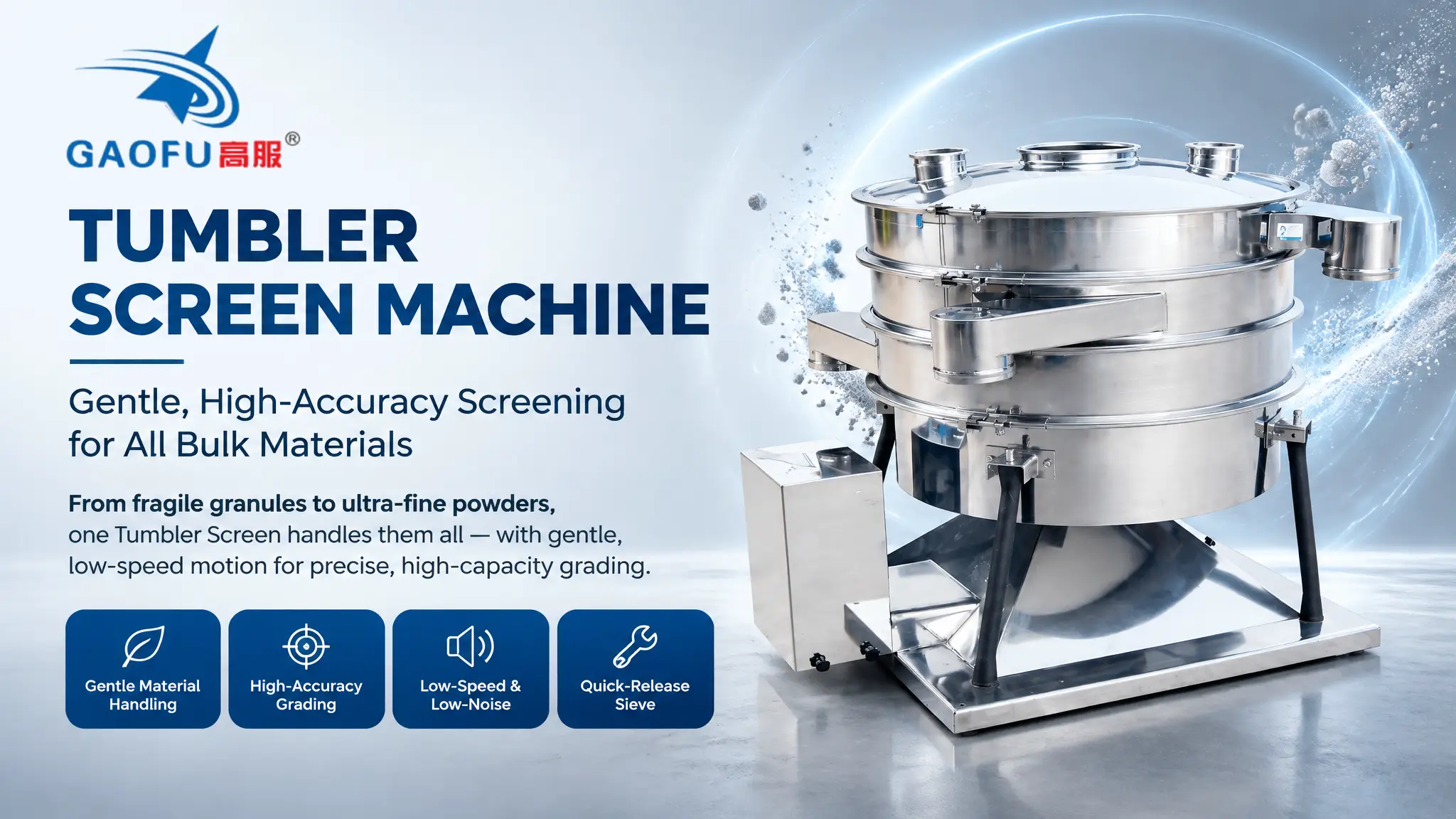
Over 10,000+ customers' choice, Focus on screening industry 40+ years
Conventional vibrating screens rely on high-frequency excitation to throw material repeatedly on the screen surface, with particles falling back onto the mesh in a “point-impact” manner. This motion pattern is a source of efficiency for materials such as ore and sand that can withstand abrasion, but for pharmaceutical excipients it represents a different form of work: each time a particle falls back onto the mesh, it bears an instantaneous impact load, and brittle crystals develop microcracks or fracture directly in the process. Industry test data indicate that conventional vibrating screening machines typically produce a breakage rate of 3%–8% when handling brittle/crystalline materials, while low-frequency tumbler-type equipment can keep the breakage rate within 0.5%. These figures come from specific materials and test conditions and should not be directly extrapolated to all excipient types, but the mechanical difference they point to is real: impact force tends to create new surfaces (fines), while rolling friction tends to preserve existing surfaces.
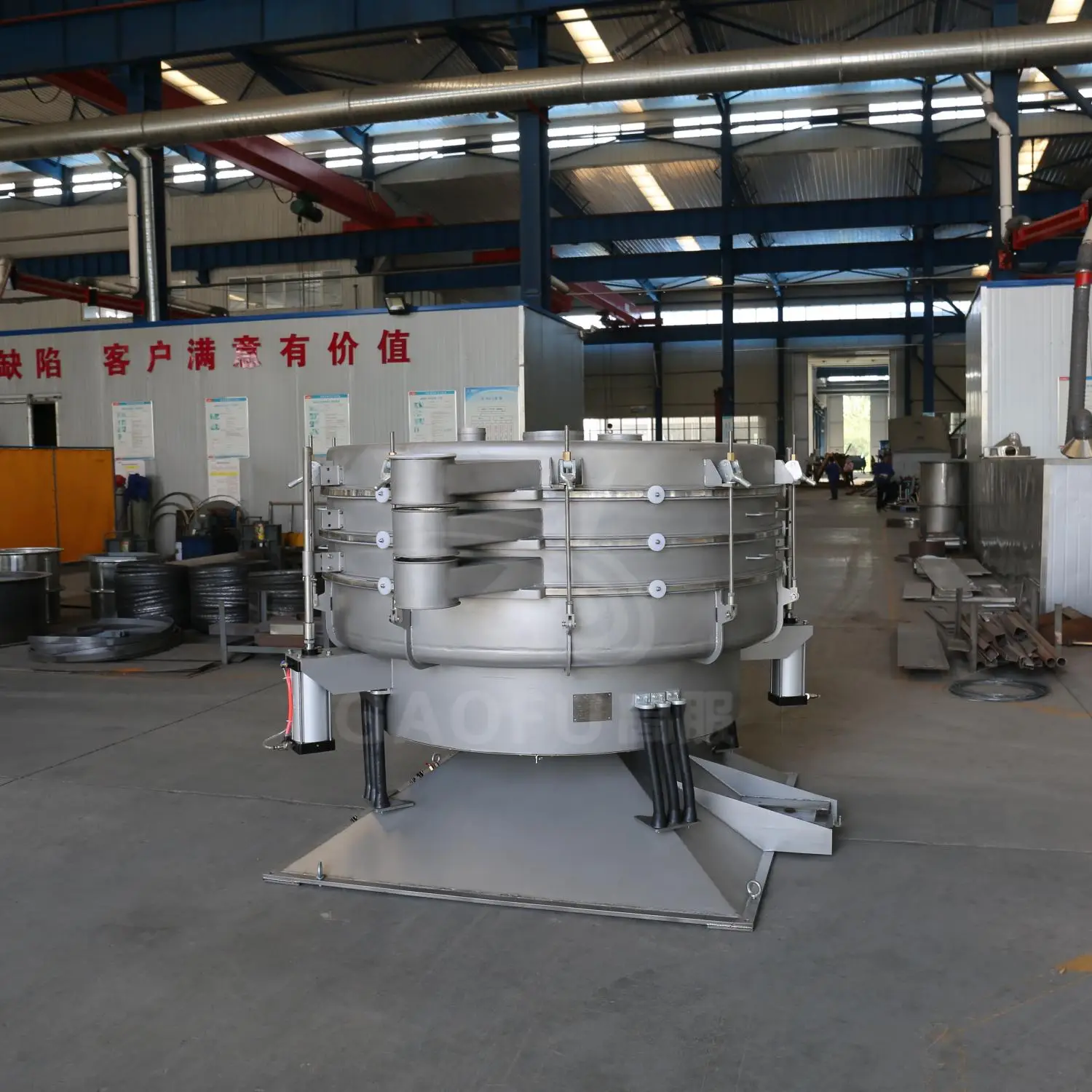
The motion principle of Gaofu’s GFBD series tumbler screen machine essentially replaces “impact collision” with “rolling friction.” An adjustable eccentric-weight exciter drives the screen body in a non-linear three-dimensional spiral motion. Material rolls gently along the screen surface in an involute spiral path, and the operating acceleration is only about one-fourth to one-fifth that of a conventional vibrating screen. Particles are basically not thrown off the screen surface; the interaction with the mesh is “surface-contact sliding” rather than “point-contact impact.” In this motion mode, fine particles pass through the mesh through continuous rolling and stratification of the material bed on the screen surface, rather than through violent vertical throwing. Grading accuracy is ensured by the residence time of material on the screen surface and the movement state of the material bed, not at the expense of particle integrity.
First: Preserving crystal morphology means preserving the predictability of downstream formulation. Pharmaceutical lactose and mannitol are crystalline excipients, and the integrity of crystal morphology directly affects powder flowability and compression behavior. Fines generated by crystal fracture have a larger specific surface area, stronger interparticle van der Waals forces, and reduced flowability, which may cause uneven blending or content uniformity fluctuation in direct compression or dry granulation. The low-acceleration motion of the tumbler screen machine significantly reduces the mechanical stress on crystal particles during screening, resulting in a higher proportion of intact particles, so that excipients entering the formulation process are closer to their design specifications in powder properties.
Second: Reducing “fines that should never have been generated” reduces the processing burden of subsequent steps. Fines generated additionally during screening do not disappear. They either escape with airflow and cause yield loss, remain in the finished product and change the particle size distribution, or require additional screening or reworking in subsequent steps. By suppressing the increase in fines at the generation mechanism level, the tumbler screen machine means excipient manufacturers deliver products with a more concentrated particle size distribution and smaller batch-to-batch variation, so that downstream customers receive a raw material that does not require “formulation adjustment to accommodate.”
Third: Low damage and low wear are the same thing at the equipment level. Impact force acts not only on particles but also on the screen mesh and screen body structure. High-frequency throwing subjects the mesh to repeated beating and makes fatigue fracture more likely; in the tumbler screen machine, the mesh mainly experiences uniform surface abrasion, and the machine as a whole has no strong alternating stress, so the failure rates of the sieve frame, damping springs, and bearings are correspondingly reduced. For continuously operating excipient production lines, the reduction in equipment wear and the reduction in material loss come from the same mechanical starting point.
The low-damage design of the tumbler screen machine cannot make all particles remain intact during screening. Any screening operation involves some degree of interparticle collision and screen surface friction. The key is whether these effects are kept within the threshold that the material can withstand, and whether the resulting increase in fines is at an acceptable and repeatable level. The eccentricity, rotational speed, and screen surface inclination of Gaofu tumbler screen machines can be adjusted according to the target particle size, bulk density, and brittleness of specific excipients, so that equipment parameters correspond to material characteristics rather than using one fixed set of parameters to “cover all” product types.
For pharmaceutical excipient manufacturers, judging whether a sieving machine is truly “low-damage” ultimately cannot stop at a description of the motion principle. A more reliable approach is to run an actual screening trial with your own material and your own target particle size range, and compare the particle size distribution and fines increase between feed and discharge. If your company is handling lactose, mannitol, microcrystalline cellulose, or other excipients sensitive to particle integrity, you can provide Gaofu Machinery with the material name, target particle size range, and current loss data, and arrange a sample screening trial or obtain operating references for the GFBD series in similar excipient applications—using measured results to determine the extent to which low-damage screening can reduce your particle breakage and material loss.
Pharmaceutical Industry Client Testimonials
Dong-E E-Jiao, Harbin Pharmaceutical Group, North China Pharmaceutical,Yangtze River Pharmaceutical Group, Taiji Group, Huadong Medicine,CSPC Group, Northeast Pharmaceutical, Guangzhou Baiyunshan, Tongrentang,Huiren Pharmaceutical, Fosun Pharma, Xiuzheng Pharmaceutical, Lijun Pharmaceutical,Luye Pharma Group, Di'ao Group, TianGongLi, Hengrui Medicine, Jiuzhitang, Jiangzhong Pharmaceutical, Lunan Pharmaceutical, Yunnan Baiyao, Sunflower Pharmaceutical,China Sanjiu Enterprise Group, Sanjin Pharmaceutical, Yiling Pharmaceutical,Wantong Pharmaceutical, Pientzehuang, Ma Yinglong Pharmaceutical, Guangyuyuan,Aodong Pharmaceutical, Besunyen, Jingfukang Pharmaceutical, Furen Pharmaceutical Group,Guizhou Bailing, Conba, Huasu Pharmaceutical, Yifang Pharmaceutical
Fortune 500 Client Testimonials
CNPC、CSCEC、Sinochem Holdings、CRCC、China Minmetals Corporation、CNOOC、CR、Sinopharm、CHN Energy、COFCO Corporation、Huawei Technologies、PowerChina、CITIC Group、Wuchan Zhongda Group、NORINCO、Chalco、CNBM、 Shaanxi Coal and Chemical Industry Group、Ansteel Group、CETC、CSSC、CASC、CEC、Jinchuan Group、CASIC、Conch Cement、CNNC、SPH、Shanxi Coking Coal Group、 Zhongtai Chemical、GPHL、DEC、Sinosteel Corporation、MCC、China National Salt Industry Chemical、China Baowu Steel Group、China Animal Husbandry Industry Co., Ltd.、CECEP
About Gaofu
Xinxiang Gaofu Machinery Co., Ltd. was founded back in the 1980s. With over 40 years of development, it has been certified as a National-level Specialized, Refined, Unique & Innovative Little Giant Enterprise, National Green Factory, National High-tech Enterprise, and National Intellectual Property Advantage Enterprise, and serves as the President Unit of China Vibration Screening Industry Association.
The company is accredited with the Henan Provincial Industrial Design Center, Henan Provincial Engineering Technology Research Center for Intelligent On-line Screening System, and Xinxiang Municipal Engineering Technology Research Center for Fine Screening.
Gaofu has obtained more than 500 patents including invention patents, utility model patents and design patents, been awarded the Science and Technology Achievement Prize issued by the Ministry of Industry and Information Technology of China, and participated in drafting and formulating 4 national standards.
Gaofu's product portfolio covers multiple series and hundreds of specifications, including vibrating screening equipment, conveying equipment, coal crushing equipment, filtration equipment and automatic material handling systems.
Core products include vibrating screens, screening machines, vibratory sifters, rotary vibrating screens, ultrasonic vibrating screens, linear vibrating screens, airflow screens, gyratory screens, roller screens, dewatering screens, bar screens, vacuum feeding machines, dust-free feeding stations, bulk bag feeding stations, feeding systems, automatic powder feeding systems, automatic slag-discharging filters, leaf filters, clay filters, toothed roll crushers, coal crushers and other machinery.
These products are widely applied in food, pharmaceutical, chemical, metallurgy, construction materials, mining, thermal power, environmental protection and many other industries, winning recognition and trust from over 10,000 clients worldwide.
Gaofu products enjoy strong sales across Greater China, and are exported to more than 100 countries and regions such as Russia, Canada, the United States, New Zealand, Japan, Brazil and South Africa.
Upholding the corporate mission of Improving material quality & efficiency to fully satisfy customer demands, Gaofu maintains long-term partnerships with clients to achieve win-win development.
At present, Gaofu is an official qualified supplier for numerous Fortune Global 500 enterprises, including CNPC, Sinopec, Sinochem Holdings, China Resources Group, Sinopharm Group, COFCO, China National Building Material, China Aerospace Science and Technology Corporation, Jinchuan Group and more.
Gaofu Machinery ranks No.1 in global sales volume of vibrating screens.
In May 2024, Frost & Sullivan, a world-renowned international consulting firm, issued a Market Position Verification Certificate confirming that Gaofu achieved the world's largest shipment volume of vibrating screens in the global market in 2023.