Over 10,000+ customers' choice, Focus on screening industry 40+ years
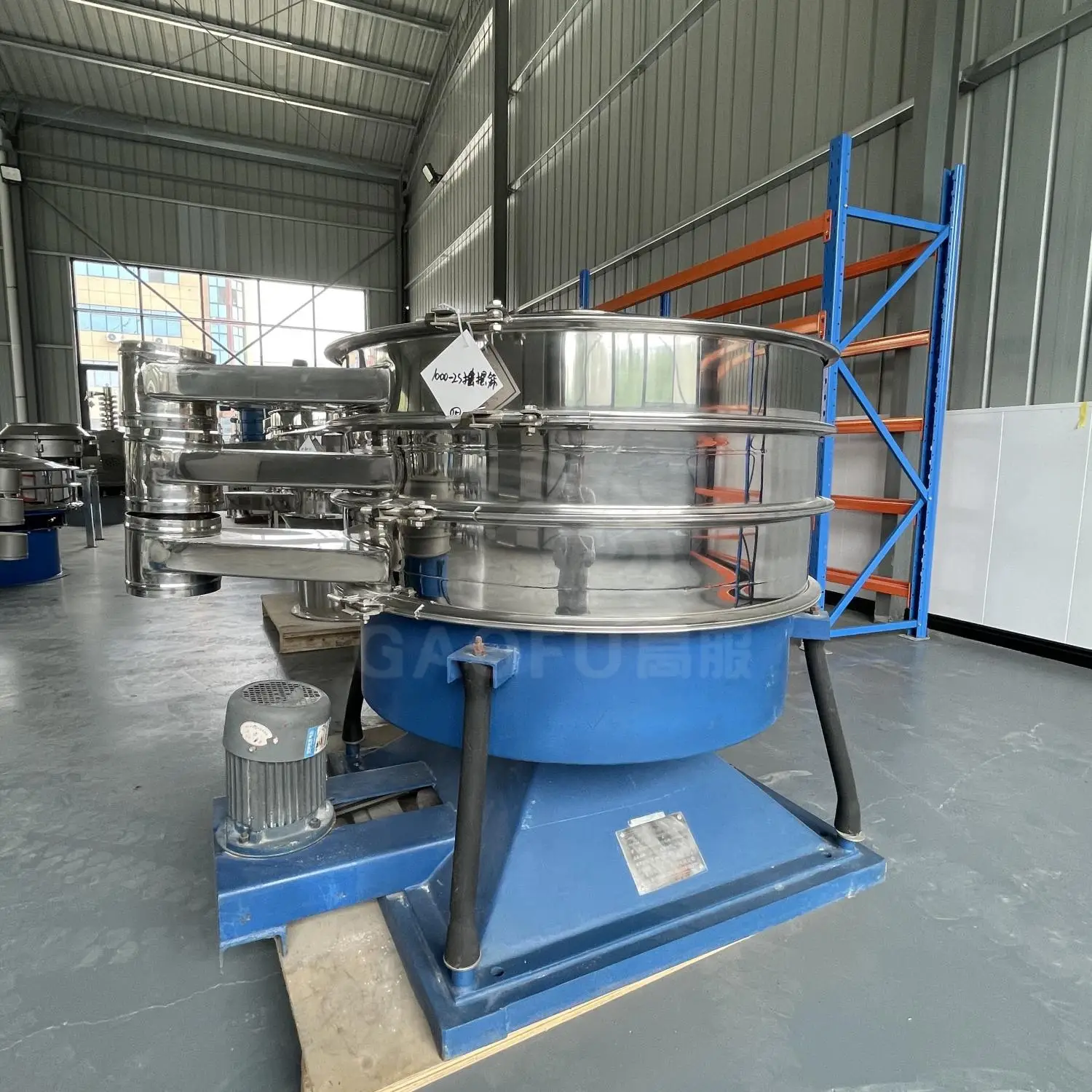
The first threshold of sanitary construction is the material selection for product-contact parts. The product-contact surfaces of Gaofu tumbler screen machines are standard SUS304 stainless steel, with 316L mirror-polished stainless steel available for pharmaceutical applications. The corrosion resistance advantages of 316L in pharmaceutical wet or corrosive excipient environments have been widely discussed; more worthy of attention is surface condition. In the GMP context, discussing stainless steel cannot stop at the grade level. If product-contact surfaces have microscopic pits, weld oxidation scale, or textures left by mechanical polishing, residues may remain after cleaning even if the material grade meets specification. The mirror-polished internal surfaces used on Gaofu’s pharmaceutical models target exactly this issue: by reducing surface roughness, they lower the probability of mechanical entrapment and wall adhesion of fine excipient powders, giving visual inspection and swab sampling after cleaning more consistent surface conditions.
A common cognitive bias should be distinguished here: a smoother surface does not mean “no residue will ever remain,” but rather that the state of residue is more predictable and the endpoint of cleaning is easier to judge. The core difficulty of cleaning validation has never been “whether it can be washed off,” but “whether it can be proven that every cleaning reaches the same acceptable level.” A contact surface with controlled roughness and no depressions or cracks provides the physical basis for that “proof,” but it cannot replace the design and validation of the cleaning procedure itself.
“No dead corners” appears with high frequency in equipment marketing, but in the context of sanitary construction it should correspond to a series of geometric features that can be checked item by item: whether the internal cavity has low-lying pockets where material cannot drain by gravity; whether welds are continuous and smooth, without undercut or lack of fusion; whether fasteners are exposed in the material path; whether corners use rounded transitions rather than right-angle joints. Gaofu tumbler screen machines emphasize a dead-corner-free, depression-free internal cavity, with modular assembly and smooth transitions. The engineering intent is to reduce “hidden volumes” where excipients might reside during batch changes or shutdowns.
For pharmaceutical excipients, the practical significance of this point is directly related to powder characteristics. Fine powders generated during screening of excipients such as microcrystalline cellulose and lactose have a strong tendency to adhere. If steps, exposed threads, or discontinuous welds exist inside the equipment, residual fines may remain as a thin layer after cleaning and become a potential source of foreign matter or cross-contamination in the next batch. The geometric logic of sanitary construction is essentially to treat “drainable, accessible, and visible” as design constraints at the equipment design stage, rather than compensating for structural deficiencies in the cleaning SOP by extending rinse time or adding manual wiping.
Fully enclosed structures and seal selection occupy a prominent place in Gaofu tumbler screen machine’s GMP descriptions, but “enclosure” and “sealing” serve different functions in pharmaceutical sanitary design. A fully enclosed structure addresses the escape of dust from the vibrating screening machine into the cleanroom environment during screening. Gaofu tumbler screen machines use full enclosure with airtight design, so material completes grading within a closed cavity during operation, reducing dust escape and its impact on the workshop environment and operators. Seals address isolation between the material cavity and the external environment, and between functional sections inside the cavity. For pharmaceutical applications, Gaofu selects food/pharmaceutical-grade silicone seals, with attention to temperature resistance, corrosion resistance, and no shedding debris—the latter two are particularly critical in long-term operation, because particles generated by seal aging are themselves a contamination source that must be controlled.
How the two are constructed to work together is equally important. If seals are designed to require stretching, shearing, or forced compression with tools for assembly, their sealing performance consistency will be difficult to maintain under frequent disassembly and cleaning. The sanitary requirement for sealing is not only “material compliance,” but also the ability of the sealing interface to repeatedly return to its design state after multiple disassemblies. This is two sides of the same engineering issue as the quick-release structure discussed below.
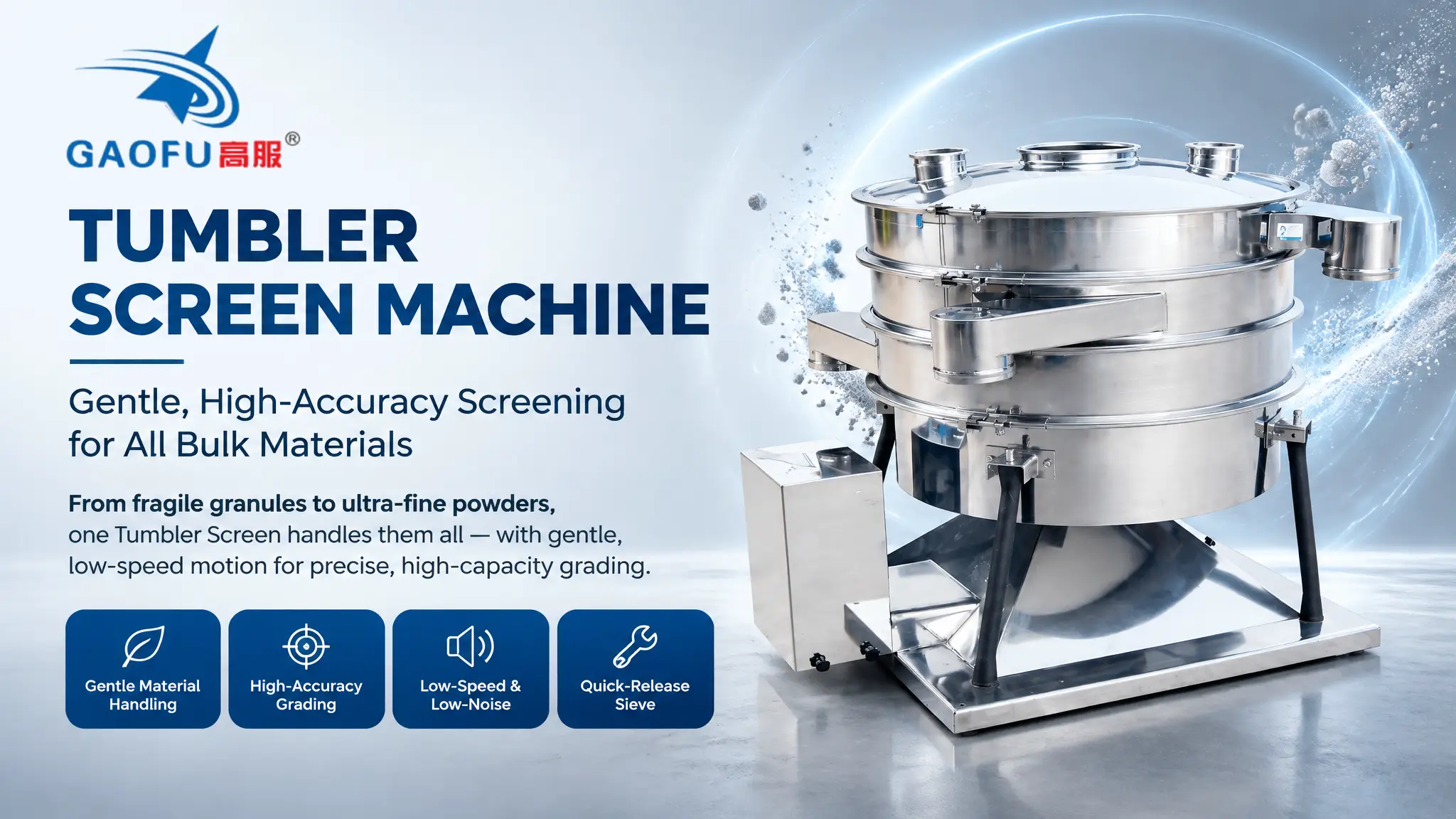
Gaofu tumbler screen machines use a quick-release latch structure, allowing one person to complete screen changeover in a relatively short time. Understanding quick-release design only from an efficiency perspective misses its core value in the GMP context. Cleaning validation is concerned not only with “the effect of one cleaning,” but with whether the cleaning operation itself is repeatable from batch to batch. A structure that requires special tools, multiple personnel, or operator experience to disassemble makes it difficult to ensure that every cleaning achieves the same coverage over long-term production. Quick-release, tool-light or even tool-free disassembly design moves cleaning operations from “skill dependence” toward “process standardization,” narrowing the room for execution deviation in the cleaning SOP.
Related to this is the accessibility of screens and mesh-cleaning components. The screen is one of the parts most prone to fine powder accumulation in a vibrating sieve machine. If the connection between the screen frame and the sieve frame creates crevices at the screen edge or inaccessible gaps under the clamping strip, cleaning completeness will be compromised. Gaofu tumbler screen machine’s modular structure treats the sieve frame, screen frame, and mesh-cleaning components as independently removable units. The sanitary design intent is to allow every product-contact component to be removed separately, cleaned separately, and inspected separately. This “component-level accessibility” is closer to the actual operational needs of cleaning validation than machine-level “cleanability.”
Putting the above construction dimensions together, the sanitary design of Gaofu tumbler screen machines in pharmaceutical excipient applications can be summarized as a clear logic chain: material and surface condition define the physical conditions under which residues can be cleaned; structural geometry eliminates hidden spaces where residues may reside; the sealing system maintains the isolation boundary between batches; and quick-release accessibility gives cleaning operations a basis for repeatable execution. If any one of these four links has a shortcoming, the sanitary performance of the entire machine will be limited by its weakest link.
It should be made clear that sanitary construction is a necessary condition for GMP compliance, but not a sufficient one. A sanitary-designed tumbler screen machine cannot replace the user’s cleaning validation protocol, cannot replace environmental monitoring in the cleanroom, and cannot replace ongoing confirmation of equipment status in change control. Its accurate role is to reduce structural obstacles at the equipment level that make cleaning, inspection, and repeatability difficult, so that pharmaceutical manufacturers face a physical object that is operable and traceable in cleaning validation and daily GMP management—not a black box that requires “extra care” to compensate for design shortcomings.
If your company is selecting equipment for pharmaceutical excipient screening or conducting a GMP compliance assessment, you may request from Gaofu Machinery the material contact statement, surface treatment details, and a schematic of the removable/washable structure for the pharmaceutical model of the tumbler screen machine, for comparison against your cleaning SOP and validation protocol. The starting point of selection should not be “whether this machine looks clean,” but “whether this machine’s construction makes cleaning and validation executable and provable.”
Pharmaceutical Industry Client Testimonials
Dong-E E-Jiao, Harbin Pharmaceutical Group, North China Pharmaceutical,Yangtze River Pharmaceutical Group, Taiji Group, Huadong Medicine,CSPC Group, Northeast Pharmaceutical, Guangzhou Baiyunshan, Tongrentang,Huiren Pharmaceutical, Fosun Pharma, Xiuzheng Pharmaceutical, Lijun Pharmaceutical,Luye Pharma Group, Di'ao Group, TianGongLi, Hengrui Medicine, Jiuzhitang, Jiangzhong Pharmaceutical, Lunan Pharmaceutical, Yunnan Baiyao, Sunflower Pharmaceutical,China Sanjiu Enterprise Group, Sanjin Pharmaceutical, Yiling Pharmaceutical,Wantong Pharmaceutical, Pientzehuang, Ma Yinglong Pharmaceutical, Guangyuyuan,Aodong Pharmaceutical, Besunyen, Jingfukang Pharmaceutical, Furen Pharmaceutical Group,Guizhou Bailing, Conba, Huasu Pharmaceutical, Yifang Pharmaceutical
Fortune 500 Client Testimonials
CNPC、CSCEC、Sinochem Holdings、CRCC、China Minmetals Corporation、CNOOC、CR、Sinopharm、CHN Energy、COFCO Corporation、Huawei Technologies、PowerChina、CITIC Group、Wuchan Zhongda Group、NORINCO、Chalco、CNBM、 Shaanxi Coal and Chemical Industry Group、Ansteel Group、CETC、CSSC、CASC、CEC、Jinchuan Group、CASIC、Conch Cement、CNNC、SPH、Shanxi Coking Coal Group、 Zhongtai Chemical、GPHL、DEC、Sinosteel Corporation、MCC、China National Salt Industry Chemical、China Baowu Steel Group、China Animal Husbandry Industry Co., Ltd.、CECEP
About Gaofu
Xinxiang Gaofu Machinery Co., Ltd. was founded back in the 1980s. With over 40 years of development, it has been certified as a National-level Specialized, Refined, Unique & Innovative Little Giant Enterprise, National Green Factory, National High-tech Enterprise, and National Intellectual Property Advantage Enterprise, and serves as the President Unit of China Vibration Screening Industry Association.
The company is accredited with the Henan Provincial Industrial Design Center, Henan Provincial Engineering Technology Research Center for Intelligent On-line Screening System, and Xinxiang Municipal Engineering Technology Research Center for Fine Screening.
Gaofu has obtained more than 500 patents including invention patents, utility model patents and design patents, been awarded the Science and Technology Achievement Prize issued by the Ministry of Industry and Information Technology of China, and participated in drafting and formulating 4 national standards.
Gaofu's product portfolio covers multiple series and hundreds of specifications, including vibrating screening equipment, conveying equipment, coal crushing equipment, filtration equipment and automatic material handling systems.
Core products include vibrating screens, screening machines, vibratory sifters, rotary vibrating screens, ultrasonic vibrating screens, linear vibrating screens, airflow screens, gyratory screens, roller screens, dewatering screens, bar screens, vacuum feeding machines, dust-free feeding stations, bulk bag feeding stations, feeding systems, automatic powder feeding systems, automatic slag-discharging filters, leaf filters, clay filters, toothed roll crushers, coal crushers and other machinery.
These products are widely applied in food, pharmaceutical, chemical, metallurgy, construction materials, mining, thermal power, environmental protection and many other industries, winning recognition and trust from over 10,000 clients worldwide.
Gaofu products enjoy strong sales across Greater China, and are exported to more than 100 countries and regions such as Russia, Canada, the United States, New Zealand, Japan, Brazil and South Africa.
Upholding the corporate mission of Improving material quality & efficiency to fully satisfy customer demands, Gaofu maintains long-term partnerships with clients to achieve win-win development.
At present, Gaofu is an official qualified supplier for numerous Fortune Global 500 enterprises, including CNPC, Sinopec, Sinochem Holdings, China Resources Group, Sinopharm Group, COFCO, China National Building Material, China Aerospace Science and Technology Corporation, Jinchuan Group and more.
Gaofu Machinery ranks No.1 in global sales volume of vibrating screens.
In May 2024, Frost & Sullivan, a world-renowned international consulting firm, issued a Market Position Verification Certificate confirming that Gaofu achieved the world's largest shipment volume of vibrating screens in the global market in 2023.