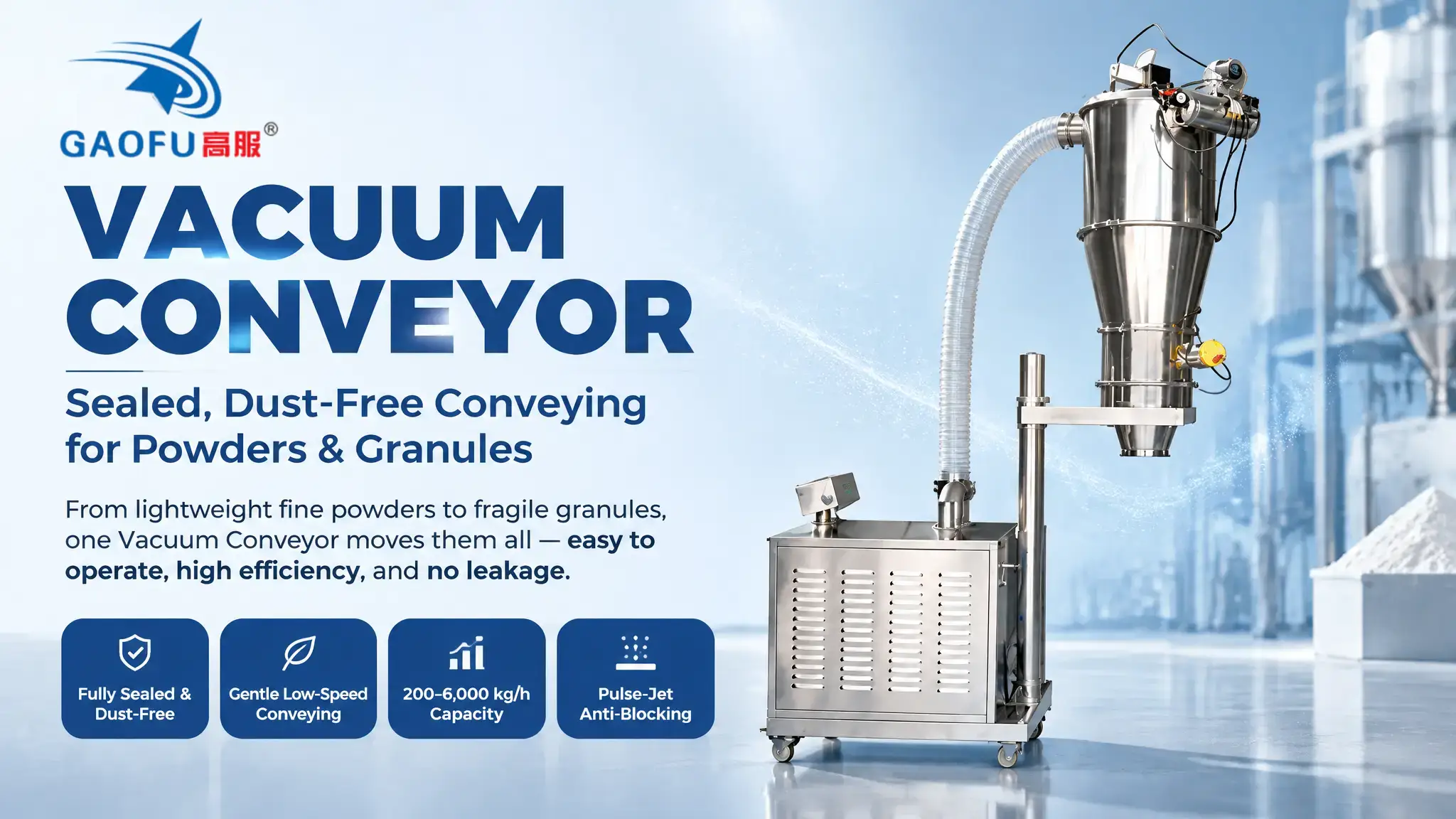
Over 10,000+ customers' choice, Focus on screening industry 40+ years
A Vacuum Conveyor uses a vacuum source to create negative pressure inside the conveying pipeline. Under this pressure difference, catalyst material is drawn from a storage point and transported through the pipeline to a receiving unit.
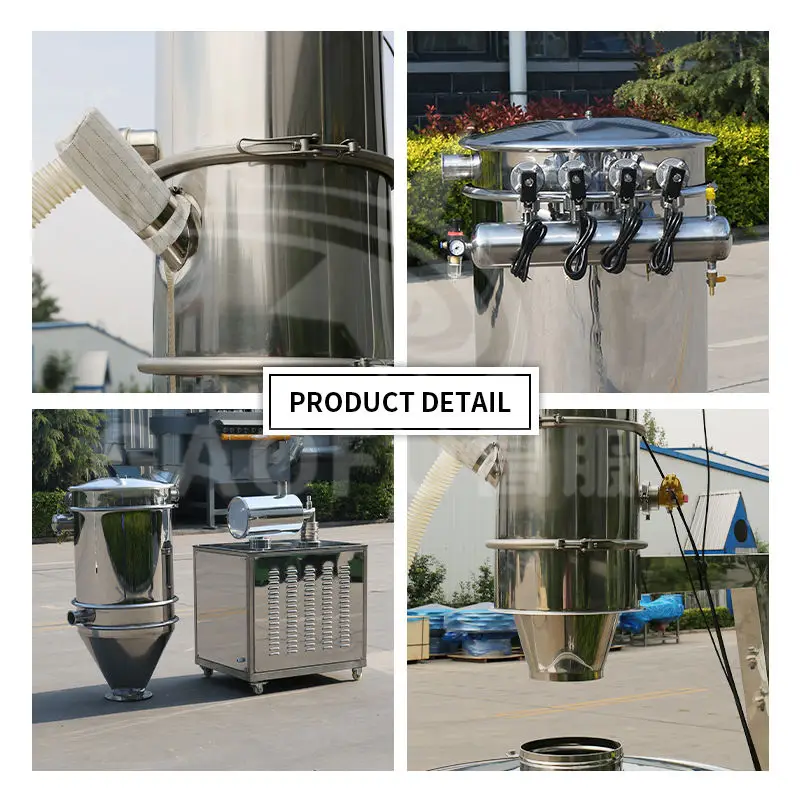
At the receiving unit, the conveying air is separated from the material through a filtration system. The collected catalyst is then discharged into a designated hopper or connected process interface.
A typical material transfer sequence is:
Storage Hopper → Vacuum Suction → Pipeline Conveying → Material-Air Separation → Material Discharge → Reactor Feeding Point
Compared with repeated manual handling, this arrangement can simplify the transfer process and provide a more centralized material delivery route.
The actual configuration depends on catalyst properties, conveying distance, required capacity, and the layout of the production line.
Reactor feeding often involves coordination between material storage, conveying equipment, weighing devices, and the reactor inlet. A Vacuum Conveyor can serve as the material transfer link between these process stages.
Its practical advantages include:
Reduced manual handling: Automated suction and transfer can reduce the need for operators to repeatedly lift and pour catalyst materials.
Enclosed conveying: A closed pipeline can help limit direct exposure to airborne powder during transfer, subject to proper sealing and filter maintenance.
Flexible process integration: The system can be arranged to connect storage hoppers, intermediate receivers, and reactor feeding interfaces.
Improved material transfer coordination: Automated conveying can help match material delivery with the operating rhythm of upstream and downstream equipment.
Fewer intermediate handling steps: A suitable pipeline layout can reduce unnecessary manual transfers between process stations.
For applications requiring continuous or batch feeding, the Vacuum Conveyor can be integrated with weighing, metering, and control equipment. Precise dosing and continuous feeding depend on the complete system configuration; the conveyor alone does not guarantee a specific feed rate or dosing accuracy.
Catalyst powders may have different flow characteristics, particle strengths, and chemical properties. During manual transfer, powder can become airborne, particularly when materials are poured from one container into another.
The enclosed conveying structure of a Vacuum Conveyor helps reduce direct material exposure and can support better dust management in the production area. However, actual dust control also depends on pipeline connections, sealing performance, filter selection, maintenance, and the plant's dust extraction arrangements.
For fragile catalyst granules, conveying conditions also deserve attention. Air velocity, pipeline length, bend layout, conveying rate, and particle strength can all affect abrasion and fines generation. Appropriate system design and material testing are recommended to evaluate particle breakage during transfer.
A Vacuum Conveyor is a material handling device. It does not directly change catalyst composition, chemical activity, or catalytic performance.
Before selecting equipment for catalyst feeding, manufacturers should evaluate the following factors:
Material characteristics: Particle size, bulk density, flowability, moisture content, abrasiveness, and particle strength.
Chemical properties: Corrosivity, toxicity, and any special handling requirements identified in the material safety data sheet (SDS).
Conveying requirements: Transfer distance, vertical lift, required capacity, and feeding frequency.
Production layout: The positions of storage hoppers, receiving units, reactor inlets, and connecting pipelines.
Process control: Whether the application requires batch transfer, continuous feeding, weighing, or quantitative dosing.
Safety requirements: Whether combustible dust, hazardous substances, or special gas-handling conditions require additional engineered protection.
For sealed reactors, the feeding interface should also be assessed for pressure balancing, gas venting, and process interlocks. These functions need to be coordinated with the overall process design rather than assumed to be provided by the Vacuum Conveyor itself.
Standard vacuum conveying equipment should not automatically be regarded as explosion-proof or inert-gas protected. Where special protection is required, the system must be evaluated and configured according to the actual material hazards and applicable safety requirements.
A well-planned catalyst feeding system should consider more than the transfer equipment alone. The Vacuum Conveyor can be integrated with storage hoppers, weighing systems, intermediate bins, and reactor feeding interfaces to create a coordinated material handling arrangement.
Where the process also requires particle classification or removal of oversized material, downstream or upstream screening equipment may be considered separately. Depending on the application, a vibratory screen, vibrating screening machine, Sieving machine, or vibratory sifter can be incorporated into the production line. A suitable vibrating sieve machine, Industrial sieving machine, or Rotary Vibrator Screen can support particle-size separation according to the selected screen aperture.
Conveying and screening perform different functions: the Vacuum Conveyor transfers materials, while screening equipment classifies particles by size. Their integration should be based on the actual process sequence and material requirements.
For catalyst production lines involving reactor charging, a Vacuum Conveyor provides an enclosed, negative-pressure method of transferring powder and granular materials. With an appropriate system layout, it can reduce manual handling, support dust management, and improve coordination between material storage and reactor feeding.
For reliable operation, equipment selection should take into account material properties, conveying conditions, feeding requirements, reactor interfaces, and applicable safety measures. When weighing and metering equipment are required, they should be integrated into the complete feeding system to meet the intended process requirements.
Chemical Industry Client Testimonials
Wanhua Chemical, Yuntianhua Group, Kingfa Science & Technology, Formosa Plastics Group, China Pingmei Shenma Group, Kemai Co., Ltd., Luxi Chemical, Liby Group, Oriental Yuhong, Davco, Chenming Group, Guanhao High-Tech
Kaifei Chemical, Sunsine Chemical, Weilin Co., Ltd., Xuyang Group, 3Trees, Maydos, Loyal Group (Kingpor Group), AkzoNobel, CSSC Hanguang, Haike Group, Nice Group, Taishan Fiberglass, Wanhua, Red Eagle, China XLX Fertiliser (Xinlianxin), CCtech Catalysis, China National Bluestar, Sakura Paint, ITANOS, Yanggu Huatai, Sennics, Longxing Chemical Group, Tunhe Co., Ltd., GHW International, Jianye Chemical, Finehope
Fortune 500 Client Testimonials
CNPC、CSCEC、Sinochem Holdings、CRCC、China Minmetals Corporation、CNOOC、CR、Sinopharm、CHN Energy、COFCO Corporation、Huawei Technologies、PowerChina、CITIC Group、Wuchan Zhongda Group、NORINCO、Chalco、CNBM、 Shaanxi Coal and Chemical Industry Group、Ansteel Group、CETC、CSSC、CASC、CEC、Jinchuan Group、CASIC、Conch Cement、CNNC、SPH、Shanxi Coking Coal Group、 Zhongtai Chemical、GPHL、DEC、Sinosteel Corporation、MCC、China National Salt Industry Chemical、China Baowu Steel Group、China Animal Husbandry Industry Co., Ltd.、CECEP
About Gaofu
Xinxiang Gaofu Machinery Co., Ltd. was founded back in the 1980s. With over 40 years of development, it has been certified as a National-level Specialized, Refined, Unique & Innovative Little Giant Enterprise, National Green Factory, National High-tech Enterprise, and National Intellectual Property Advantage Enterprise, and serves as the President Unit of China Vibration Screening Industry Association.
The company is accredited with the Henan Provincial Industrial Design Center, Henan Provincial Engineering Technology Research Center for Intelligent On-line Screening System, and Xinxiang Municipal Engineering Technology Research Center for Fine Screening.
Gaofu has obtained more than 500 patents including invention patents, utility model patents and design patents, been awarded the Science and Technology Achievement Prize issued by the Ministry of Industry and Information Technology of China, and participated in drafting and formulating 4 national standards.
Gaofu's product portfolio covers multiple series and hundreds of specifications, including vibrating screening equipment, conveying equipment, coal crushing equipment, filtration equipment and automatic material handling systems.
Core products include vibrating screens, screening machines, vibratory sifters, rotary vibrating screens, ultrasonic vibrating screens, linear vibrating screens, airflow screens, gyratory screens, roller screens, dewatering screens, bar screens, vacuum feeding machines, dust-free feeding stations, bulk bag feeding stations, feeding systems, automatic powder feeding systems, automatic slag-discharging filters, leaf filters, clay filters, toothed roll crushers, coal crushers and other machinery.
These products are widely applied in food, pharmaceutical, chemical, metallurgy, construction materials, mining, thermal power, environmental protection and many other industries, winning recognition and trust from over 10,000 clients worldwide.
Gaofu products enjoy strong sales across Greater China, and are exported to more than 100 countries and regions such as Russia, Canada, the United States, New Zealand, Japan, Brazil and South Africa.
Upholding the corporate mission of Improving material quality & efficiency to fully satisfy customer demands, Gaofu maintains long-term partnerships with clients to achieve win-win development.
At present, Gaofu is an official qualified supplier for numerous Fortune Global 500 enterprises, including CNPC, Sinopec, Sinochem Holdings, China Resources Group, Sinopharm Group, COFCO, China National Building Material, China Aerospace Science and Technology Corporation, Jinchuan Group and more.
Gaofu Machinery ranks No.1 in global sales volume of vibrating screens.
In May 2024, Frost & Sullivan, a world-renowned international consulting firm, issued a Market Position Verification Certificate confirming that Gaofu achieved the world's largest shipment volume of vibrating screens in the global market in 2023.