Over 10,000+ customers' choice, Focus on screening industry 40+ years
Catalyst performance is influenced by various factors, including chemical composition, active components, pore structure, manufacturing processes, and operating conditions. Although particle size is not the only factor determining catalytic performance, particle size distribution can affect material flow, catalyst loading, and contact conditions during certain reaction processes.
Particle Size Variations Can Affect Material Distribution
When catalyst particles vary considerably in size, uneven distribution may occur during conveying, storage, or reactor loading. Screening according to process requirements helps separate particles into different size ranges for more organized material handling.
Fine Powder Content Needs to Be Managed
A certain amount of fines may be generated during catalyst production, transfer, and use. Excessive fines can affect material flow and downstream operations. In some reactor applications, they may also make pressure-drop management more challenging. Using an appropriate screen mesh specification can help control the proportions of different particle size fractions.
Particle Size Distribution Supports Process Integration
Different production processes may require catalysts within specific particle size ranges. Screening helps establish more clearly defined size fractions, making it easier to manage subsequent batching, packaging, reactor loading, or further processing operations.
It is important to emphasize that screening equipment separates particles physically according to screen aperture size. It does not directly change catalyst chemical composition, active component content, or catalytic activity. Particle size screening can form part of catalyst quality management, but catalytic performance still needs to be verified through appropriate testing and reaction evaluation.
The finer the screen mesh used for catalyst powder, the more attention needs to be paid to interactions between particles and screen apertures. Some powders may adhere to the screen surface due to static electricity, moisture content, interparticle forces, or agglomeration. This can cause localized screen blinding and affect the screening process.
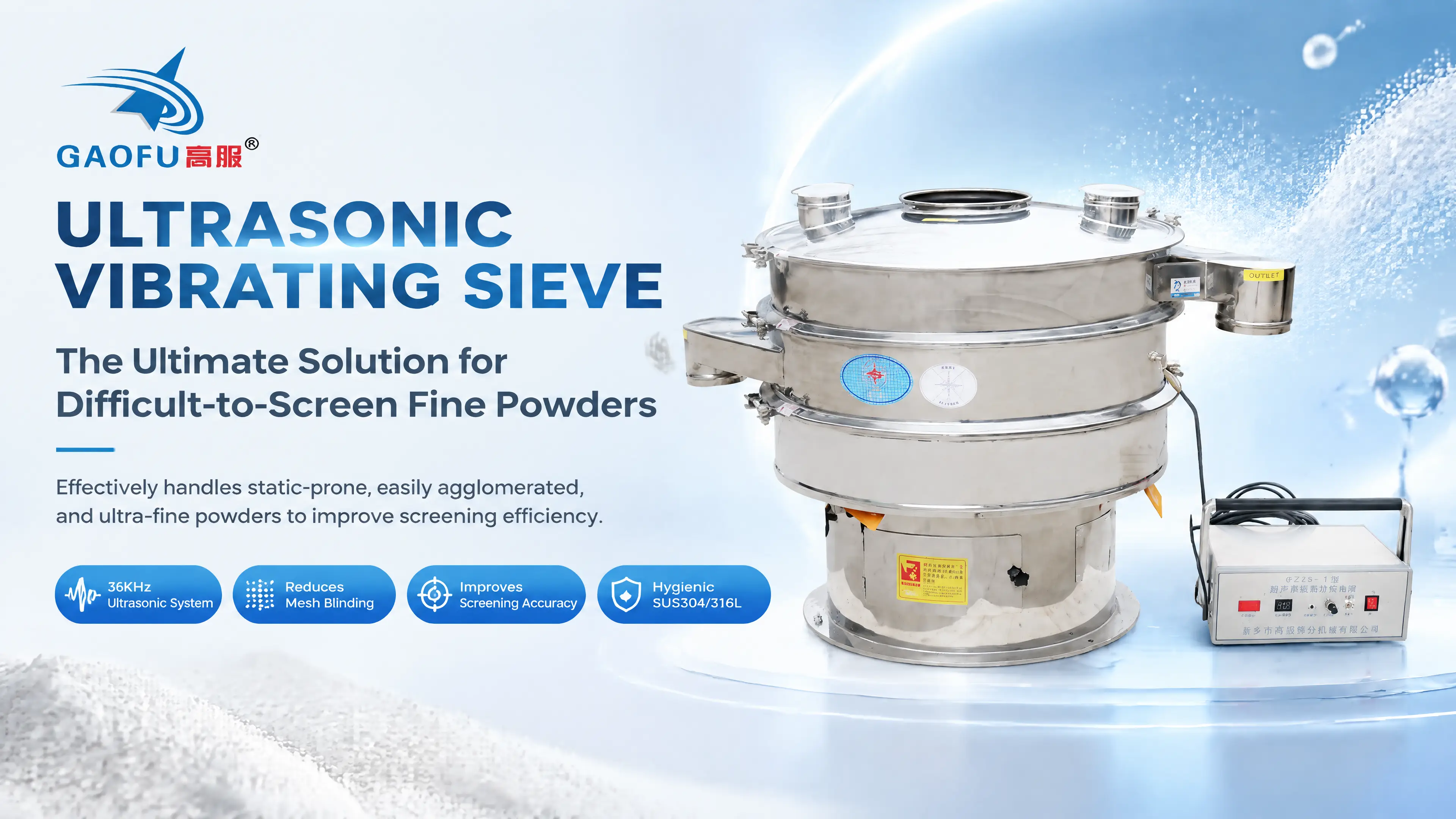
Gaofu Machinery's Ultrasonic Vibrating Sieve combines conventional rotary vibratory screening with ultrasonic screen-cleaning technology, allowing material movement and auxiliary screen cleaning to work together.
Its operating principle can be understood through two main functions:
Three-Dimensional Vibratory Motion: Promoting Material Distribution and Stratification
The vibration motor drives the screen body to generate compound motion in horizontal, vertical, and inclined directions. Material spreads, rolls, and stratifies across the screen surface. Particles of different sizes come into contact with the screen apertures and are classified according to the mesh opening size.
This motion helps improve material distribution across the screen surface and provides suitable conditions for continuous screening.
Ultrasonic Screen Cleaning: Helping Reduce Fine Particle Adhesion
The equipment is fitted with an ultrasonic screen-cleaning system. Through a transducer, high-frequency mechanical vibrations are transmitted to the screen mesh, helping reduce fine particle adhesion and accumulation around the apertures. For certain catalyst powders prone to screen blinding, this can help improve screen operating conditions.
Gaofu's S49-AC series uses an ultrasonic system with an operating frequency of 36 kHz. The configuration can be evaluated according to material characteristics and screening requirements. It should be noted that ultrasonic screen cleaning is an auxiliary technology and cannot guarantee that screen blinding will be completely avoided under all operating conditions. Actual performance should be verified through material testing.
Screening requirements vary across catalyst production processes. Some operations need to remove particles outside a specified size range, others need to control the fine powder content, while some require materials to be separated into multiple particle size fractions. Gaofu Machinery's Ultrasonic Vibrating Sieve can be evaluated and configured according to different production requirements.
Advantage 1: Supporting Fine-Mesh Screening and Helping Reduce Screen Blinding
For catalyst materials with high fine-powder content or a tendency to adhere to the screen, the ultrasonic cleaning system helps reduce particle accumulation around the apertures, limiting the impact of certain screen-blinding conditions on the screening process.
Advantage 2: Multi-Layer Screening for Multiple Particle Size Fractions
Depending on process requirements, suitable screen layers and aperture sizes can be selected to separate materials into different particle size ranges. Multi-fraction screening helps manufacturers collect and manage catalyst particles of different specifications separately, providing classified materials for downstream operations.
Advantage 3: Adjustable Screening Motion for Different Material Characteristics
The equipment uses structures such as eccentric weights to generate three-dimensional vibratory motion. The movement of the screen body directly affects the material's travel path across the screen surface. Operating parameters can be adjusted according to material flowability, target particle size, and processing capacity.
Advantage 4: Multiple Equipment Sizes for Production Line Integration
Gaofu's S49-AC series offers models with different screen diameters and screening areas. Manufacturers can select a suitable model based on production capacity, installation space, target particle size, and the layout of upstream and downstream equipment. This helps integrate the screening machine into existing production processes.
Advantage 5: Convenient Screen Inspection and Maintenance
The screen mesh is an important component affecting screening results. During equipment maintenance, the mesh can be inspected and replaced according to the equipment configuration. Timely checks for damage, looseness, and localized blockage help maintain suitable conditions for particle size classification.
Catalyst particle size screening is not an independent solution for optimizing catalytic reactions. Rather, it is part of raw material preparation and production management. By setting appropriate screening targets, manufacturers can direct different particle size fractions to the relevant downstream processes.
For example, a screening stage can be incorporated into catalyst production or pretreatment according to actual process requirements:
Raw Material Preparation → Ultrasonic Vibrating Sieve for Particle Classification → Separate Collection of Different Size Fractions → Particle Size Testing and Quality Evaluation → Batching, Packaging, or Reactor Loading
In this workflow, the Ultrasonic Vibrating Sieve performs physical classification according to screen aperture size. After screening, different particle size fractions can be collected separately and evaluated through particle size testing and catalyst performance assessment to determine whether they meet downstream process requirements.
For catalysts loaded into reactors, particle size distribution may be related to loading uniformity, bed conditions, and fluid flow through the catalyst bed. However, actual reaction performance is also influenced by many other factors, including catalyst chemistry, reaction temperature, pressure, flow rate, feed composition, and reactor design. It cannot be determined from screening results alone.
Different catalysts may vary significantly in particle strength, moisture content, flowability, and chemical properties. To ensure that an Ultrasonic Vibrating Sieve is suitable for the actual application, manufacturers should pay particular attention to the following factors during equipment selection:
Target Particle Size Range: Define the required particle size range, screening precision, and fine powder content to help determine suitable screen apertures.
Physical Material Properties: Understand particle shape, strength, moisture content, and tendency to agglomerate to assess whether ultrasonic screen cleaning is appropriate.
Production Requirements: Provide information on hourly processing capacity, feeding method, operating schedule, and installation space to help select a suitable model and screening area.
Chemical and Safety Conditions: Refer to the material's Safety Data Sheet (SDS) to determine whether the catalyst presents corrosion, toxicity, or combustible dust hazards. Product-contact materials, enclosure design, and any necessary safety features should then be evaluated accordingly.
For catalysts that are prone to breakage, particle attrition and fines generation during screening should also be considered. Equipment vibration parameters, feeding methods, and screening time may all affect particle condition. Testing with the actual material is recommended for a comprehensive evaluation.
Catalyst particle size management is relevant to raw material classification, material handling, and downstream process integration. Gaofu Machinery's Ultrasonic Vibrating Sieve combines three-dimensional vibratory motion with 36 kHz ultrasonic screen-cleaning technology, providing screening support for certain fine powders, agglomerating materials, and fine-mesh applications.
By selecting suitable screen specifications, equipment models, and operating parameters, manufacturers can classify catalyst particles according to their process requirements and improve particle size management. This provides more clearly defined material fractions for subsequent batching, reactor loading, and catalytic process operations.
Gaofu Machinery can help evaluate suitable Ultrasonic Vibrating Sieve configurations based on catalyst samples, target particle size, processing capacity, and actual operating conditions.
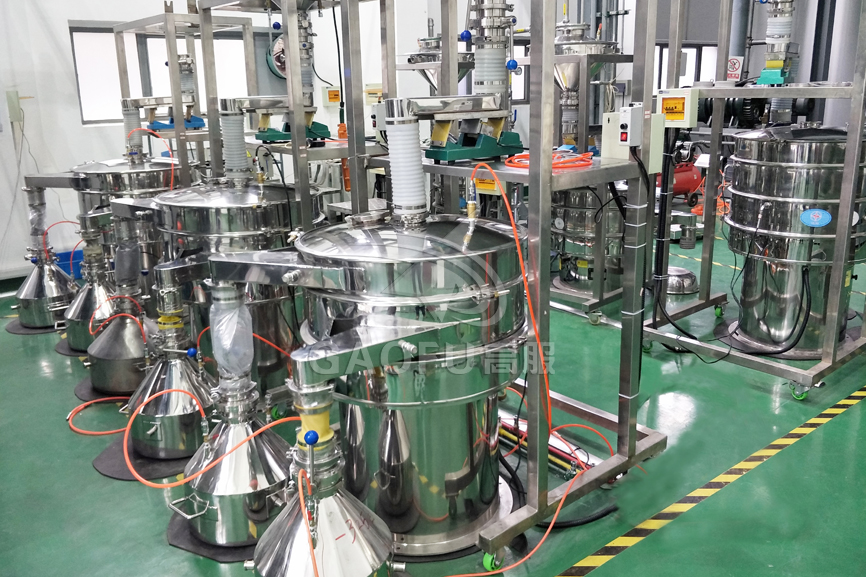
Chemical Industry Client Testimonials
Wanhua Chemical, Yuntianhua Group, Kingfa Science & Technology, Formosa Plastics Group, China Pingmei Shenma Group, Kemai Co., Ltd., Luxi Chemical, Liby Group, Oriental Yuhong, Davco, Chenming Group, Guanhao High-Tech
Kaifei Chemical, Sunsine Chemical, Weilin Co., Ltd., Xuyang Group, 3Trees, Maydos, Loyal Group (Kingpor Group), AkzoNobel, CSSC Hanguang, Haike Group, Nice Group, Taishan Fiberglass, Wanhua, Red Eagle, China XLX Fertiliser (Xinlianxin), CCtech Catalysis, China National Bluestar, Sakura Paint, ITANOS, Yanggu Huatai, Sennics, Longxing Chemical Group, Tunhe Co., Ltd., GHW International, Jianye Chemical, Finehope
Fortune 500 Client Testimonials
CNPC、CSCEC、Sinochem Holdings、CRCC、China Minmetals Corporation、CNOOC、CR、Sinopharm、CHN Energy、COFCO Corporation、Huawei Technologies、PowerChina、CITIC Group、Wuchan Zhongda Group、NORINCO、Chalco、CNBM、 Shaanxi Coal and Chemical Industry Group、Ansteel Group、CETC、CSSC、CASC、CEC、Jinchuan Group、CASIC、Conch Cement、CNNC、SPH、Shanxi Coking Coal Group、 Zhongtai Chemical、GPHL、DEC、Sinosteel Corporation、MCC、China National Salt Industry Chemical、China Baowu Steel Group、China Animal Husbandry Industry Co., Ltd.、CECEP
About Gaofu
Xinxiang Gaofu Machinery Co., Ltd. was founded back in the 1980s. With over 40 years of development, it has been certified as a National-level Specialized, Refined, Unique & Innovative Little Giant Enterprise, National Green Factory, National High-tech Enterprise, and National Intellectual Property Advantage Enterprise, and serves as the President Unit of China Vibration Screening Industry Association.
The company is accredited with the Henan Provincial Industrial Design Center, Henan Provincial Engineering Technology Research Center for Intelligent On-line Screening System, and Xinxiang Municipal Engineering Technology Research Center for Fine Screening.
Gaofu has obtained more than 500 patents including invention patents, utility model patents and design patents, been awarded the Science and Technology Achievement Prize issued by the Ministry of Industry and Information Technology of China, and participated in drafting and formulating 4 national standards.
Gaofu's product portfolio covers multiple series and hundreds of specifications, including vibrating screening equipment, conveying equipment, coal crushing equipment, filtration equipment and automatic material handling systems.
Core products include vibrating screens, screening machines, vibratory sifters, rotary vibrating screens, ultrasonic vibrating screens, linear vibrating screens, airflow screens, gyratory screens, roller screens, dewatering screens, bar screens, vacuum feeding machines, dust-free feeding stations, bulk bag feeding stations, feeding systems, automatic powder feeding systems, automatic slag-discharging filters, leaf filters, clay filters, toothed roll crushers, coal crushers and other machinery.
These products are widely applied in food, pharmaceutical, chemical, metallurgy, construction materials, mining, thermal power, environmental protection and many other industries, winning recognition and trust from over 10,000 clients worldwide.
Gaofu products enjoy strong sales across Greater China, and are exported to more than 100 countries and regions such as Russia, Canada, the United States, New Zealand, Japan, Brazil and South Africa.
Upholding the corporate mission of Improving material quality & efficiency to fully satisfy customer demands, Gaofu maintains long-term partnerships with clients to achieve win-win development.
At present, Gaofu is an official qualified supplier for numerous Fortune Global 500 enterprises, including CNPC, Sinopec, Sinochem Holdings, China Resources Group, Sinopharm Group, COFCO, China National Building Material, China Aerospace Science and Technology Corporation, Jinchuan Group and more.
Gaofu Machinery ranks No.1 in global sales volume of vibrating screens.
In May 2024, Frost & Sullivan, a world-renowned international consulting firm, issued a Market Position Verification Certificate confirming that Gaofu achieved the world's largest shipment volume of vibrating screens in the global market in 2023.