Over 10,000+ customers' choice, Focus on screening industry 40+ years
Coconut milk is not simply a low-viscosity liquid. After crushing, grinding, and extraction, the slurry may contain coconut fibers, fine particles, and a certain proportion of dispersed fat. Viscosity, solid content, and flow behavior can also vary depending on the formulation and processing stage.
For this reason, selecting screening equipment for liquid coconut milk involves more than choosing a screen mesh size. Material compatibility, enclosed connections, and screening structure should also be considered.
Food-contact materials
Components that come into direct contact with coconut milk, including screen frames, screen supports, and feed and discharge connections, should be evaluated according to food-processing requirements. Stainless steel and appropriate surface finishes may be considered for production lines with specific hygiene requirements.
Enclosed connection structures
The feed inlet, discharge outlet, and equipment connections should be configured according to the production line layout. Properly designed connections can help reduce open material transfer and product spillage.
An enclosed structure can help limit product exposure and splashing during filtration, but it should not be interpreted as a guarantee of completely dust-free or sterile operation.
Screen removal and cleaning access
Fibers and fat-containing residues in coconut milk may adhere to the screen surface and other product-contact areas. Equipment design should therefore consider convenient screen removal, internal inspection, and cleaning procedures to support routine food production hygiene management.
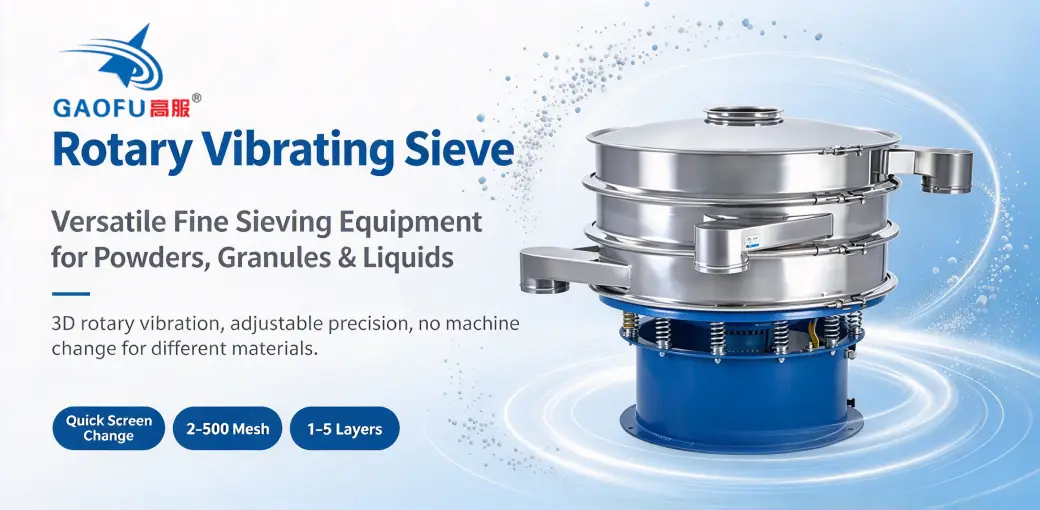
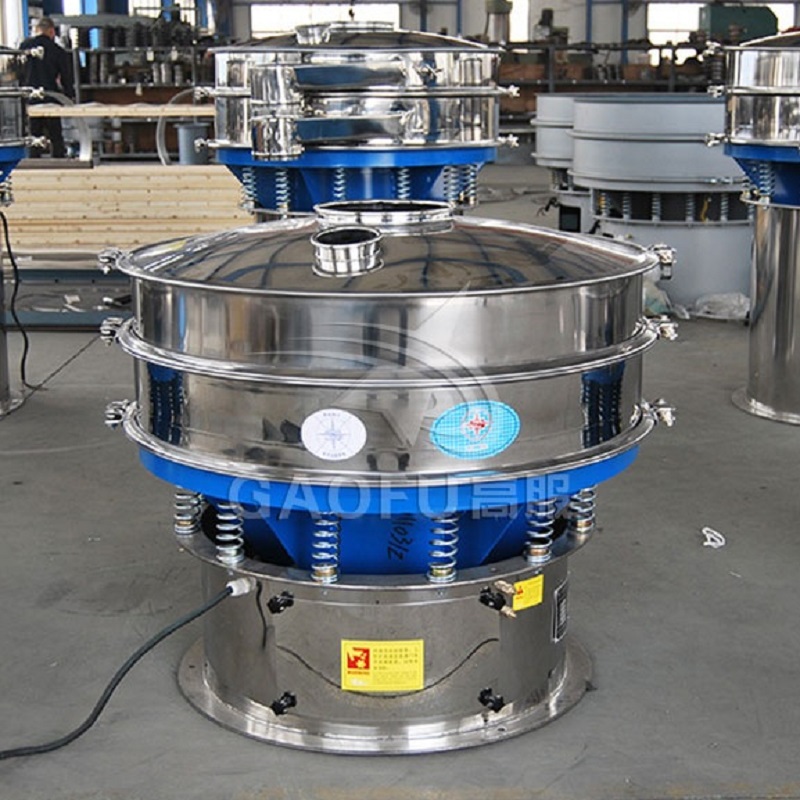
A Rotary Vibratory Sieve generally consists of a screen body, screen mesh, vibrating motor, vibration-isolation supports, and feeding and discharge components.
During operation, the vibrating motor generates excitation forces that drive the screen body into a controlled vibratory motion. This movement distributes the slurry across the screen surface and facilitates particle separation.
When liquid coconut milk enters the screening area, liquid and smaller particles that can pass through the screen apertures move through the mesh. Larger coconut fibers and coarse particles that meet the retention conditions remain on the screen surface and are discharged through the designated outlet.
This separation process is primarily based on screen aperture size. It does not change the fat content or emulsification state of the coconut milk itself. Products requiring further improvements in texture or dispersion stability may need additional homogenization and blending processes.
Three operating stages deserve particular attention:
Feed control: Adjust the feed rate according to slurry flow characteristics and equipment capacity to help prevent localized accumulation or uneven feeding.
Screening control: Select screen specifications according to the target particle size and evaluate filtration throughput and retention through material testing.
Discharge control: Configure the discharge structure according to the fiber content and retained material characteristics to help reduce residue accumulation on the screen.
The technical specifications of a food-grade Rotary Vibratory Sieve are important not only for equipment selection but also for evaluating its suitability for actual coconut milk filtration conditions.
Manufacturers should pay particular attention to the following parameters.
1. Screen Diameter and Effective Screening Area
The screen diameter determines the available screening space and is an important factor when evaluating processing capacity.
Manufacturers should consider the required coconut milk throughput, feed concentration, and available installation space when selecting the appropriate equipment size.
2. Screen Mesh Count and Aperture Size
Screen specifications determine the particle size range that the equipment can retain.
Mesh count and aperture size are not interchangeable measurements. Different wire diameters and weaving patterns can result in different actual opening sizes, even when the mesh count is the same.
For coconut milk filtration, screen selection should be based on fiber characteristics, coarse particle dimensions, and the required filtration results. Simply choosing a higher mesh count is not always appropriate. Smaller apertures may increase filtration resistance and make fiber accumulation or screen blinding more likely.
3. Vibrating Motor Power and Operating Parameters
The vibrating motor provides the excitation force required for screening. Motor power, vibration frequency, and amplitude should be matched to the equipment structure and material characteristics.
For liquid coconut milk, actual material trials are recommended to evaluate how vibration conditions affect slurry distribution, screening throughput, and fiber retention. Higher vibration intensity does not necessarily produce better filtration results.
4. Processing Capacity
Processing capacity depends on several factors, including slurry viscosity, solid content, screen specifications, feed conditions, and operating parameters.
Even when the same equipment model is used, different coconut milk formulations may produce different processing results.
During equipment selection, manufacturers should define their target throughput and verify actual capacity through material testing or on-site trials.
5. Product-Contact Materials and Sealing Configuration
For food-processing applications, particular attention should be paid to the materials used in product-contact components, surface finishes, seal compatibility, and connection structures.
Specific configurations should be determined according to food-contact requirements, cleaning methods, and production conditions. A stainless steel exterior alone does not establish that all equipment components meet the required food hygiene standards.
Liquid coconut milk does not typically generate airborne dust in the same way as dry powder. However, splashing, dripping, leakage, and product exposure may still occur during feeding, screening, discharge, and pipeline transfer.
When planning a filtration process, manufacturers should consider the following details.
Feeding section
Configure the feed connection according to the discharge method of the upstream extraction equipment. Reducing open transfer and controlling the slurry feed rate can help improve process management.
Screening chamber
Evaluate the enclosed structure according to production environment and cleaning requirements. Screen frame connections, sealing areas, and inspection points should be considered together to balance operation and maintenance needs.
Discharge section
Design the discharge connection to match downstream storage tanks, conveying pipelines, or homogenization equipment. Appropriate connections can help reduce product spillage and unnecessary secondary transfer.
It is important to understand that enclosed filtration primarily helps reduce product exposure and splashing. It does not independently provide sterile processing conditions. Food production still requires appropriate cleaning and sanitation procedures, hygiene management, and quality control measures.
Coconut milk products vary in viscosity, fiber content, target filtration requirements, and processing capacity. Equipment configuration should therefore be based on the specific application.
For coconut milk filtration, Gaofu Machinery can evaluate Rotary Vibratory Sieve specifications, including screen diameter, screen mesh parameters, vibrating motor configuration, feeding and discharge structures, and food-contact components.
Before finalizing an equipment proposal, manufacturers are encouraged to provide coconut milk slurry samples and relevant process information, including:
Coconut milk slurry viscosity and solid content
Approximate size of the fibers and coarse particles to be retained
Required processing capacity and continuous operation requirements
Pipeline connections and available installation space
Food-contact material and cleaning management requirements
Material testing can help evaluate screening throughput, particle retention, screen surface buildup, and cleaning and maintenance requirements. These results provide a more reliable basis for selecting equipment configurations suited to the production line.
Liquid coconut milk filtration requires a balance between screening performance, food-contact requirements, and production site management.
Food-contact materials, suitable screen mesh specifications, appropriate vibration parameters, and enclosed feeding and discharge connections all contribute to equipment suitability.
Gaofu Machinery can evaluate Rotary Vibratory Sieve configurations according to coconut milk slurry characteristics and production line requirements. The equipment can help retain fibers and coarse particles that meet the screen's retention conditions, providing filtration support for subsequent plant-based beverage processing.
By evaluating technical specifications alongside actual operating conditions, manufacturers can select screening equipment that integrates more effectively into their liquid coconut milk production processes.
Food Industry Client Testimonials
Nestlé, CP Group, Haitian Flavour & Fragrance, Yihai Kerry, Yili, Mengniu,Shuanghui, Wahaha, Master Kong, Want Want, Anjoy Foods, Angel Yeast,Yangyuan Foods, Uni-President Enterprises, Qiaqia Food, Luhua Group,Alpenliebe, Golden Monkey, Orion, Xizhilang,Sanquan Foods, Synear Food, Oishi, Wong Lo Kat, Yanjing Beer, Seamild,Jinpai, Chubang, Hengshun Vinegar Industry, Longda Group, Beijing Daoxiangcun, Anhe Dairy,Weiwei Group, Xiangpiaopiao, Maiquer, Tianbing, Binqi Food, Ligao Okun
Fortune 500 Client Testimonials
CNPC、CSCEC、Sinochem Holdings、CRCC、China Minmetals Corporation、CNOOC、CR、Sinopharm、CHN Energy、COFCO Corporation、Huawei Technologies、PowerChina、CITIC Group、Wuchan Zhongda Group、NORINCO、Chalco、CNBM、 Shaanxi Coal and Chemical Industry Group、Ansteel Group、CETC、CSSC、CASC、CEC、Jinchuan Group、CASIC、Conch Cement、CNNC、SPH、Shanxi Coking Coal Group、 Zhongtai Chemical、GPHL、DEC、Sinosteel Corporation、MCC、China National Salt Industry Chemical、China Baowu Steel Group、China Animal Husbandry Industry Co., Ltd.、CECEP
About Gaofu
Xinxiang Gaofu Machinery Co., Ltd. was founded back in the 1980s. With over 40 years of development, it has been certified as a National-level Specialized, Refined, Unique & Innovative Little Giant Enterprise, National Green Factory, National High-tech Enterprise, and National Intellectual Property Advantage Enterprise, and serves as the President Unit of China Vibration Screening Industry Association.
The company is accredited with the Henan Provincial Industrial Design Center, Henan Provincial Engineering Technology Research Center for Intelligent On-line Screening System, and Xinxiang Municipal Engineering Technology Research Center for Fine Screening.
Gaofu has obtained more than 500 patents including invention patents, utility model patents and design patents, been awarded the Science and Technology Achievement Prize issued by the Ministry of Industry and Information Technology of China, and participated in drafting and formulating 4 national standards.
Gaofu's product portfolio covers multiple series and hundreds of specifications, including vibrating screening equipment, conveying equipment, coal crushing equipment, filtration equipment and automatic material handling systems.
Core products include vibrating screens, screening machines, vibratory sifters, rotary vibrating screens, ultrasonic vibrating screens, linear vibrating screens, airflow screens, gyratory screens, roller screens, dewatering screens, bar screens, vacuum feeding machines, dust-free feeding stations, bulk bag feeding stations, feeding systems, automatic powder feeding systems, automatic slag-discharging filters, leaf filters, clay filters, toothed roll crushers, coal crushers and other machinery.
These products are widely applied in food, pharmaceutical, chemical, metallurgy, construction materials, mining, thermal power, environmental protection and many other industries, winning recognition and trust from over 10,000 clients worldwide.
Gaofu products enjoy strong sales across Greater China, and are exported to more than 100 countries and regions such as Russia, Canada, the United States, New Zealand, Japan, Brazil and South Africa.
Upholding the corporate mission of Improving material quality & efficiency to fully satisfy customer demands, Gaofu maintains long-term partnerships with clients to achieve win-win development.
At present, Gaofu is an official qualified supplier for numerous Fortune Global 500 enterprises, including CNPC, Sinopec, Sinochem Holdings, China Resources Group, Sinopharm Group, COFCO, China National Building Material, China Aerospace Science and Technology Corporation, Jinchuan Group and more.
Gaofu Machinery ranks No.1 in global sales volume of vibrating screens.
In May 2024, Frost & Sullivan, a world-renowned international consulting firm, issued a Market Position Verification Certificate confirming that Gaofu achieved the world's largest shipment volume of vibrating screens in the global market in 2023.