Over 10,000+ customers' choice, Focus on screening industry 40+ years
High-mesh screens have smaller apertures and can meet the fine classification requirements of some pharmaceutical powders. However, they also place greater demands on material properties and screening conditions.
Fine particles may adhere to the screen
Some pharmaceutical powders have very small particle sizes and relatively large specific surface areas. Electrostatic attraction and surface adhesion between particles may cause powder to accumulate on the screen surface, restricting the passage of material through the apertures.
Agglomerates may not disperse easily
During storage and conveying, pharmaceutical powders may be affected by humidity, temperature, and interparticle forces. These factors can cause loose agglomerates to form. When their size exceeds the target screen aperture, they may remain on the screen surface and contribute to blinding.
Uneven feeding can cause localized buildup
If too much material enters the screening chamber within a short period, or if the powder is distributed unevenly, certain areas of the screen may become overloaded, increasing the risk of screen blinding.
Screening parameters may not match material properties
Screen mesh size, feed rate, airflow conditions, and powder characteristics are closely related. An unsuitable equipment configuration or operating setup may affect the overall screening process.
For this reason, fine screening with high-mesh screens requires more than simply selecting smaller apertures. Material dispersion, equipment design, and operating parameters should all be considered.
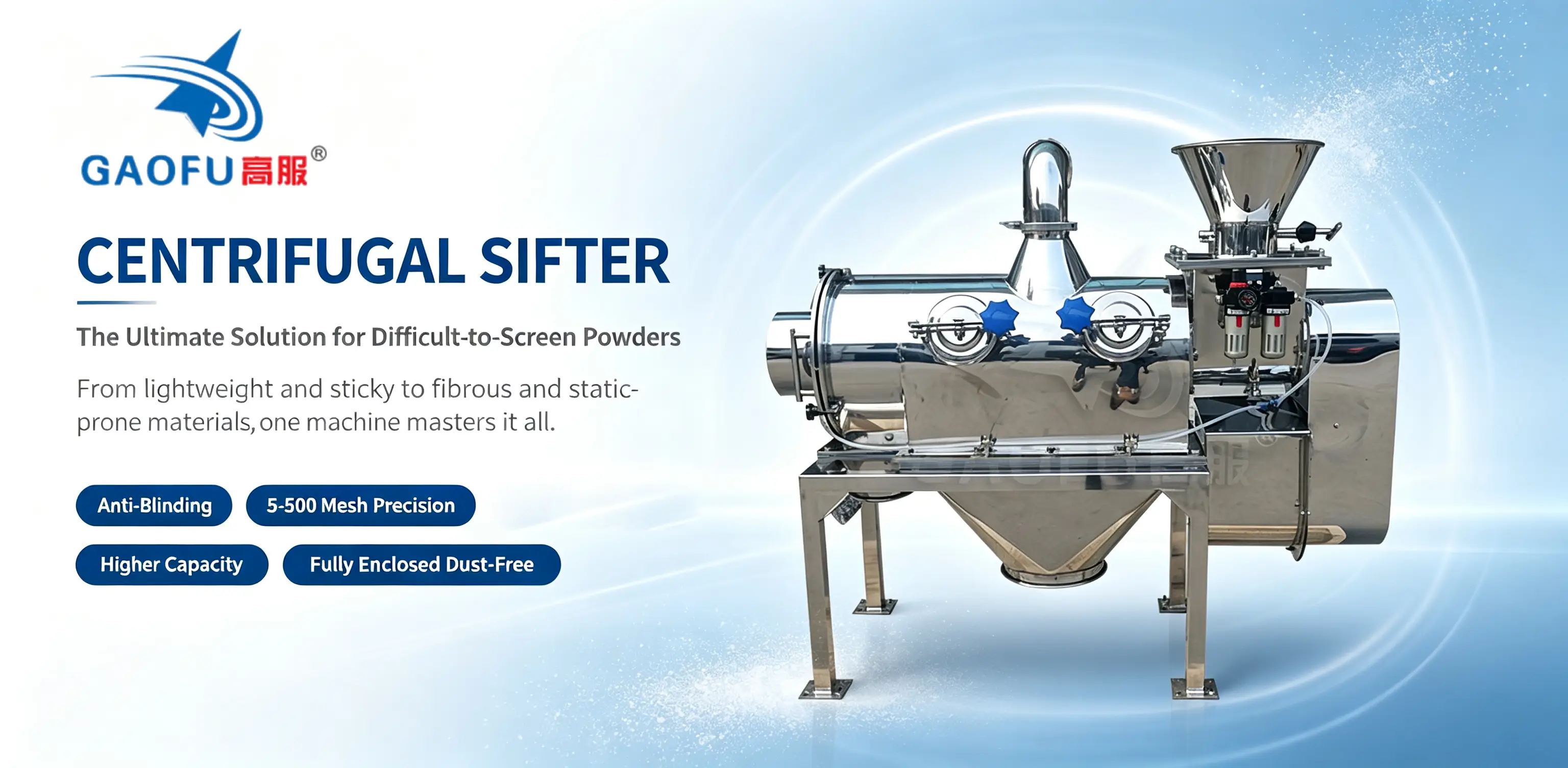
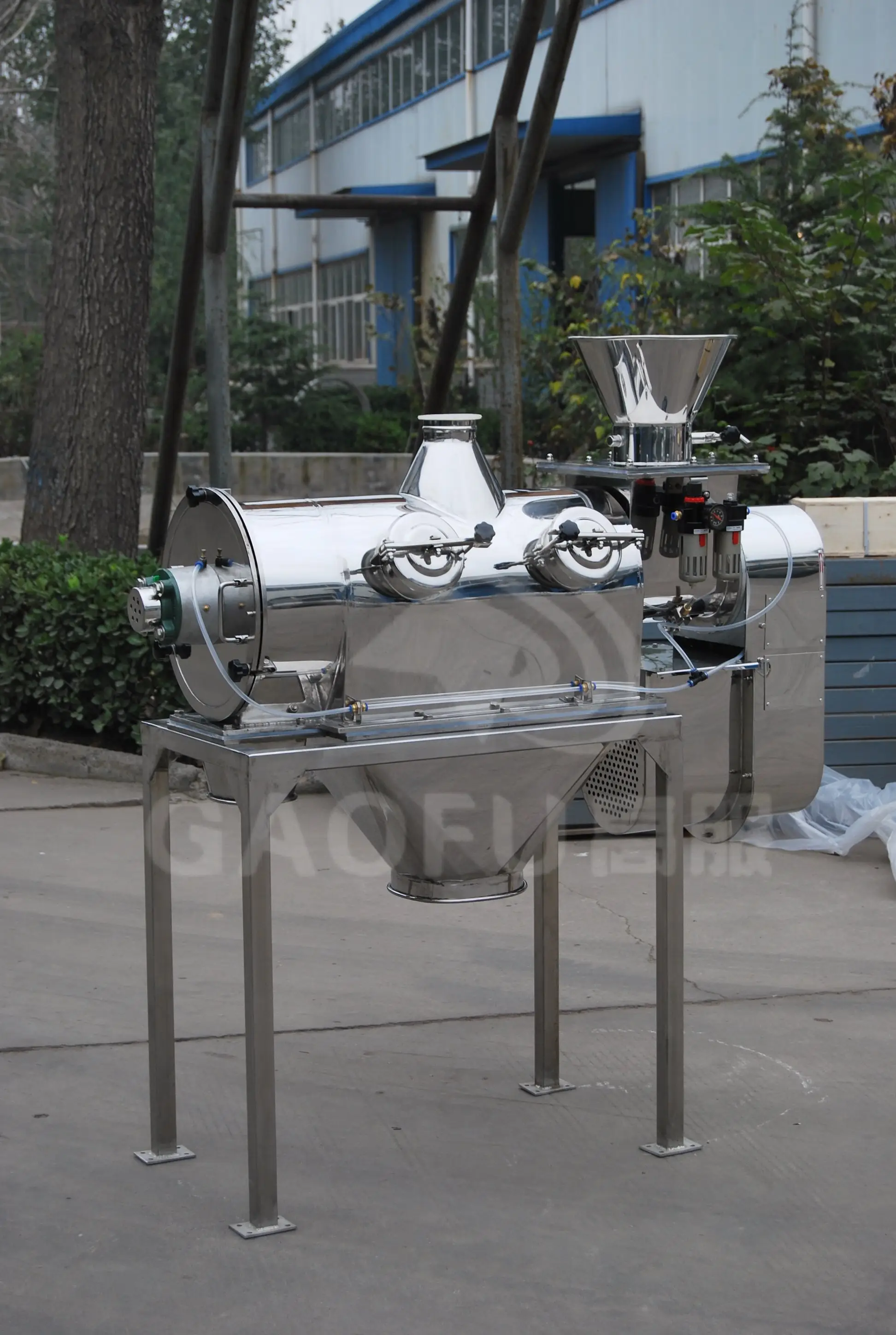
Unlike a conventional rotary vibrating sieve, which uses a vibration motor to drive the screen body, a Centrifugal Sifter uses an internal rotating mechanism together with airflow to disperse incoming powder. The material is then classified according to the screen mesh aperture.
The working process can be understood in three stages.
Stage 1: Material enters the screening chamber
Pharmaceutical powder enters the machine through the feed inlet and moves toward the screening area under the action of the internal rotating mechanism.
Stage 2: Airflow assists material dispersion
Airflow helps disperse the powder and may separate some loose agglomerates, improving material distribution across the screen area. For fine powders prone to mild agglomeration, this process can help reduce the impact of localized material buildup on screening.
Stage 3: The screen performs particle-size classification
The dispersed material passes through the screen. Particles that meet the screening requirements pass through the apertures, while larger particles are retained or continue moving within the screening chamber before being discharged according to the equipment configuration.
It is important to understand that a Centrifugal Sifter does not rely solely on airflow to separate particles by size or density. Its primary classification mechanism is screen mesh separation, while airflow assists material dispersion and movement.
The value of a Centrifugal Sifter is not based on a promise that the screen will never become blocked. Instead, its airflow-assisted dispersion mechanism and properly matched operating parameters can help improve screening conditions for certain fine powders that tend to agglomerate.
For Western medicine powder applications, manufacturers should consider the following factors:
Improving powder distribution: Airflow-assisted dispersion can help separate some loose agglomerates and promote more even material distribution within the screening chamber.
Reducing the impact of localized buildup: Adjusting the feed rate according to material throughput requirements can help prevent excessive material accumulation in a short period.
Selecting suitable screen specifications: Choose screen apertures according to the target particle size, material passage requirements, and oversized particle separation needs rather than simply selecting the highest possible mesh count.
Optimizing operating parameters: Evaluate airflow conditions and machine settings according to powder flowability, moisture content, and agglomeration behavior.
For pharmaceutical powders with strong electrostatic tendencies, high moisture content, or noticeable adhesion, additional measures such as environmental control, material pretreatment, and equipment cleaning should also be considered.
Equipment selection should be based on material characteristics and actual screening objectives. Even powders used in the same pharmaceutical industry can differ considerably in particle size distribution, moisture content, electrostatic behavior, and adhesion.
Before selecting a Centrifugal Sifter, manufacturers should consider several questions.
Is the powder prone to agglomeration?
If the main issue involves loose agglomerates, airflow-assisted dispersion may offer practical benefits. However, hard agglomerates with high mechanical strength may require deagglomeration or other pretreatment processes.
What mesh size is required?
Screen specifications should be determined according to the actual particle size distribution and screening objectives. A higher mesh count does not automatically mean better screening performance.
Is the material sensitive to humidity or static electricity?
For powders that are sensitive to environmental conditions, manufacturers should also consider the production environment, storage conditions, and material conveying methods.
Does the equipment meet pharmaceutical cleaning requirements?
Product-contact components, screen installation and removal methods, and internal equipment structures should be evaluated according to the manufacturer's cleaning management procedures and batch changeover requirements.
Material testing can help assess screen passage, material retention, processing capacity, and operational stability, providing a practical basis for equipment configuration.
To address potential agglomeration, adhesion, and screen blinding during high-mesh pharmaceutical powder screening, Gaofu Machinery can evaluate Centrifugal Sifter configurations according to material characteristics and production objectives.
Equipment selection may involve screen mesh specifications, feeding methods, internal structure, and operating parameters.
In addition to the target particle size, manufacturers should consider powder flowability, processing capacity, cleaning requirements, and integration with the existing production line.
For pharmaceutical powders with reasonable flowability but a tendency to form loose agglomerates, material testing can help determine whether airflow-assisted dispersion is suitable. For highly adhesive powders or materials containing strong agglomerates, further evaluation may be necessary, including the possibility of additional pretreatment.
High-mesh screening places greater demands on powder dispersion, screen specifications, and equipment operating conditions. When fine powders experience adhesion, agglomeration, or localized accumulation, a Centrifugal Sifter offers an alternative approach by combining airflow-assisted material dispersion with screen mesh classification.
Gaofu Machinery focuses on the actual screening challenges of different pharmaceutical powders. Through material analysis and testing, suitable equipment configurations can be evaluated to help manufacturers optimize fine screening processes and reduce screen blinding issues in high-mesh powder applications.
Pharmaceutical Industry Client Testimonials
Dong-E E-Jiao, Harbin Pharmaceutical Group, North China Pharmaceutical,Yangtze River Pharmaceutical Group, Taiji Group, Huadong Medicine,CSPC Group, Northeast Pharmaceutical, Guangzhou Baiyunshan, Tongrentang,Huiren Pharmaceutical, Fosun Pharma, Xiuzheng Pharmaceutical, Lijun Pharmaceutical,Luye Pharma Group, Di'ao Group, TianGongLi, Hengrui Medicine, Jiuzhitang, Jiangzhong Pharmaceutical, Lunan Pharmaceutical, Yunnan Baiyao, Sunflower Pharmaceutical,China Sanjiu Enterprise Group, Sanjin Pharmaceutical, Yiling Pharmaceutical,Wantong Pharmaceutical, Pientzehuang, Ma Yinglong Pharmaceutical, Guangyuyuan,Aodong Pharmaceutical, Besunyen, Jingfukang Pharmaceutical, Furen Pharmaceutical Group,Guizhou Bailing, Conba, Huasu Pharmaceutical, Yifang Pharmaceutical
Fortune 500 Client Testimonials
CNPC、CSCEC、Sinochem Holdings、CRCC、China Minmetals Corporation、CNOOC、CR、Sinopharm、CHN Energy、COFCO Corporation、Huawei Technologies、PowerChina、CITIC Group、Wuchan Zhongda Group、NORINCO、Chalco、CNBM、 Shaanxi Coal and Chemical Industry Group、Ansteel Group、CETC、CSSC、CASC、CEC、Jinchuan Group、CASIC、Conch Cement、CNNC、SPH、Shanxi Coking Coal Group、 Zhongtai Chemical、GPHL、DEC、Sinosteel Corporation、MCC、China National Salt Industry Chemical、China Baowu Steel Group、China Animal Husbandry Industry Co., Ltd.、CECEP
About Gaofu
Xinxiang Gaofu Machinery Co., Ltd. was founded back in the 1980s. With over 40 years of development, it has been certified as a National-level Specialized, Refined, Unique & Innovative Little Giant Enterprise, National Green Factory, National High-tech Enterprise, and National Intellectual Property Advantage Enterprise, and serves as the President Unit of China Vibration Screening Industry Association.
The company is accredited with the Henan Provincial Industrial Design Center, Henan Provincial Engineering Technology Research Center for Intelligent On-line Screening System, and Xinxiang Municipal Engineering Technology Research Center for Fine Screening.
Gaofu has obtained more than 500 patents including invention patents, utility model patents and design patents, been awarded the Science and Technology Achievement Prize issued by the Ministry of Industry and Information Technology of China, and participated in drafting and formulating 4 national standards.
Gaofu's product portfolio covers multiple series and hundreds of specifications, including vibrating screening equipment, conveying equipment, coal crushing equipment, filtration equipment and automatic material handling systems.
Core products include vibrating screens, screening machines, vibratory sifters, rotary vibrating screens, ultrasonic vibrating screens, linear vibrating screens, airflow screens, gyratory screens, roller screens, dewatering screens, bar screens, vacuum feeding machines, dust-free feeding stations, bulk bag feeding stations, feeding systems, automatic powder feeding systems, automatic slag-discharging filters, leaf filters, clay filters, toothed roll crushers, coal crushers and other machinery.
These products are widely applied in food, pharmaceutical, chemical, metallurgy, construction materials, mining, thermal power, environmental protection and many other industries, winning recognition and trust from over 10,000 clients worldwide.
Gaofu products enjoy strong sales across Greater China, and are exported to more than 100 countries and regions such as Russia, Canada, the United States, New Zealand, Japan, Brazil and South Africa.
Upholding the corporate mission of Improving material quality & efficiency to fully satisfy customer demands, Gaofu maintains long-term partnerships with clients to achieve win-win development.
At present, Gaofu is an official qualified supplier for numerous Fortune Global 500 enterprises, including CNPC, Sinopec, Sinochem Holdings, China Resources Group, Sinopharm Group, COFCO, China National Building Material, China Aerospace Science and Technology Corporation, Jinchuan Group and more.
Gaofu Machinery ranks No.1 in global sales volume of vibrating screens.
In May 2024, Frost & Sullivan, a world-renowned international consulting firm, issued a Market Position Verification Certificate confirming that Gaofu achieved the world's largest shipment volume of vibrating screens in the global market in 2023.