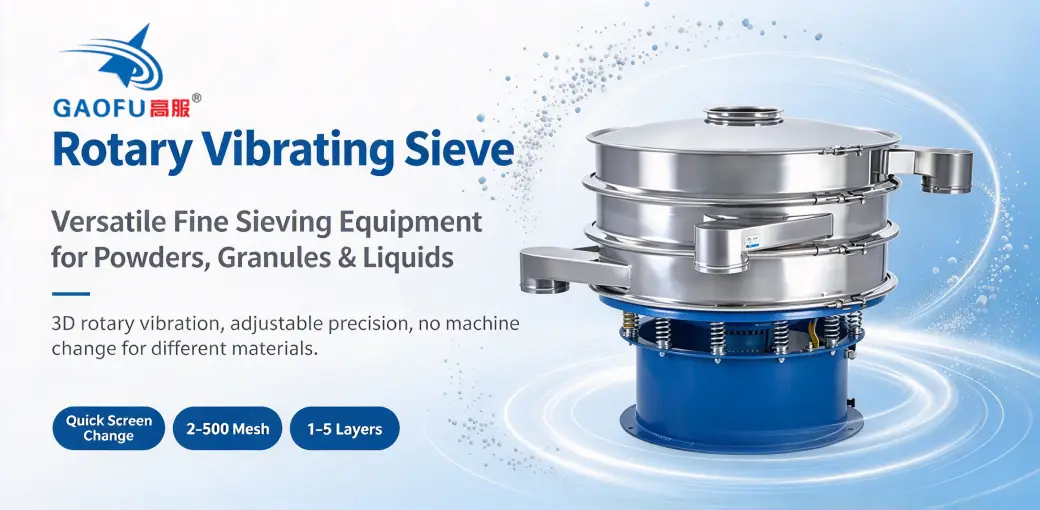
Over 10,000+ customers' choice, Focus on screening industry 40+ years
Breaking “adhesion” down, at least three pathways are acting simultaneously.
The first is interfacial adsorption of protein molecules. Proteins are macromolecular active organic substances, and when particles contact stainless steel screen wires, the adsorption of molecular chain segments at the interface is a spontaneous process. This adsorption is progressive: the initial stage is only monolayer coverage, and as operating time extends, the adsorbed layer thickens and compacts, forming an elastic “protein film” that gradually seals off the effective open area.
The second is moisture-induced liquid bridges and caking. Protein powder has extremely strong moisture absorption capacity, and trace water vapor in the environment is sufficient to cause the particle surfaces to regain moisture, forming liquid bridges between particles, with agglomerate sizes far exceeding individual particles. When these agglomerates are compacted on the screen surface, they become semi-cured lumps that neither pass through the apertures nor are necessarily dispersible by vibration.
The third is electrostatic adsorption. Dry powder becomes charged during conveying and vibration friction, and fine powder is adsorbed onto screen wires and the inner walls of the screen frame, forming “bridges” at aperture edges and further reducing the open area.
Among these three pathways, the mechanical impact of bouncing balls is effective against mechanical embedding, but has limited effect on molecular-level adsorbed films and electrostatic bridging. This is why some production lines still experience recurring screen blinding after switching to bouncing balls and increasing amplitude—there is a mismatch between the screen-cleaning method and the blinding mechanism.
Ultrasonic screen cleaning follows a different physical pathway. High-frequency electrical signals are converted by a transducer into ultrasonic vibration, which is uniformly transmitted to the screen surface through a resonance ring, giving the screen wires high-frequency micro-amplitude vibration. This vibration generates continuous detachment acceleration at the contact interface between particles and screen wires, weakening adsorption and adhesion forces, preventing fine powder from stably residing at aperture edges, and allowing agglomerates to be dispersed in a suspended state and pass through the screen. Publicly available technical descriptions summarize its action as “suppressing adhesion, friction, flattening, wedging and other screen-blinding factors.”
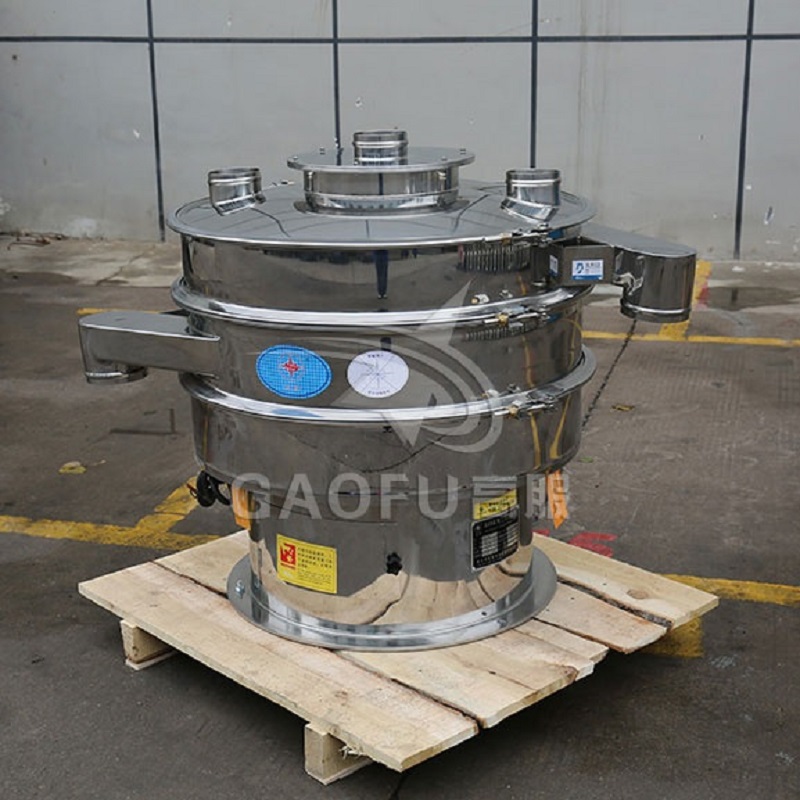
Compared with bouncing balls, the engineering positioning of the two has a clear division of labor: bouncing balls address mechanical embedding that has already occurred, while ultrasound supplements microscopic adhesion and electrostatic adsorption. For materials such as protein powder where adhesion is the dominant mechanism, ultrasound is not an “enhanced bouncing ball” but an independent intervention targeting another blinding pathway. Gaofu S49-AC ultrasonic models are equipped with 18–40 kHz ultrasonic transducer devices, and screen permeability can be maintained above 96%; they are designed precisely for ultrafine, highly electrostatic, moisture-absorbing and clumping powder scenarios.
Even if the screen-cleaning method is correctly selected, if vibration parameters, feeding conditions and hygiene management do not match, screen blinding will still reappear at another stage.
Vibration parameters need to correspond to material conditions. The viscosity and moisture of protein powder fluctuate between batches, and running with fixed parameters means some batches are in an “under-vibrated” state—the material layer advances too slowly, residence time on the screen surface is too long, and compaction and adhesion are aggravated. Gaofu S49 series supports adjustment of amplitude and frequency; the baseline parameters of 1,440 r/min vibration frequency and 2–3 mm double amplitude can be adjusted between “sufficient for screening” and “not excessively compacting” according to incoming material conditions. The screen replacement structure is also incorporated into continuous operation considerations: the mother-and-son screen separation design allows screen replacement to be completed within 3–5 minutes, reducing process interruptions caused by screen cleaning or product changeovers.
Hygiene conditions directly relate to whether the substrate for adhesion is clean. Material-contact parts use 304 or 316L stainless steel, with mirror-polished inner surfaces (roughness Ra ≤0.8 μm); seals are food-grade silicone, and the fully enclosed structure prevents dust leakage and external contamination. Smooth screen wire surfaces and a clean chamber reduce the anchor points for initial protein molecule adsorption; conversely, if the screen surface already has a substrate of dried residual powder or microbial growth, the efficiency of any screen-cleaning method will be weakened from the starting point. Controlling production environment humidity within the 45%–60% range is also a conventional process condition for reducing the incidence of moisture-induced agglomeration.
The anti-blinding configuration of the rotary vibratory sieve addresses adhesion and embedding problems inside the screening equipment. It does not change the moisture-absorbing nature of protein powder, does not replace the control of final moisture content in upstream drying processes, and does not replace humidity management at the workshop level. For incoming materials that have already severely absorbed moisture and caked, what screening can do is retain or break them up, not reverse quality changes that have already occurred. However, in the chain from spray drying to packaging, screening is a node where material, in a highly dispersed state, is exposed to mechanical interfaces and environmental conditions. At this node, aligning screen-cleaning methods with blinding mechanisms—using ultrasound for adhesion, bouncing balls for embedding, parameter adjustment for batch fluctuations, and materials and enclosure for hygiene substrates—transforms screen blinding from a “recurring fault” into a process condition that can be broken down and managed at the design and operation levels.
Food Industry Client Testimonials
Nestlé, CP Group, Haitian Flavour & Fragrance, Yihai Kerry, Yili, Mengniu,Shuanghui, Wahaha, Master Kong, Want Want, Anjoy Foods, Angel Yeast,Yangyuan Foods, Uni-President Enterprises, Qiaqia Food, Luhua Group,Alpenliebe, Golden Monkey, Orion, Xizhilang,Sanquan Foods, Synear Food, Oishi, Wong Lo Kat, Yanjing Beer, Seamild,Jinpai, Chubang, Hengshun Vinegar Industry, Longda Group, Beijing Daoxiangcun, Anhe Dairy,Weiwei Group, Xiangpiaopiao, Maiquer, Tianbing, Binqi Food, Ligao Okun
Fortune 500 Client Testimonials
CNPC、CSCEC、Sinochem Holdings、CRCC、China Minmetals Corporation、CNOOC、CR、Sinopharm、CHN Energy、COFCO Corporation、Huawei Technologies、PowerChina、CITIC Group、Wuchan Zhongda Group、NORINCO、Chalco、CNBM、 Shaanxi Coal and Chemical Industry Group、Ansteel Group、CETC、CSSC、CASC、CEC、Jinchuan Group、CASIC、Conch Cement、CNNC、SPH、Shanxi Coking Coal Group、 Zhongtai Chemical、GPHL、DEC、Sinosteel Corporation、MCC、China National Salt Industry Chemical、China Baowu Steel Group、China Animal Husbandry Industry Co., Ltd.、CECEP
About Gaofu
Xinxiang Gaofu Machinery Co., Ltd. was founded back in the 1980s. With over 40 years of development, it has been certified as a National-level Specialized, Refined, Unique & Innovative Little Giant Enterprise, National Green Factory, National High-tech Enterprise, and National Intellectual Property Advantage Enterprise, and serves as the President Unit of China Vibration Screening Industry Association.
The company is accredited with the Henan Provincial Industrial Design Center, Henan Provincial Engineering Technology Research Center for Intelligent On-line Screening System, and Xinxiang Municipal Engineering Technology Research Center for Fine Screening.
Gaofu has obtained more than 500 patents including invention patents, utility model patents and design patents, been awarded the Science and Technology Achievement Prize issued by the Ministry of Industry and Information Technology of China, and participated in drafting and formulating 4 national standards.
Gaofu's product portfolio covers multiple series and hundreds of specifications, including vibrating screening equipment, conveying equipment, coal crushing equipment, filtration equipment and automatic material handling systems.
Core products include vibrating screens, screening machines, vibratory sifters, rotary vibrating screens, ultrasonic vibrating screens, linear vibrating screens, airflow screens, gyratory screens, roller screens, dewatering screens, bar screens, vacuum feeding machines, dust-free feeding stations, bulk bag feeding stations, feeding systems, automatic powder feeding systems, automatic slag-discharging filters, leaf filters, clay filters, toothed roll crushers, coal crushers and other machinery.
These products are widely applied in food, pharmaceutical, chemical, metallurgy, construction materials, mining, thermal power, environmental protection and many other industries, winning recognition and trust from over 10,000 clients worldwide.
Gaofu products enjoy strong sales across Greater China, and are exported to more than 100 countries and regions such as Russia, Canada, the United States, New Zealand, Japan, Brazil and South Africa.
Upholding the corporate mission of Improving material quality & efficiency to fully satisfy customer demands, Gaofu maintains long-term partnerships with clients to achieve win-win development.
At present, Gaofu is an official qualified supplier for numerous Fortune Global 500 enterprises, including CNPC, Sinopec, Sinochem Holdings, China Resources Group, Sinopharm Group, COFCO, China National Building Material, China Aerospace Science and Technology Corporation, Jinchuan Group and more.
Gaofu Machinery ranks No.1 in global sales volume of vibrating screens.
In May 2024, Frost & Sullivan, a world-renowned international consulting firm, issued a Market Position Verification Certificate confirming that Gaofu achieved the world's largest shipment volume of vibrating screens in the global market in 2023.