Over 10,000+ customers' choice, Focus on screening industry 40+ years
Whey protein or soy protein powder obtained by spray drying typically has a median particle size in the range of ten to several tens of micrometers. Publicly available research indicates that the effect of particle size on powder flowability can outweigh the effects of differences in protein composition; smaller particle sizes and stronger interparticle cohesion lead to poorer flowability. The same set of studies also observed a moderate correlation between particle-size parameters and the insoluble index, while flowability indicators (Carr index, Hausner ratio) were negatively correlated with particle size. Translated into production-line language: when the fine powder proportion is too high or the distribution is too broad, the powder is more likely to bridge in hoppers, fluctuate in metering screws, and tend to clump rather than disperse during reconstitution.
But this does not mean “the finer the better” or “the coarser the better.” The reconstitution properties of protein powder are also affected by particle surface morphology, porosity and agglomeration state. The truly controllable variable is narrowing the distribution to the target interval: cutting off oversize agglomerates and coarse particles at the upper limit, allowing excessively fine dust to pass through at the lower limit, and keeping the powder entering packaging or downstream mixing within a narrower window in the particle-size dimension.
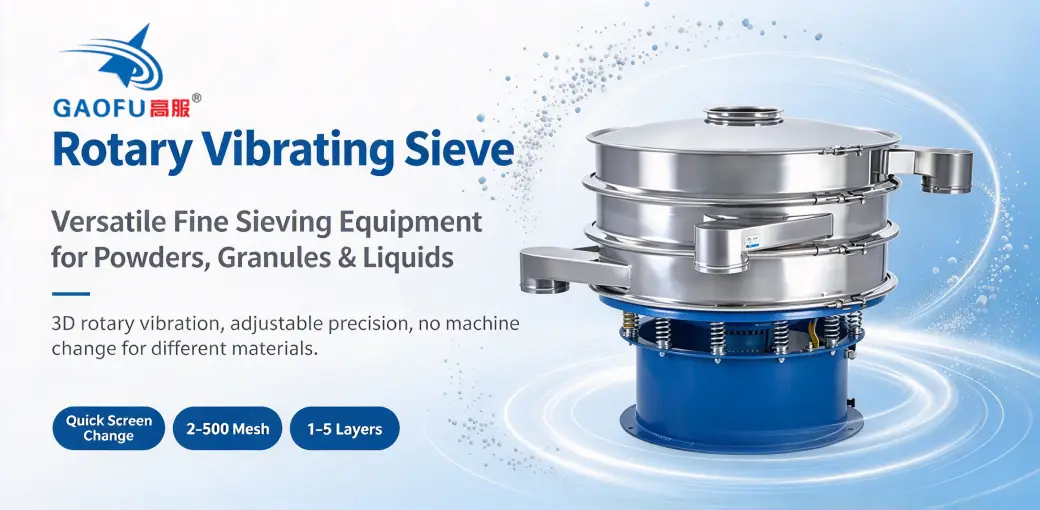
The classification logic of the rotary vibratory sieve is not to make all particles pass a certain mesh count, but to use multiple screen decks to continuously segment particle-size intervals. Gaofu S49 series supports 1 to 5 screen deck configurations, with screening accuracy up to 600 mesh (0.02 mm) and filtration accuracy down to 5 micrometers. For the common target intervals of protein powder, this means the upper screen deck retains oversize particles and agglomerates, the middle screen deck produces product in the target particle-size interval, and the lower deck allows fine powder to pass through—all three completed simultaneously in one feed, rather than relying on the binary “pass or retain” result of a single screen deck.
The engineering consequence of this configuration is a narrower distribution. A single screen deck can only answer “pass or not pass,” while the multilayer configuration tightens the target interval from both sides simultaneously: the proportion of particles falling within the window changes from a random result dependent on initial conditions into a process output that can be defined through screen combination and operating parameters.
The difficulty of protein powder screening lies not in whether the aperture is fine enough, but in two simultaneously acting mechanisms that erode the uniformity already established.
The first is static electricity and moisture-absorbing agglomeration. Protein powder particles are fine and contain hydrophilic groups; after becoming charged through friction in a dry environment, they adsorb onto the screen mesh, and after absorbing moisture, liquid bridges form between particles, with agglomerate sizes far exceeding individual particles. Gaofu equips protein powder screening equipment with flexible screen-cleaning devices and adjustable amplitude and frequency, continuously cleaning screen surface residue through the synergy of vibration and screen cleaning. For ultrafine powders with extremely fine fineness and strong static electricity, an ultrasonic system can be optionally configured, using high-frequency micro-vibration to keep the powder in a suspended state on the screen surface, suppressing screen blinding caused by adhesion, wedging and agglomeration. The action mode of ultrasonic screen cleaning does not rely on the mechanical impact of bouncing balls; for protein powder that has already formed mild agglomerates, it breaks up adhesion and bridging rather than altering the particles themselves through high-intensity impact.
The second is the continuity of changeovers and screen cleaning. Food production lines frequently switch between plant protein, whey protein and different formulas. The quick-release screen structure allows screen replacement to be completed within 3–5 minutes, and the fully enclosed silicone sealing structure easily restores the airtight state after reclosing. If uniformity can only be achieved in the initial stage of a batch, and screen cleaning and changeovers push the system back to the starting point each time, then “batch consistency” becomes impossible to discuss.
For a rotary vibratory sieve to enter a protein powder food production line, the interface conditions it must satisfy are not limited to screening accuracy itself.
At the material level, material-contact parts are typically made of 304 stainless steel, with the option of upgrading to 316L for scenarios with higher cleanliness requirements. Inner surfaces are mirror-polished to Ra ≤0.4 μm, welds are ground to eliminate hygiene dead corners, and seals use food-grade silicone; the overall design aligns with GMP and food production hygiene standards. The migration of alloy elements from food-contact stainless steel needs to be considered within the framework of GB 4806.9—2023; limits for impurity elements such as lead, cadmium and arsenic have been further tightened in the new version, and stainless steel is judged on the results of the third migration test. What equipment manufacturers can provide is traceable material selection and surface treatment processes; finished product compliance is still borne by line final inspection, but the screening stage should not become the variable requiring after-the-fact remediation.
At the enclosure and integration level, the fully enclosed structure combined with food-grade seals separates the screening chamber from the workshop environment, reducing dust escape and external foreign matter ingress. The equipment can be integrated with automated production lines for continuous operation, and the orientation and diameter of inlet and outlet ports can be customized according to line layout. Operating noise is controlled below 75 dB. For food powder workshops with multiple pieces of equipment running continuously, this is the basic condition for the screening stage to be embedded in the line without becoming an additional noise source.
The role of the rotary vibratory sieve in protein powder particle-size control needs to be accurately defined: it addresses the particle-size distribution of the particle population before it enters downstream processes, narrowing the distribution to a definable interval through multiple screen decks, and using screen-cleaning mechanisms and enclosed structures to make this interval reproducible during continuous operation and batch switching. It does not change the molecular structure of proteins, does not replace the optimization of spray drying process parameters, and does not reverse agglomeration or fine powder generation that has already occurred.
However, for protein powder processing that takes reconstitution properties, flowability and batch consistency as its factory-release bottom line, screening is the last controllable node between “the initial state determined by spray drying” and “the material state actually faced by downstream processes” in terms of particle-size distribution. Making the distribution narrowing at this node stable removes one source of fluctuation from downstream metering, mixing and filling. Gaofu S49 series rotary vibratory sieves’ multilayer classification configuration, ultrasonic or flexible screen-cleaning options, and food-grade materials and enclosed structure in protein powder scenarios point not to an isolated “uniformity” indicator, but to making particle-size distribution a process condition that can be defined at the parameter level and maintained within the rhythm of the production line.
Food Industry Client Testimonials
Nestlé, CP Group, Haitian Flavour & Fragrance, Yihai Kerry, Yili, Mengniu,Shuanghui, Wahaha, Master Kong, Want Want, Anjoy Foods, Angel Yeast,Yangyuan Foods, Uni-President Enterprises, Qiaqia Food, Luhua Group,Alpenliebe, Golden Monkey, Orion, Xizhilang,Sanquan Foods, Synear Food, Oishi, Wong Lo Kat, Yanjing Beer, Seamild,Jinpai, Chubang, Hengshun Vinegar Industry, Longda Group, Beijing Daoxiangcun, Anhe Dairy,Weiwei Group, Xiangpiaopiao, Maiquer, Tianbing, Binqi Food, Ligao Okun
Fortune 500 Client Testimonials
CNPC、CSCEC、Sinochem Holdings、CRCC、China Minmetals Corporation、CNOOC、CR、Sinopharm、CHN Energy、COFCO Corporation、Huawei Technologies、PowerChina、CITIC Group、Wuchan Zhongda Group、NORINCO、Chalco、CNBM、 Shaanxi Coal and Chemical Industry Group、Ansteel Group、CETC、CSSC、CASC、CEC、Jinchuan Group、CASIC、Conch Cement、CNNC、SPH、Shanxi Coking Coal Group、 Zhongtai Chemical、GPHL、DEC、Sinosteel Corporation、MCC、China National Salt Industry Chemical、China Baowu Steel Group、China Animal Husbandry Industry Co., Ltd.、CECEP
About Gaofu
Xinxiang Gaofu Machinery Co., Ltd. was founded back in the 1980s. With over 40 years of development, it has been certified as a National-level Specialized, Refined, Unique & Innovative Little Giant Enterprise, National Green Factory, National High-tech Enterprise, and National Intellectual Property Advantage Enterprise, and serves as the President Unit of China Vibration Screening Industry Association.
The company is accredited with the Henan Provincial Industrial Design Center, Henan Provincial Engineering Technology Research Center for Intelligent On-line Screening System, and Xinxiang Municipal Engineering Technology Research Center for Fine Screening.
Gaofu has obtained more than 500 patents including invention patents, utility model patents and design patents, been awarded the Science and Technology Achievement Prize issued by the Ministry of Industry and Information Technology of China, and participated in drafting and formulating 4 national standards.
Gaofu's product portfolio covers multiple series and hundreds of specifications, including vibrating screening equipment, conveying equipment, coal crushing equipment, filtration equipment and automatic material handling systems.
Core products include vibrating screens, screening machines, vibratory sifters, rotary vibrating screens, ultrasonic vibrating screens, linear vibrating screens, airflow screens, gyratory screens, roller screens, dewatering screens, bar screens, vacuum feeding machines, dust-free feeding stations, bulk bag feeding stations, feeding systems, automatic powder feeding systems, automatic slag-discharging filters, leaf filters, clay filters, toothed roll crushers, coal crushers and other machinery.
These products are widely applied in food, pharmaceutical, chemical, metallurgy, construction materials, mining, thermal power, environmental protection and many other industries, winning recognition and trust from over 10,000 clients worldwide.
Gaofu products enjoy strong sales across Greater China, and are exported to more than 100 countries and regions such as Russia, Canada, the United States, New Zealand, Japan, Brazil and South Africa.
Upholding the corporate mission of Improving material quality & efficiency to fully satisfy customer demands, Gaofu maintains long-term partnerships with clients to achieve win-win development.
At present, Gaofu is an official qualified supplier for numerous Fortune Global 500 enterprises, including CNPC, Sinopec, Sinochem Holdings, China Resources Group, Sinopharm Group, COFCO, China National Building Material, China Aerospace Science and Technology Corporation, Jinchuan Group and more.
Gaofu Machinery ranks No.1 in global sales volume of vibrating screens.
In May 2024, Frost & Sullivan, a world-renowned international consulting firm, issued a Market Position Verification Certificate confirming that Gaofu achieved the world's largest shipment volume of vibrating screens in the global market in 2023.