Over 10,000+ customers' choice, Focus on screening industry 40+ years
First, the material side. After spray drying, protein powder has fine particles and low bulk density. Under the three-dimensional compound vibration of the rotary vibratory sieve, fine powder is continuously exposed to airflow disturbance within the screening chamber. If the screen body is inadequately sealed, fine powder escapes outward from clamp ring mating surfaces and inlet/outlet ports, directly manifesting as yield loss. More subtly, protein powder dust escaping into the workshop air increases the particulate load of the working environment. GBZ 2.1—2019 sets occupational exposure limits for hazardous chemical agents in the workplace, including a framework of limits for total dust and respirable dust. Dust control in food powder processing workshops is not merely about the sensory impression of “tidiness”; it falls within a quantitative framework of occupational hygiene management.
Now the safety side. Protein powder is a combustible organic dust. In publicly available food dust explosibility information, protein powder is included in the list of substances requiring attention for explosion parameters, with related testing covering minimum ignition temperature of a dust cloud, minimum ignition temperature of a dust layer, and lower explosive limit concentration. The lower explosive limit of grain-type dusts is typically in the range of 40–200 g/m³, and a dust layer only 1 mm thick is sufficient to form an explosible dust cloud in a space 5 meters high. This means that the continuous fine dust escape in a screening workshop is not just a hygiene issue; it is simultaneously accumulating the material basis for the “concentration condition” of a dust explosion.
The core principles of dust explosion prevention in food factories established by GB 15577—2018 “Safety Regulations for Dust Explosion Prevention and Protection” are “source dust control, enclosed isolation, and removal of ignition sources.” The engineering meaning of this statement is direct: rather than relying on ventilation dilution or dust removal systems to “chase” dust after it enters the workshop air, it is better to seal the escape pathways at the equipment node where the dust is generated.
Screening is precisely such a node. Dried material tends to form dust clouds during unloading, screening and conveying, and the high-frequency vibration and material tumbling inside screening equipment are exactly the conditions under which dust is continuously generated. If the screen body itself is not an enclosed vessel, subsequent workshop dust removal is merely compensating for inadequate equipment sealing.
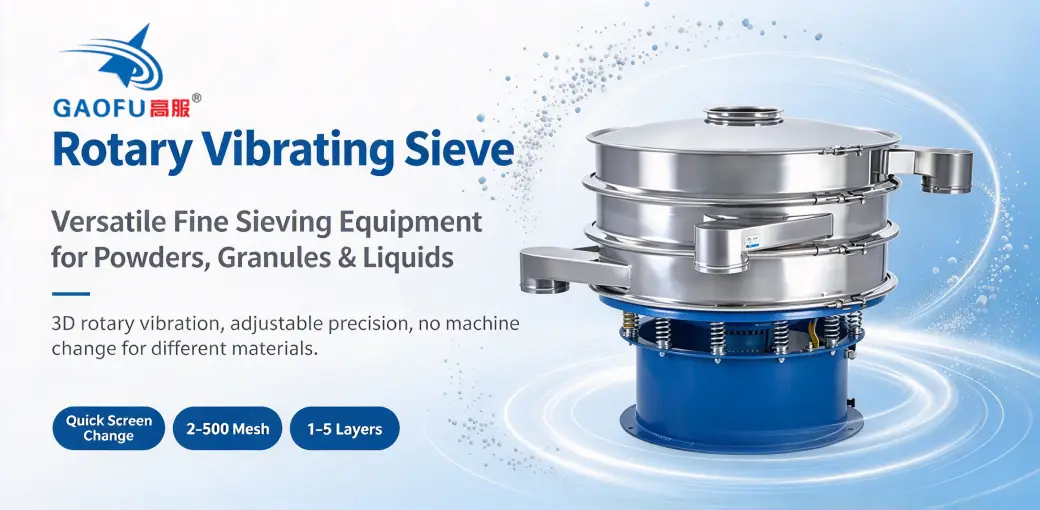
Dust control of Gaofu S49 series rotary vibratory sieves in protein powder scenarios consists of two layers of structural logic.
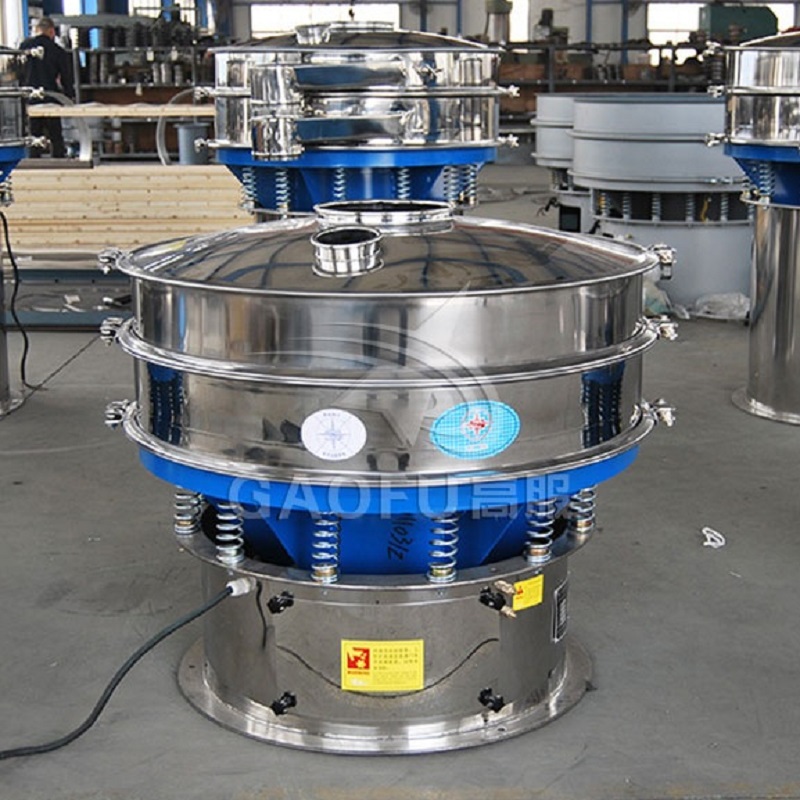
The first layer is passive enclosure. The entire machine adopts a fully enclosed design, with food-grade silicone seals at the mating positions of the screen frame, screen cover and clamp ring, creating a physical separation between the screening chamber and the workshop environment during operation, preventing dust from spilling out and external foreign matter from entering. Material-contact parts use 304 or 316L stainless steel, with inner surfaces mirror-polished to Ra ≤0.4 μm and welds ground smooth with no dead corners, reducing protein powder clinging and residue on the chamber walls—residue itself is also a source of subsequent batch cross-contamination and dust regeneration.
With passive sealing alone, slight positive pressure may still form inside the screening chamber during vibration and material tumbling, subjecting sealing surfaces to outward pressure. Therefore, the second layer is active containment: the equipment is provided with dust extraction interfaces that can be connected to a negative-pressure line, maintaining the interior of the screen body at a slight negative pressure, with airflow direction from the workshop into the chamber, counteracting the escape tendency at microscopic gaps in sealing surfaces. Publicly available information on Gaofu’s enclosed dust-free screening solutions shows that the combination of the three-dimensional rotary vibratory sieve and negative-pressure dust removal can control workshop dust concentration below 10 mg/m³. In the dual context of occupational hygiene and environmental emissions, this value provides a quantifiable reference for improving “dust problems.”
If an enclosed structure comes at the expense of screen-cleaning convenience, it is difficult to maintain over the long term in continuous protein powder production. The tendency of protein powder to absorb moisture and agglomerate means aperture embedding is a continuous risk. If every screen cleaning requires opening the sealed structure, the engineering value of the enclosed design will be offset by frequent downtime. The bouncing-ball screen-cleaning device beneath the screen mesh completes cleaning actions inside the enclosed chamber without opening the screen body; the quick-release structure allows screen replacement to be completed within 3–5 minutes, and the matching design of seals and clamp rings makes it easy to restore the airtight state after reclosing. Enclosure is not a one-time assembly state, but a working condition repeatedly maintained during screen cleaning, screen replacement and continuous operation.
Explosion-proof configuration as an extension of enclosure logic
For combustible dusts such as protein powder, enclosure itself is one of the fundamental measures of dust explosion prevention. On this basis, Gaofu S49 series can be equipped with explosion-proof motors to meet the electrical requirements of dust explosion-proof scenarios. The moving parts and electrical components of the screening equipment operate outside the enclosed chamber, forming a physical separation from the dust cloud inside; the equipment grounding system is used to dissipate friction-accumulated static charge, reducing the possibility of electrostatic discharge as an ignition source. These configurations, together with the enclosed structure, form a logical closed loop: keep dust inside the chamber, keep ignition sources outside the chamber.
It should be made clear that the boundary of what a rotary vibratory sieve’s enclosure can cover is dust escape control of the screening equipment itself. It does not replace the design of ventilation and dust removal systems at the workshop level, does not change the moisture-absorbing and agglomerating nature of protein powder, and does not remedy dust exposure that has already occurred in processes before or after screening. However, in the powder processing chain from drying to packaging, screening is a node where material, in a highly dispersed state, comes into contact with the external environment. By closing off the openings at this node, the particulate load in workshop air has one less continuous incremental source, material yield has one less silent loss pathway, and dust explosion prevention has one more equipment-side barrier at the source of the “concentration condition.” Gaofu Machinery’s fully enclosed structure, negative-pressure dust extraction interface, food-grade material configuration and optional explosion-proof solutions on the rotary vibratory sieve point precisely to this kind of enclosed screening condition with a clear scope of action and a clear standards basis.
Food Industry Client Testimonials
Nestlé, CP Group, Haitian Flavour & Fragrance, Yihai Kerry, Yili, Mengniu,Shuanghui, Wahaha, Master Kong, Want Want, Anjoy Foods, Angel Yeast,Yangyuan Foods, Uni-President Enterprises, Qiaqia Food, Luhua Group,Alpenliebe, Golden Monkey, Orion, Xizhilang,Sanquan Foods, Synear Food, Oishi, Wong Lo Kat, Yanjing Beer, Seamild,Jinpai, Chubang, Hengshun Vinegar Industry, Longda Group, Beijing Daoxiangcun, Anhe Dairy,Weiwei Group, Xiangpiaopiao, Maiquer, Tianbing, Binqi Food, Ligao Okun
Fortune 500 Client Testimonials
CNPC、CSCEC、Sinochem Holdings、CRCC、China Minmetals Corporation、CNOOC、CR、Sinopharm、CHN Energy、COFCO Corporation、Huawei Technologies、PowerChina、CITIC Group、Wuchan Zhongda Group、NORINCO、Chalco、CNBM、 Shaanxi Coal and Chemical Industry Group、Ansteel Group、CETC、CSSC、CASC、CEC、Jinchuan Group、CASIC、Conch Cement、CNNC、SPH、Shanxi Coking Coal Group、 Zhongtai Chemical、GPHL、DEC、Sinosteel Corporation、MCC、China National Salt Industry Chemical、China Baowu Steel Group、China Animal Husbandry Industry Co., Ltd.、CECEP
About Gaofu
Xinxiang Gaofu Machinery Co., Ltd. was founded back in the 1980s. With over 40 years of development, it has been certified as a National-level Specialized, Refined, Unique & Innovative Little Giant Enterprise, National Green Factory, National High-tech Enterprise, and National Intellectual Property Advantage Enterprise, and serves as the President Unit of China Vibration Screening Industry Association.
The company is accredited with the Henan Provincial Industrial Design Center, Henan Provincial Engineering Technology Research Center for Intelligent On-line Screening System, and Xinxiang Municipal Engineering Technology Research Center for Fine Screening.
Gaofu has obtained more than 500 patents including invention patents, utility model patents and design patents, been awarded the Science and Technology Achievement Prize issued by the Ministry of Industry and Information Technology of China, and participated in drafting and formulating 4 national standards.
Gaofu's product portfolio covers multiple series and hundreds of specifications, including vibrating screening equipment, conveying equipment, coal crushing equipment, filtration equipment and automatic material handling systems.
Core products include vibrating screens, screening machines, vibratory sifters, rotary vibrating screens, ultrasonic vibrating screens, linear vibrating screens, airflow screens, gyratory screens, roller screens, dewatering screens, bar screens, vacuum feeding machines, dust-free feeding stations, bulk bag feeding stations, feeding systems, automatic powder feeding systems, automatic slag-discharging filters, leaf filters, clay filters, toothed roll crushers, coal crushers and other machinery.
These products are widely applied in food, pharmaceutical, chemical, metallurgy, construction materials, mining, thermal power, environmental protection and many other industries, winning recognition and trust from over 10,000 clients worldwide.
Gaofu products enjoy strong sales across Greater China, and are exported to more than 100 countries and regions such as Russia, Canada, the United States, New Zealand, Japan, Brazil and South Africa.
Upholding the corporate mission of Improving material quality & efficiency to fully satisfy customer demands, Gaofu maintains long-term partnerships with clients to achieve win-win development.
At present, Gaofu is an official qualified supplier for numerous Fortune Global 500 enterprises, including CNPC, Sinopec, Sinochem Holdings, China Resources Group, Sinopharm Group, COFCO, China National Building Material, China Aerospace Science and Technology Corporation, Jinchuan Group and more.
Gaofu Machinery ranks No.1 in global sales volume of vibrating screens.
In May 2024, Frost & Sullivan, a world-renowned international consulting firm, issued a Market Position Verification Certificate confirming that Gaofu achieved the world's largest shipment volume of vibrating screens in the global market in 2023.