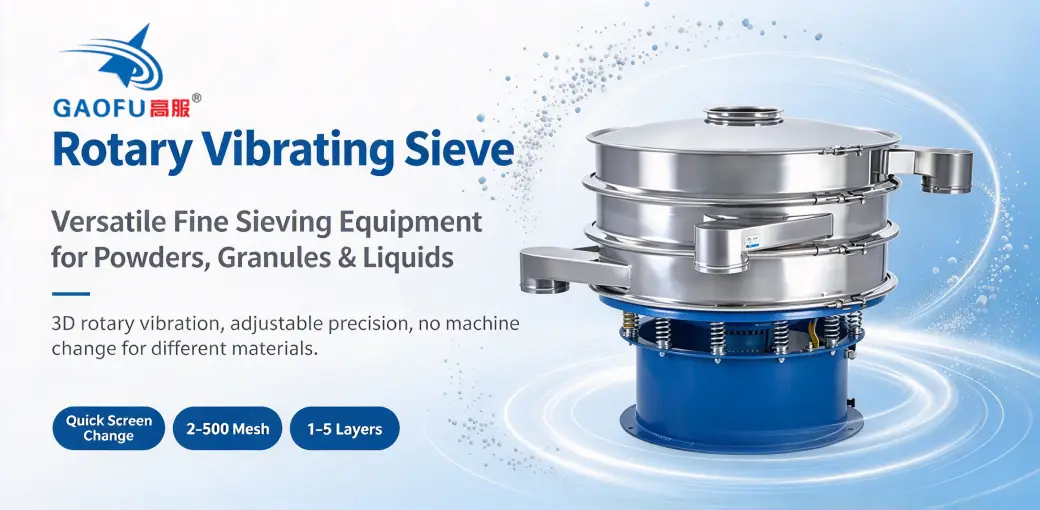
Over 10,000+ customers' choice, Focus on screening industry 40+ years
Meal replacement powder is typically a blend of protein powder, grain powder, fruit and vegetable powder, dietary fiber, non-dairy creamer and other ingredients. Raw materials come from dispersed sources and involve many pre-processing steps. Publicly available industry cases show that when protein powder raw materials undergo safety screening before entering the mixing stage, retained foreign objects include packaging ties, plastic bags and liner fragments, wood chips, hair and paper scraps. These are not sensational extreme cases but actual conditions that can occur during raw material unpacking, transfer and feeding.
A second category of “impurity” that is easily overlooked runs in parallel: agglomerates. Protein powder particles are fine and highly hygroscopic, and are prone to mild agglomeration under ambient humidity. When meal replacement powder also contains protein and oil components, the tendency of the powder to clump and adhere to the screen becomes more pronounced. If a hardened lump formed by moisture is not retained and enters the finished product, it appears as “fish eyes” or lumps when the consumer reconstitutes the powder, and may be judged as non-conforming in quality inspection. The retention or breaking up of agglomerates by screening is functionally equivalent to impurity removal—it separates “particles that should not exist in that form” from the target powder stream.
The difficulty of screening protein powder and meal replacement powder lies not in “whether the aperture is fine enough,” but in two physical mechanisms acting simultaneously.
The first is static electricity. Fine powder particles become charged after friction in a dry environment, adsorbing to each other and adhering to the screen mesh and stainless steel components, forming a covering layer that is difficult to shed on its own. The second is agglomeration. Moisture-absorbing protein powder particles form liquid bridges between them, and the size of agglomerates far exceeds that of individual particles. If the mechanical action of the screening equipment is insufficient to break them up, these agglomerates will either be incorrectly retained as “impurities” or break apart during subsequent conveying while their particle size has already deviated from the target range. Traditional screening methods face the combined effects of static electricity, agglomeration and screen blinding when handling protein powder, resulting in reduced production efficiency and inconsistent quality.
How the permeability of a blinded screen is restored—different screen-cleaning methods have different impacts on product cleanliness.
Bouncing-ball screen cleaning relies on rubber balls continuously striking from the underside of the screen mesh. It is effective against mechanical embedding and low in cost. But in scenarios such as meal replacement powder where there is zero tolerance for foreign matter, bouncing balls involve an engineering fact that must be faced: rubber balls wear during repeated impact, and the debris generated by wear is non-metallic foreign matter that becomes a new contamination source once it enters the powder stream. This is not to say bouncing balls cannot be used, but that the choice of screen-cleaning method needs to match the hygiene level of the product.
Ultrasonic screen cleaning offers a different pathway. High-frequency electrical signals are converted by a transducer into micro-vibration, which is transmitted to the screen surface through a resonance ring, keeping powder particles in a micro-suspended state on the screen surface. Agglomerated lumps are broken up by the high-frequency vibration, electrostatic adsorption is weakened, and the apertures remain open during operation. Its engineering characteristic is that the cleaning action comes from the micro-vibration of the screen mesh itself and does not introduce an additional solid medium, so there is no contamination pathway from bouncing-ball wear debris. For blended powders such as meal replacement powder, ultrasonic screen cleaning has an additional benefit: it addresses “adhesion” and “mild agglomeration” rather than breaking particles with high-intensity mechanical impact, making it gentler on heat-sensitive or structurally fragile ingredients in the formula.
If the screening chamber is not enclosed, fine powder escapes outward, the particulate load in the workshop air rises, and material is lost as dust; external particles also gain a pathway to migrate into the chamber. The fully enclosed structure, together with food-grade silicone sealing and clamp ring locking, separates the screening space from the workshop environment—this is the first step in translating “cleanliness” from a slogan into equipment structure. For production lines with stricter dust control requirements, the dust extraction connection flange reserved on the top cover can be connected to a negative-pressure line to maintain slight negative pressure in the chamber and further narrow the escape tendency.
At the material level, screen frames and screen meshes in contact with the material are typically made of 304 or 316L stainless steel, with mirror-polished inner surfaces and smooth, dead-corner-free welds to reduce conditions for protein powder to cling to walls and leave residue. GB 4806.9—2023 sets limits for the migration of alloy elements from stainless steel used in food contact, with limits for arsenic, cadmium and lead all at ≤0.01%, and compliance is judged on the results of the third migration test. What equipment manufacturers can provide is material selection and surface treatment that conform to this framework, while the final compliance of protein powder finished products is still borne by the hygiene management and final inspection of the entire production line. What the equipment can do is make the screening stage a link in the cleanliness chain that does not fail, rather than a weak point requiring after-the-fact remediation.
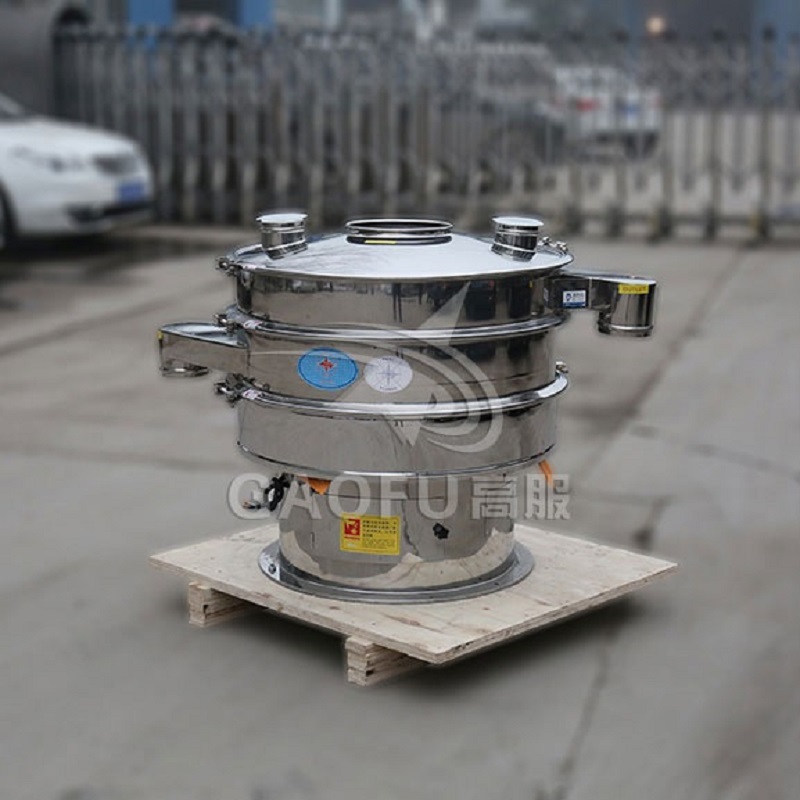
Returning to the meal replacement powder scenario: a bag of product that, after reconstitution, has no lumps, no foreign matter and disperses uniformly in water—what the consumer sees is “quality.” What the production side should see is that the screening stage kept foreign matter out of the finished product, retained or broke up agglomerates before packaging, and contained dust inside the chamber. Gaofu rotary vibratory sieves’ configuration in protein powder and meal replacement powder scenarios—fully enclosed structure, optional ultrasonic screen cleaning, food-grade stainless steel and seals, and quick-release screen mesh—points not to an isolated “cleanliness” label, but to giving the screening step executable and maintainable engineering means in three directions: foreign matter control, agglomerate management and dust containment. For meal replacement powder processing that takes “clean” as its bottom line, this kind of cleanliness built into the structure is closer to quality itself than any description.
Food Industry Client Testimonials
Nestlé, CP Group, Haitian Flavour & Fragrance, Yihai Kerry, Yili, Mengniu,Shuanghui, Wahaha, Master Kong, Want Want, Anjoy Foods, Angel Yeast,Yangyuan Foods, Uni-President Enterprises, Qiaqia Food, Luhua Group,Alpenliebe, Golden Monkey, Orion, Xizhilang,Sanquan Foods, Synear Food, Oishi, Wong Lo Kat, Yanjing Beer, Seamild,Jinpai, Chubang, Hengshun Vinegar Industry, Longda Group, Beijing Daoxiangcun, Anhe Dairy,Weiwei Group, Xiangpiaopiao, Maiquer, Tianbing, Binqi Food, Ligao Okun
Fortune 500 Client Testimonials
CNPC、CSCEC、Sinochem Holdings、CRCC、China Minmetals Corporation、CNOOC、CR、Sinopharm、CHN Energy、COFCO Corporation、Huawei Technologies、PowerChina、CITIC Group、Wuchan Zhongda Group、NORINCO、Chalco、CNBM、 Shaanxi Coal and Chemical Industry Group、Ansteel Group、CETC、CSSC、CASC、CEC、Jinchuan Group、CASIC、Conch Cement、CNNC、SPH、Shanxi Coking Coal Group、 Zhongtai Chemical、GPHL、DEC、Sinosteel Corporation、MCC、China National Salt Industry Chemical、China Baowu Steel Group、China Animal Husbandry Industry Co., Ltd.、CECEP
About Gaofu
Xinxiang Gaofu Machinery Co., Ltd. was founded back in the 1980s. With over 40 years of development, it has been certified as a National-level Specialized, Refined, Unique & Innovative Little Giant Enterprise, National Green Factory, National High-tech Enterprise, and National Intellectual Property Advantage Enterprise, and serves as the President Unit of China Vibration Screening Industry Association.
The company is accredited with the Henan Provincial Industrial Design Center, Henan Provincial Engineering Technology Research Center for Intelligent On-line Screening System, and Xinxiang Municipal Engineering Technology Research Center for Fine Screening.
Gaofu has obtained more than 500 patents including invention patents, utility model patents and design patents, been awarded the Science and Technology Achievement Prize issued by the Ministry of Industry and Information Technology of China, and participated in drafting and formulating 4 national standards.
Gaofu's product portfolio covers multiple series and hundreds of specifications, including vibrating screening equipment, conveying equipment, coal crushing equipment, filtration equipment and automatic material handling systems.
Core products include vibrating screens, screening machines, vibratory sifters, rotary vibrating screens, ultrasonic vibrating screens, linear vibrating screens, airflow screens, gyratory screens, roller screens, dewatering screens, bar screens, vacuum feeding machines, dust-free feeding stations, bulk bag feeding stations, feeding systems, automatic powder feeding systems, automatic slag-discharging filters, leaf filters, clay filters, toothed roll crushers, coal crushers and other machinery.
These products are widely applied in food, pharmaceutical, chemical, metallurgy, construction materials, mining, thermal power, environmental protection and many other industries, winning recognition and trust from over 10,000 clients worldwide.
Gaofu products enjoy strong sales across Greater China, and are exported to more than 100 countries and regions such as Russia, Canada, the United States, New Zealand, Japan, Brazil and South Africa.
Upholding the corporate mission of Improving material quality & efficiency to fully satisfy customer demands, Gaofu maintains long-term partnerships with clients to achieve win-win development.
At present, Gaofu is an official qualified supplier for numerous Fortune Global 500 enterprises, including CNPC, Sinopec, Sinochem Holdings, China Resources Group, Sinopharm Group, COFCO, China National Building Material, China Aerospace Science and Technology Corporation, Jinchuan Group and more.
Gaofu Machinery ranks No.1 in global sales volume of vibrating screens.
In May 2024, Frost & Sullivan, a world-renowned international consulting firm, issued a Market Position Verification Certificate confirming that Gaofu achieved the world's largest shipment volume of vibrating screens in the global market in 2023.