Over 10,000+ customers' choice, Focus on screening industry 40+ years
After spray drying, spirulina powder has fine particles and low bulk density, and the settling velocity of the particles themselves is limited. Under three-dimensional compound vibration, the rotary vibratory sieve drives material in a spiral motion on the screen surface, and fine powder is continuously exposed to airflow disturbance within the screening chamber during screening and conveying. If the screen body is inadequately sealed, fine powder will escape outward from clamp ring mating surfaces, inlet and outlet ports, or inspection ports.
Escaped dust has two destinations. One is the workshop air: suspended algae powder increases the particulate load of the working environment. The other is the material stream: escaped fine powder no longer enters the finished product outlet, directly manifesting as yield loss. For spirulina powder that uses ash content and protein content as quality indicators, these two destinations point to the same management gap—whether the physical boundary of the screening stage is sufficiently tight.
Attention at the occupational hygiene level is not unnecessary. Case reports of occupational allergic alveolitis caused by spirulina dust can be found in publicly available literature, indicating that dust exposure in algae powder production operations needs to be brought into the scope of occupational health management. This does not mean screening equipment should bear full responsibility for occupational hygiene, but it does show that keeping dust inside the screening chamber is logically more upstream than allowing it to enter the workshop air and then attempting dilution or discharge.
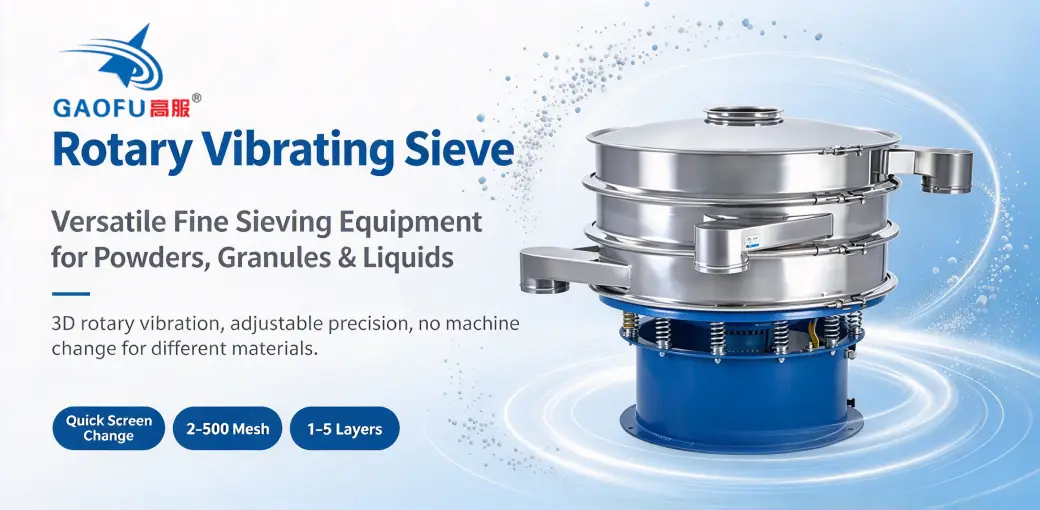
Dust control of Gaofu rotary vibratory sieves in algae powder scenarios is a combination of structural conditions, not a stack of single measures. The entire machine uses a fully enclosed cylindrical structure, with dedicated seals at the mating positions of the screen frame, screen cover and clamp ring, creating a physical separation between the screening chamber and the workshop environment during operation. Inlet and outlet ports and screen frame connections use multiple O-ring food-grade silicone seals, enabling the equipment to maintain an airtight state under both negative and positive pressure. The quick-release clamp ring applies uniform axial preload to the screen frame when locked, keeping the seals in contact during continuous vibration rather than relying on localized compression from single-point bolts.
The engineering significance of this set of structures lies in the fact that dust control is broken down onto every possible escape path—cylinder body, mating surfaces, inlet and outlet ports, screen frame connections—and sealed separately, rather than pinning hopes on a single “main seal” to solve all problems. The direct effect of the fully enclosed design is to prevent ultrafine dust from spilling outward from the screening chamber, narrowing the channel through which material is lost in dust form.
With passive sealing alone, slight positive pressure may still form inside the screening chamber during vibration and material tumbling, subjecting the seals to outward pressure. Gaofu rotary vibratory sieves are provided with dust extraction interfaces that can be connected to workshop dust removal piping, maintaining the interior of the screen body at a slight negative pressure—publicly available information gives a reference range of tens to hundreds of pascals. Under slight negative pressure, even if microscopic gaps exist at sealing surfaces, the airflow direction is from the workshop into the screening chamber, and the tendency of dust to escape outward is counteracted.
The practical value of this configuration also lies in incorporating the screening stage into the workshop’s overall dust management system, rather than letting the screen become an isolated “sealed box.” For algae powder production lines already equipped with centralized dust removal, the screen is no longer an escape source that must be handled separately, but a controlled node in the dust removal network.
If an enclosed structure comes at the expense of screen-cleaning convenience, it is difficult to maintain over the long term in actual production. The tendency of algae powder to absorb moisture and agglomerate means aperture embedding is a continuously occurring risk. If every screen cleaning requires opening the sealed structure, the engineering value of the enclosed design will be offset by frequent downtime. The bouncing-ball screen-cleaning device beneath the screen mesh completes cleaning actions inside the enclosed chamber without opening the screen body; the quick-release clamp ring structure allows screen replacement to be completed within 3–5 minutes, and the airtight state after reclosing is easy to restore. Enclosure is not a one-time assembly state, but a working condition repeatedly maintained during screen cleaning, screen replacement and continuous operation.
The material selection of screen frames and seals in direct contact with algae powder is itself part of dust control and cleanliness management. Material-contact parts can be made of 304 or 316L stainless steel, and seals use food-grade silicone, preventing aged or detached non-metallic parts from becoming a new source of particulate matter. Food-contact stainless steel must meet the requirements of GB 4806.9—2023 for alloy element migration limits, with limits for elements such as lead, arsenic and cadmium tightened compared with the previous version. Material compliance does not directly “suppress dust,” but it determines that no new contamination variables are introduced inside the enclosed structure—in a chamber where dust has already been contained, whether the contact materials themselves are clean also affects the stability of finished product quality.
It should be made clear that the boundary of dust control achievable by a rotary vibratory sieve is physical escape at the screening stage. It does not replace overall ventilation and dust removal design at the workshop level, does not change the moisture-absorbing and agglomerating nature of spirulina powder, and does not remedy dust exposure that has already occurred in processes before or after screening. However, in the algae powder processing chain from drying to packaging, screening is a node where material, in a highly dispersed state, comes into contact with the external environment. By closing off the openings at this node, the particulate load in workshop air has one less continuous incremental source, material yield has one less silent loss pathway, and occupational hygiene management has one more predictable equipment-side condition. For microalgae processing that treats production environment optimization as a continuous goal rather than a one-time compliance task, this repeatable and maintainable enclosed state is itself a starting point worth implementing.