Over 10,000+ customers' choice, Focus on screening industry 40+ years
1. Where Does Material Loss Come From in Recycled Material Screening?
Material loss in recycled plastic pellet screening is usually distributed across the following locations.
Fine powder escaping with airflow. Recycled materials contain a relatively high proportion of fines and cutting debris. During screening, fine powder becomes airborne with air flow. If the equipment is not adequately enclosed, it escapes from the feed inlet, discharge outlet, and inspection ports, causing material loss and affecting the workshop environment.
Qualified pellets entrained in oversize material. When linked pellets, oversize pellets, and impurities are discharged from the upper layer outlet, they may entrain some qualified pellets. The amount entrained is affected by the material layer thickness on the screen surface, screen grading, and discharge outlet arrangement. For recycled materials, linked pellets and irregular pellets are more common, so the entrainment risk increases accordingly.
Screen cleaning residue. Static adsorption and fine powder wedging cause material to adhere to the screen and the inner wall of the screen frame. During cleaning, this material may be treated as waste. The higher the screen cleaning frequency, the greater the cleaning loss.
Changeover cleaning loss. During multi-product and multi-color changeovers, residual pellets inside the equipment need to be cleaned to avoid color mixing and cross-contamination. Material removed during cleaning becomes loss, and cleaning time also affects effective operation.
Over-crushing and secondary fines. Excessive vibration intensity or excessively fast material travel on the screen surface may cause pellets to receive excessive impact, generating new fines and debris and increasing the burden of subsequent fines removal and loss.
Static adsorption and cleaning. For recycled materials with strong static electricity, fine powder adheres to the screen, screen frame, and areas near the discharge outlet. During cleaning, it easily scatters or becomes airborne, creating loss and cleaning burden.
These locations indicate that reducing loss in recycled material screening requires simultaneous attention to fines control, oversize entrainment, screen cleaning residue, changeover cleaning, and operating parameters, rather than adjusting only one equipment parameter.
2. How Layered Classification Reduces Entrainment in Oversize Material
Through multi-layer screen configuration, the rotary vibrating sieve separates interception, classification, and fines collection, reducing the entrainment of qualified pellets in oversize material.
Top-layer interception. The top screen aperture is determined according to recycled pellet specifications and the possible size of linked pellets and impurities. It mainly intercepts linked pellets, oversize pellets, packaging debris, and caked material. The top layer does not undertake finished product particle size control; it protects the middle screen and finished product purity. The top screen bears relatively large material impact and foreign matter load, and its tension and damage condition should be checked regularly.
Middle-layer classification. The middle screen is the key layer controlling finished pellet size. Its aperture is selected according to the target pellet size. Qualified pellets pass through to the lower layer, and oversize pellets are discharged along the screen surface from an independent discharge outlet. The selection of middle-layer mesh needs to balance particle size concentration and screening efficiency. If the mesh is too high, screening resistance for qualified pellets increases, pellet residence time on the screen surface is extended, and entrainment in oversize material may increase. If the mesh is too low, oversize pellets may enter the finished product, and particle size control fails.
Bottom-layer fines collection. The bottom screen or sieve bottom collects fines and pellet cutting debris. Fines can be processed separately, reused, or treated as waste according to process requirements. Each layer’s discharge outlet is set independently, and coarse material, qualified pellets, and fines are discharged separately, reducing repeated transfer and mixed grades.
The role of layered configuration is to form independent channels for different particle size grades inside the equipment, reducing repeated mixing of coarse material and fines on the same screen surface. For recycled materials, this helps reduce the probability that qualified pellets are discharged together with linked pellets and impurities.
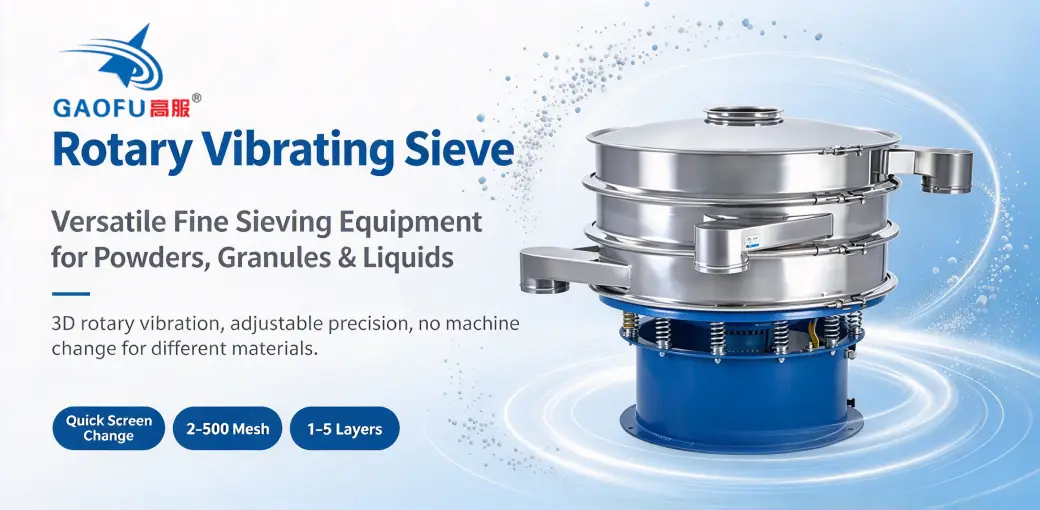
The equipment can be equipped with 1 to 5 screen layers, simultaneously performing 2 to 6 grades of separation or filtration. The reference screening accuracy can reach 600 mesh (0.02 mm), the reference filtration accuracy can reach 5 microns, the reference grading efficiency is 90% to 98%, and the reference normal service life of the equipment is 15 to 20 years. The above parameters are for reference only. Actual selection should be confirmed based on recycled pellet characteristics, capacity targets, and site conditions, and is subject to actual equipment selection.
3. How Screen Cleaning and Electrostatic Grounding Reduce Cleaning Loss
In recycled material screening, fine powder wedging and static adsorption are the main sources of screen cleaning loss. The coordination of the screen cleaning device and electrostatic grounding can reduce stable adhesion of material on the screen and screen frame.
Bouncing-ball screen cleaning. The equipment can be equipped with a bouncing-ball screen cleaning device. Bouncing balls are located below the screen and continuously bounce under vibration, striking the underside of the screen to dislodge wedged or adhering pellets and fines. For recycled material working conditions with medium fine content and static adsorption that is not yet extreme, bouncing-ball screen cleaning has a direct structure and relatively simple maintenance and can serve as a basic configuration. After bouncing balls wear, impact force decreases, and they need to be inspected, replenished, or replaced regularly.
Ultrasonic screen cleaning. When recycled material has relatively high fine content, the screening mesh is relatively fine, or the static problem is relatively prominent, the mechanical impact of bouncing balls may not be sufficient to maintain clear screen openings. An ultrasonic screen cleaning system converts high-frequency electrical signals into high-frequency mechanical vibration through a transducer and transmits the vibration to the screen, causing the screen to produce high-frequency, low-amplitude vibration and interfering with stable retention of fines on the screen surface. For scenarios requiring fine screening such as recycled PET bottle flakes, ultrasonic vibration superimposed on the three-dimensional vibration of the rotary vibrating sieve helps address fine powder agglomeration and screen blinding. The performance of ultrasonic screen cleaning is affected by the matching between transducer and screen, installation condition of the transmission structure, screen tension, and ultrasonic power. Improper configuration may result in insufficient local vibration or screen overheating, and confirmation through material testing is required.
Electrostatic grounding. Recycled plastic pellets easily generate static electricity during conveying and screening. Fine powder adheres to the screen, screen frame, and areas near the discharge outlet. The equipment should implement reliable electrostatic grounding, and metal components and pipe flange connections of the system should maintain continuity. Grounding is related not only to fine powder adhesion but also to dust explosion safety. Grounding connections should be included in regular inspection, as vibration and disassembly may loosen connection points.
The role of the coordination between screen cleaning and grounding is to reduce stable adhesion of fines inside the equipment, thereby reducing cleaning frequency and material scattering during cleaning. The choice of screen cleaning method should be determined based on recycled material fine content, static tendency, screen mesh, and actual blinding conditions, and should not be configured simply according to a single condition.
4. How Enclosed Structure and Feed Control Reduce Escape Loss
Fine powder escaping with airflow is another important source of loss in recycled material screening. An enclosed structure and feed control can reduce escape at the source.
Enclosed structure. The rotary vibrating sieve can use a fully enclosed structure. Sealing rings or sealing strips are compressed between screen frames, and between screen frames and the sieve bottom. A flexible sleeve or enclosed interface is used between the feed inlet and upstream equipment. The discharge outlet and reject outlet are connected in an enclosed manner to downstream pipes or collection containers. Inspection ports and access doors are easy to open and reset, with reliable sealing after resetting. These structures reduce fine powder dispersion into the workshop and also reduce external impurity ingress into the screening chamber. A dust collection interface can be set on the upper cover to connect to the on-site dust collection system.
Feed control. The feed rate should match screening capacity to maintain a uniform material layer on the screen surface. If feeding is too fast, the material layer on the screen surface becomes thicker, fine powder does not have enough time to pass through, pellet residence time on the screen surface is extended, and entrainment in oversize material and fine powder dispersion may increase. If feeding is too slow, the equipment capacity cannot be fully utilized. A buffer device or distribution plate can be installed at the feed inlet to distribute material evenly across the screen width. For scenarios with relatively large upstream discharge fluctuations, the feeding rhythm can be adjusted through a buffer silo or variable-frequency feeding device.
Matching operating parameters. Amplitude and screen surface inclination need to match recycled pellet morphology and fine content. Excessive vibration may intensify pellet friction and secondary fine generation. Insufficient vibration may cause material to remain on the screen surface for too long and accumulate. Parameter adjustment should observe material travel on the screen surface, screening speed, and fine generation, rather than looking only at equipment operating current.
5. How Changeover Cleaning and Material Selection Reduce Residue Loss
During multi-product and multi-color changeovers, loss caused by residual pellets inside the equipment and the risk of cross-contamination need attention.
Quick-release structure. The screen uses a quick-release mesh frame. The screen frame and discharge outlet should be easy to open and inspect, and seals should be easy to replace. The cleaning SOP should specify disassembly, cleaning, reassembly, and inspection steps. When the equipment structure is easy to disassemble in sections, cleaning time is controllable, and residual material is easier to remove.
Material and surface treatment. Parts in contact with recycled pellets can use carbon steel, 304 stainless steel, or 316L stainless steel. For general industrial-grade recycled materials, carbon steel with rust-prevention treatment can be used. For food-contact, medical-grade, or high-value recycled engineering plastics, 304 or 316L stainless steel is recommended, with polished inner walls to reduce material residue and contamination risk. Material standards should be specified during the selection stage.
Post-cleaning inspection. After cleaning, check whether the screen is intact, whether seals are properly reset, and whether residual material remains on the inner surface. For multi-color changeovers, residual pellets may cause color mixing, so the inspection step cannot be omitted.
6. Conclusion
Material loss in recycled material screening is distributed across multiple locations: fine powder escape, oversize entrainment, screen cleaning residue, changeover cleaning, and secondary fines. The approach of the plastic pellet rotary vibrating sieve to reducing loss is to reduce oversize entrainment through layered classification, reduce cleaning loss through screen cleaning and electrostatic grounding, reduce escape loss through enclosed structure and feed control, and reduce changeover residue through quick-release structure and cleaning management. The effectiveness of loss control depends on how well the equipment configuration matches recycled material characteristics, as well as whether operating parameters and daily maintenance are in place. For recycled plastics processing enterprises facing problems such as fine powder loss, linked pellet entrainment, static-related blinding, and multi-product changeovers, targeted configuration based on material characteristics and production line conditions is more practically meaningful than simply comparing equipment parameters.

Chemical Industry Client Testimonials
Wanhua Chemical, Yuntianhua Group, Kingfa Science & Technology, Formosa Plastics Group, China Pingmei Shenma Group, Kemai Co., Ltd., Luxi Chemical, Liby Group, Oriental Yuhong, Davco, Chenming Group, Guanhao High-Tech
Kaifei Chemical, Sunsine Chemical, Weilin Co., Ltd., Xuyang Group, 3Trees, Maydos, Loyal Group (Kingpor Group), AkzoNobel, CSSC Hanguang, Haike Group, Nice Group, Taishan Fiberglass, Wanhua, Red Eagle, China XLX Fertiliser (Xinlianxin), CCtech Catalysis, China National Bluestar, Sakura Paint, ITANOS, Yanggu Huatai, Sennics, Longxing Chemical Group, Tunhe Co., Ltd., GHW International, Jianye Chemical, Finehope
Fortune 500 Client Testimonials
CNPC、CSCEC、Sinochem Holdings、CRCC、China Minmetals Corporation、CNOOC、CR、Sinopharm、CHN Energy、COFCO Corporation、Huawei Technologies、PowerChina、CITIC Group、Wuchan Zhongda Group、NORINCO、Chalco、CNBM、 Shaanxi Coal and Chemical Industry Group、Ansteel Group、CETC、CSSC、CASC、CEC、Jinchuan Group、CASIC、Conch Cement、CNNC、SPH、Shanxi Coking Coal Group、 Zhongtai Chemical、GPHL、DEC、Sinosteel Corporation、MCC、China National Salt Industry Chemical、China Baowu Steel Group、China Animal Husbandry Industry Co., Ltd.、CECEP
About Gaofu
Originated in the 1980s, Xinxiang Gaofu Machinery Co., Ltd. has developed into a leading enterprise after more than 40 years of steady development. The company holds authoritative national qualifications including National-level Specialized, Refined, Unique and Innovative Little Giant Enterprise, National Green Factory, National High-tech Enterprise, and National Intellectual Property Advantage Enterprise, and acts as the President Unit of the Vibration Industry Association.
It has established three provincial and municipal R&D platforms: Henan Provincial Industrial Design Center, Henan Provincial Engineering Technology Research Center for Intelligent On-line Screening System, and Xinxiang Municipal Fine Screening Engineering Technology Research Center. Up to now, Gaofu has obtained more than 500 patents covering invention, utility model and design. It has been awarded the Science and Technology Achievement Prize by the Ministry of Industry and Information Technology of China and has participated in drafting and formulating 4 national standards.
Gaofu’s product portfolio covers multiple series and hundreds of specifications, mainly including vibrating screening equipment, conveying equipment and intelligent automatic material handling systems. We provide one-stop overall solutions such as automatic feeding systems, powder supply systems, pneumatic conveying systems, metering and weighing systems, batching systems, micro-ingredient batching systems, water supply systems, oil supply systems, fluid conveying systems, central kitchen powder supply systems, powder conveying systems and feeding systems.
In terms of food production lines, our mature supporting systems cover two major categories: baking production lines and pasta production lines. The baking series includes production lines for bread, cake, crisp cake, croissant, toast, pizza, biscuit and hamburger. The pasta series includes intelligent production lines for steamed buns, stuffed buns, twisted rolls, sesame paste cakes, steamed dumplings, boiled dumplings, fried dough sticks and pies.
Gaofu products sell well across Greater China and are exported to more than 100 countries and regions worldwide, including Russia, Canada, the United States, New Zealand, Japan, Brazil and South Africa. Widely applied in food, pharmaceutical, chemical, metallurgical, building materials, mining, thermal power, environmental protection and other industries, our products have won the trust and recognition of over 10,000 global customers.
Adhering to the corporate mission of improving material quality and efficiency to meet customer needs, Gaofu has long-term stable cooperative relationships with global clients to achieve harmonious and win-win development. At present, Gaofu has become an official qualified supplier of many Fortune Global 500 enterprises, including CNPC, Sinopec, Sinochem Group, China Resources Group, Sinopharm Group, COFCO, China National Building Material, China Aerospace and Jinchuan Group.