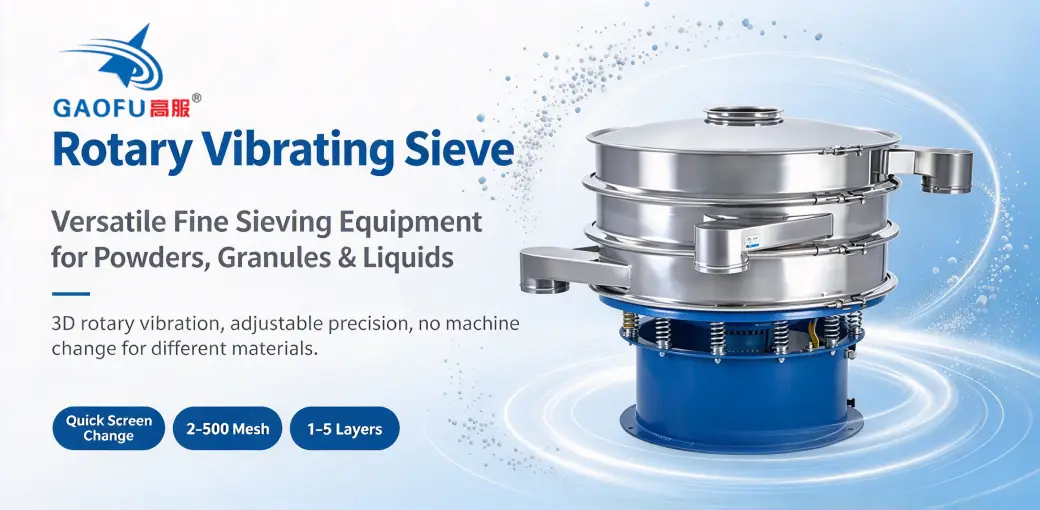
Over 10,000+ customers' choice, Focus on screening industry 40+ years
1. Why Is Static Electricity in Recycled Plastic Pellets Harder to Handle Than in Virgin Material?
The static problem in recycled plastics is rooted in the inconsistency of the material itself.
Mixed sources and unpredictable static behavior. Recycled material may come from waste plastics of different grades and colors, with mixed polymer types and considerable differences in surface characteristics. Virgin material usually has relatively stable resistivity and surface condition, and static generation and dissipation follow certain patterns. Recycled material, due to its mixed nature, may show inconsistent charging tendencies among pellets in the same batch. This means the location and speed of static-related blinding may change from batch to batch.
Superposition of fines and irregular pellets. Recycled plastics generate fines and irregularly shaped pellets during crushing and pelletizing. Fines have a large specific surface area and more easily adsorb charge. Irregular pellets have an unstable movement state on the screen surface, and their contact area and friction intensity with the screen are uneven. When fines and electrostatic adsorption are superimposed, screen openings are often covered faster than with regularly shaped virgin pellets.
Interference of contaminants with charge. Recycled material may retain dust, oil, or cleaning agents from previous processes. These contaminants change the chemical state of pellet surfaces and may enhance or alter static accumulation tendency. In some cases, the contaminants themselves also become charged through friction, further aggravating screen adhesion.
Effect of ambient humidity. Plastics are insulating materials, and static electricity does not easily dissipate through the material itself. When workshop air humidity is relatively low, charge is less able to leak away through surface moisture films. Humidity control levels vary among recycled plastics processing workshops, and the same equipment may perform differently in different seasons.
These factors indicate that static-related blinding of recycled plastic pellets cannot be solved by a single measure. The configuration of the rotary vibrating sieve needs to consider grounding, screen cleaning, and operating conditions at the same time.
2. How Does the Rotary Vibrating Sieve Dissipate Static Charge? Grounding Is the Foundation, but Not the Whole Story
Static charge is continuously generated during screening. If it cannot be conducted away from the screen and body in a timely manner, it will accumulate locally. The anti-static design of the rotary vibrating sieve must first make “dissipation” reliable.
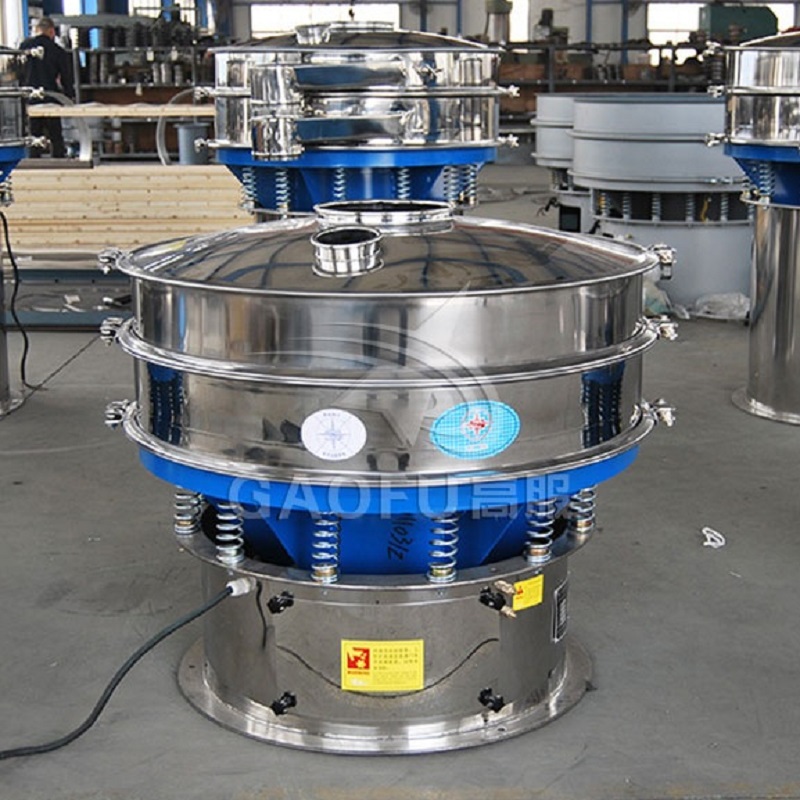
Reliable grounding of the screen and body. In the conventional structure of a rotary vibrating sieve, the screen and screen frame are usually isolated by rubber or silicone seals. This insulating layer may hinder the conduction of static charge from the screen to the body. For materials prone to static such as plastic pellets, it is necessary to ensure a continuous conductive path between the screen and screen frame, and between the screen frame and the base. Specific measures include providing conductive connections at the contact points between the screen and the tension ring, so that charge on the screen can be transferred to the external frame and then conducted to earth through a grounding wire. For models supported by non-metallic damping springs, the grounding connection needs to be led out separately from the moving body (screen body) and cannot rely solely on base grounding. In high-capacity recycled material screening, the continuity of the grounding path should be included in daily inspection, because vibration and disassembly may loosen connection points; once grounding fails, static will accumulate again.
Optional configuration of anti-static screens. For recycled materials with more prominent static problems, anti-static screens can be evaluated. Such screens reduce the tendency to generate static electricity through friction from the material level, or reduce charge retention on the screen wires through surface treatment. Anti-static screens cannot replace grounding, but they can serve as an auxiliary means to reduce the adsorption strength of the screen itself for fines.
It should be noted that grounding addresses “the dissipation of charge that has already been generated” and cannot prevent charge generation. Under working conditions with relatively high fine content in recycled material and relatively strong friction, grounding alone may not be sufficient to maintain clear screen openings. In this case, a screen cleaning device needs to intervene during operation to interfere with stable adhesion of fines on the screen surface.
3. How Does the Screen Cleaning Device Work with Grounding? Division of Labor Between Bouncing Balls and Ultrasound
The role of the screen cleaning device is to detach fines from the screen through mechanical or high-frequency vibration when electrostatic adsorption has occurred or is about to occur. For recycled plastic pellets, common configurations are bouncing-ball screen cleaning and ultrasonic screen cleaning. They can be used separately or combined according to working conditions.
Bouncing-ball screen cleaning: mechanical impact breaks adsorption. Bouncing balls are located below the screen. When the rotary vibrating sieve operates, the bouncing balls continuously strike the underside of the screen under vibration. This mechanical impact can break the electrostatic adsorption force between fines and screen wires and shake loose pellets wedged in screen openings. For working conditions where recycled plastic pellets have medium fine content and static adsorption is not yet extreme, bouncing-ball screen cleaning has a direct structure and relatively simple maintenance and can serve as a basic configuration. Bouncing balls are usually made of food-grade silicone or rubber. After wear, impact force decreases, and they need to be inspected, replenished, or replaced regularly.
Ultrasonic screen cleaning: high-frequency micro-vibration suppresses adhesion. When recycled material has relatively high fine content, the screening mesh is relatively fine (for example, above 80 mesh), or the static problem is particularly prominent, the mechanical impact of bouncing balls may not be sufficient to maintain clear screen openings. An ultrasonic screen cleaning system converts high-frequency electrical signals into high-frequency mechanical vibration through a transducer and transmits the vibration to the screen, causing the screen to produce high-frequency, low-amplitude vibration. This vibration acts on screen wires and the area near the screen surface, interfering with stable retention of fines on the screen surface and providing some suppression of electrostatic adsorption and fine agglomeration. For scenarios requiring fine screening such as recycled PET bottle flakes, ultrasonic vibration superimposed on the three-dimensional vibration of the rotary vibrating sieve helps address fine powder agglomeration and screen blinding. The performance of ultrasonic screen cleaning is affected by the matching between transducer and screen, installation condition of the transmission structure, screen tension, and ultrasonic power. Improper configuration may result in insufficient local vibration or screen overheating, and confirmation through material testing is required.
4. What Other Configurations Need Attention for Recycled Material Screening?
In addition to static electricity and screen cleaning, there are several configuration points directly related to material characteristics in recycled plastic pellet screening.
Matching screen mesh with recycled pellet size. The screening goal for recycled plastic pellets is usually to remove fines, intercept linked pellets and oversize pellets, rather than pursuing high-mesh fine grading. Screen mesh should be determined according to the particle size specification of recycled pellets and downstream use. If the mesh is too high, screening resistance increases, fines more easily remain on the screen surface, and the risk of static-related blinding rises. If the mesh is too low, fines and debris may enter the finished product. For recycled material, the top screen intercepting linked pellets and impurities and the middle screen controlling finished pellet size need to be configured separately, with the bottom layer collecting fines and each layer’s discharge outlet set independently to reduce repeated circulation of fines on the screen surface.
Material selection corresponding to recycled material categories. Parts in contact with recycled pellets can use carbon steel, 304 stainless steel, or 316L stainless steel. For impurity removal from general industrial-grade recycled materials (such as PE and PP recyclates), carbon steel with rust-prevention treatment can meet usage requirements, with relatively controllable initial investment. For food-contact recycled materials, medical-grade recycled materials, or high-value recycled engineering plastics, 304 or 316L stainless steel is recommended, with polished inner walls to reduce material residue and contamination risk. Material selection needs to be clarified at the selection stage according to the final use of the recycled material, and should not be treated uniformly as “plastic pellets.”
Control of fines and charged dust by enclosed structure. Fines and charged dust generated during recycled material screening easily disperse into the workshop, causing both material loss and environmental impact. The rotary vibrating sieve can use an enclosed structure, with sealed connections at the feed inlet, discharge outlets, and inspection ports to reduce dust escape. A dust collection interface can be set on the upper cover to connect to the on-site dust collection system. An enclosed structure provides auxiliary control of charged dust but cannot replace grounding and screen cleaning.
Relationship between explosion protection and static electricity. Recycled plastic fines may be combustible under specific conditions. Whether explosion-proof configuration is required should be determined according to material characteristics and the classification of dust explosion hazardous areas in the workshop. Electrostatic grounding is not only a screening efficiency measure but also one of the basic conditions for explosion-proof safety. Electrical components such as motors and electrical control boxes can use hardware with corresponding explosion-proof certification. Metal components and pipe flange connections of the system should maintain reliable electrostatic grounding.
5. Operation, Maintenance, and Selection Verification
The anti-static and screen cleaning performance of a recycled plastic pellet rotary vibrating sieve needs to be maintained through daily maintenance.
Grounding continuity inspection. Regularly check whether the conductive connections between the screen and screen frame, and between the screen body and base, are reliable, and whether the grounding wire is loose or broken. Vibration and disassembly may change connection points, and static will accumulate again after grounding fails. For recycled materials with prominent static problems, grounding inspection should be included in each shift or daily inspection.
Screen cleaning device condition inspection. After bouncing balls wear, they should be replenished or replaced in time. The transducer and transmission structure of the ultrasonic screen cleaning system should be checked as required. If the screen cleaning device fails, even with normal grounding, fines may still stably adhere to the screen, and blinding will gradually develop.
Screen tension and damage inspection. Screen tension affects both screening and screen cleaning performance. If too loose, secondary vibration and material accumulation easily occur; if too tight, screen life may be affected. After screen changes, check tension status. Screen damage may allow oversize pellets into the finished product or cause cross-flow between different particle size grades, and should be handled or replaced promptly.
Material condition and operation observation. During operation, observe screening speed, oversize material amount, and screen surface adhesion. If screening speed decreases, the fine proportion in oversize material increases, or an obvious powder film appears on the screen surface, check grounding, the screen cleaning device, and feeding condition, rather than simply increasing vibration intensity. For recycled material with large batch-to-batch differences, different batches may require different screen cleaning parameters or feeding rhythms.
Selection communication and material testing. The static behavior of recycled plastics is greatly affected by source, degree of mixing, fine content, and workshop humidity, and equipment parameter tables cannot fully cover it. Before selection, it is recommended to conduct on-machine testing with actual recycled material to observe charge dissipation on the screen under the grounding configuration, the suppression effect of bouncing-ball or ultrasonic screen cleaning on fine adhesion, and the screening state under different screen meshes. Equipment parameters are reference values. Actual selection should be confirmed based on material testing results and site conditions.
6. Conclusion
Static-related blinding of recycled plastic pellets stems from mixed sources, high proportions of fines and irregular pellets, and contaminants changing surface characteristics, which make static generation and accumulation harder to predict than with virgin material. The approach of the plastic pellet rotary vibrating sieve is to separate “charge dissipation” and “interference with adhesion”: reliable grounding of the screen and body is responsible for conducting generated charge to earth, while bouncing-ball or ultrasonic screen cleaning is responsible for breaking stable adsorption between fines and the screen during operation. Only when the two work together can a relatively clear screen opening state be maintained in actual screening. Grounding cannot replace screen cleaning, and screen cleaning cannot rely on grounding alone. For the fine content, screening mesh, and workshop conditions of recycled material, selecting an appropriate screen cleaning combination is more practically meaningful than simply comparing equipment parameters.
Chemical Industry Client Testimonials
Wanhua Chemical, Yuntianhua Group, Kingfa Science & Technology, Formosa Plastics Group, China Pingmei Shenma Group, Kemai Co., Ltd., Luxi Chemical, Liby Group, Oriental Yuhong, Davco, Chenming Group, Guanhao High-Tech
Kaifei Chemical, Sunsine Chemical, Weilin Co., Ltd., Xuyang Group, 3Trees, Maydos, Loyal Group (Kingpor Group), AkzoNobel, CSSC Hanguang, Haike Group, Nice Group, Taishan Fiberglass, Wanhua, Red Eagle, China XLX Fertiliser (Xinlianxin), CCtech Catalysis, China National Bluestar, Sakura Paint, ITANOS, Yanggu Huatai, Sennics, Longxing Chemical Group, Tunhe Co., Ltd., GHW International, Jianye Chemical, Finehope
Fortune 500 Client Testimonials
CNPC、CSCEC、Sinochem Holdings、CRCC、China Minmetals Corporation、CNOOC、CR、Sinopharm、CHN Energy、COFCO Corporation、Huawei Technologies、PowerChina、CITIC Group、Wuchan Zhongda Group、NORINCO、Chalco、CNBM、 Shaanxi Coal and Chemical Industry Group、Ansteel Group、CETC、CSSC、CASC、CEC、Jinchuan Group、CASIC、Conch Cement、CNNC、SPH、Shanxi Coking Coal Group、 Zhongtai Chemical、GPHL、DEC、Sinosteel Corporation、MCC、China National Salt Industry Chemical、China Baowu Steel Group、China Animal Husbandry Industry Co., Ltd.、CECEP
About Gaofu
Originated in the 1980s, Xinxiang Gaofu Machinery Co., Ltd. has developed into a leading enterprise after more than 40 years of steady development. The company holds authoritative national qualifications including National-level Specialized, Refined, Unique and Innovative Little Giant Enterprise, National Green Factory, National High-tech Enterprise, and National Intellectual Property Advantage Enterprise, and acts as the President Unit of the Vibration Industry Association.
It has established three provincial and municipal R&D platforms: Henan Provincial Industrial Design Center, Henan Provincial Engineering Technology Research Center for Intelligent On-line Screening System, and Xinxiang Municipal Fine Screening Engineering Technology Research Center. Up to now, Gaofu has obtained more than 500 patents covering invention, utility model and design. It has been awarded the Science and Technology Achievement Prize by the Ministry of Industry and Information Technology of China and has participated in drafting and formulating 4 national standards.
Gaofu’s product portfolio covers multiple series and hundreds of specifications, mainly including vibrating screening equipment, conveying equipment and intelligent automatic material handling systems. We provide one-stop overall solutions such as automatic feeding systems, powder supply systems, pneumatic conveying systems, metering and weighing systems, batching systems, micro-ingredient batching systems, water supply systems, oil supply systems, fluid conveying systems, central kitchen powder supply systems, powder conveying systems and feeding systems.
In terms of food production lines, our mature supporting systems cover two major categories: baking production lines and pasta production lines. The baking series includes production lines for bread, cake, crisp cake, croissant, toast, pizza, biscuit and hamburger. The pasta series includes intelligent production lines for steamed buns, stuffed buns, twisted rolls, sesame paste cakes, steamed dumplings, boiled dumplings, fried dough sticks and pies.
Gaofu products sell well across Greater China and are exported to more than 100 countries and regions worldwide, including Russia, Canada, the United States, New Zealand, Japan, Brazil and South Africa. Widely applied in food, pharmaceutical, chemical, metallurgical, building materials, mining, thermal power, environmental protection and other industries, our products have won the trust and recognition of over 10,000 global customers.
Adhering to the corporate mission of improving material quality and efficiency to meet customer needs, Gaofu has long-term stable cooperative relationships with global clients to achieve harmonious and win-win development. At present, Gaofu has become an official qualified supplier of many Fortune Global 500 enterprises, including CNPC, Sinopec, Sinochem Group, China Resources Group, Sinopharm Group, COFCO, China National Building Material, China Aerospace and Jinchuan Group.