Over 10,000+ customers' choice, Focus on screening industry 40+ years
In the production of dairy products such as infant formula, adult nutritional powder and whey protein powder, bag-opening and feeding is the first process step. Traditional manual bag-opening and feeding typically involves workers carrying 25 kg bags of milk powder to the feed port, cutting open the packaging bag with a knife, and pouring the milk powder into the hopper or conveying equipment of the next process.
This seemingly simple operation flow actually contains multiple stages that can be optimised in real production.
Stage 1: Dust control. Milk powder particles are extremely fine, typically between 100 and 200 mesh, with some ultra-fine products reaching 500 mesh or finer. At the moment of pouring, a large amount of fine powder rapidly disperses into the air, forming a visible "dust cloud." Milk powder dust is classified as "other dust," and long-term exposure places a continuous burden on the respiratory systems of operators. At the same time, milk powder is listed in the "Catalogue of Key Combustible Dusts in the Industrial and Trade Sectors," and its dust poses an explosion risk when it reaches certain concentrations in the air.
Stage 2: Material loss. Under traditional open feeding methods, raw material loss from dust dispersion is relatively significant. Milk powder has high economic value, and the portion that drifts away from every tonne of raw material represents a direct economic loss. For a processing enterprise with an annual output of thousands of tonnes of milk powder, the cumulative dust loss is a figure that cannot be ignored.
Stage 3: Foreign matter contamination risk. During manual bag opening, dust adhering to the outer surface of the packaging bag, packaging threads, sealing debris and other foreign matter may mix into the milk powder. Wear particles from bag-opening tools and operator hair may also become contamination sources. Physical hazards in milk powder production – string ends, paper debris, metal fragments – once mixed into the finished product, will directly trigger food safety complaints.
Stage 4: Hygiene control. Milk powder is rich in protein and fat, making it an ideal medium for microbial growth. Under open feeding methods, external dust and microorganisms may fall into the material; if the equipment has hygiene dead corners, residual milk powder can rapidly breed bacteria and mould at room temperature, contaminating subsequent batches.
Stage 5: Manual dependence. Under traditional manual feeding methods, feeding speed is limited by the physical strength and skill of workers, making it difficult to match the continuous production rhythm of modern production lines. At the same time, quality fluctuations caused by manual operations – inaccurate feeding quantities, incorrect sequence, foreign matter contamination – remain risks that are difficult to eliminate.
The existence of these problems makes the milk powder bag-opening and feeding stage a key node worthy of systematic optimisation in dairy production.
To address the above pain points, the optimisation direction for the milk powder bag-opening and feeding process can be summarised in three aspects: source enclosure, process automation, and data-driven management.
Source enclosure. Move bag-opening and feeding operations from an open environment into a sealed chamber, physically isolating the dust source from the workshop environment. Combined with a negative pressure dust collection system, the dust generated at the moment of bag opening is directionally collected, preventing dust dispersion.
Process automation. Replace manual handling, pouring and cleaning with automated equipment, reducing manual intervention and lowering the quality fluctuations and contamination risks caused by human operations.
Data-driven management. Through PLC intelligent control systems, achieve preset and monitored feeding parameters, making the feeding process controllable and traceable, and providing data support for production management.
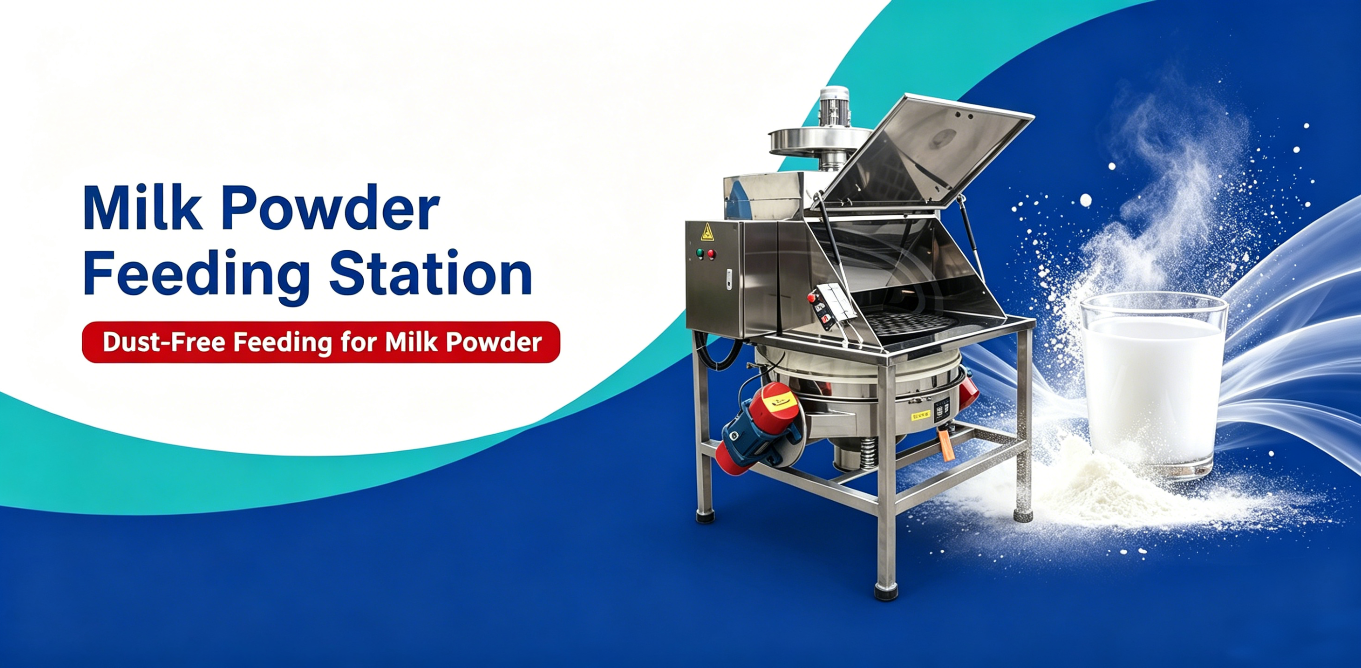
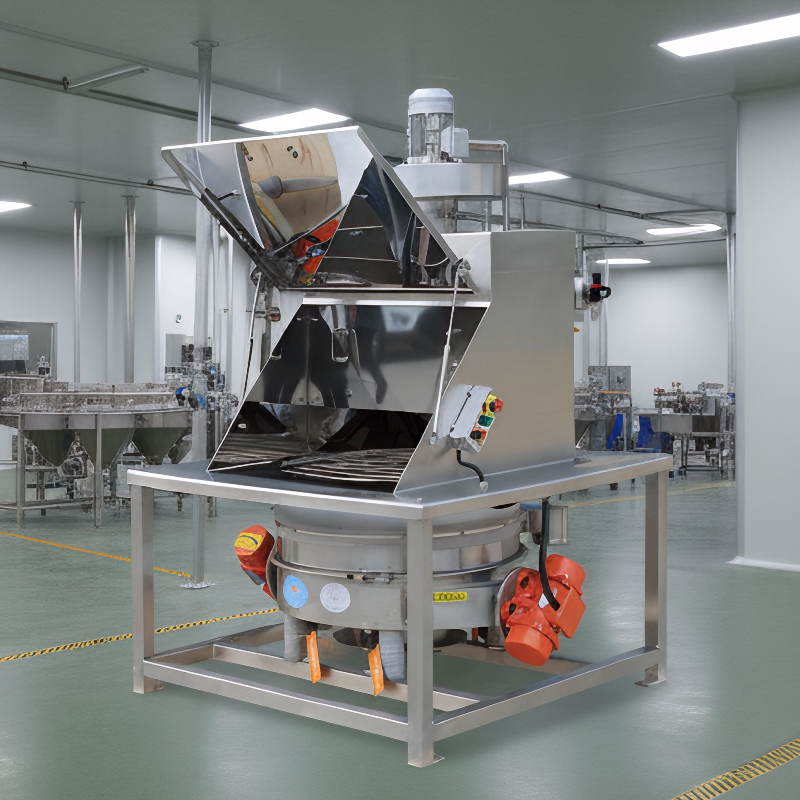
The Gaofu Machinery milk powder feeding station is a specialised machine designed around these three directions.
Advantage 1: Fully Enclosed Negative Pressure Structure – Solving Dust Dispersion at the Source
The equipment uses a fully enclosed bag-opening and feeding structure, with the feed platform located inside a sealed chamber. Operators complete bag opening and pouring operations inside the chamber, physically isolating the external environment from the dust source.
The dust collection fan operates continuously, creating a stable negative pressure environment at the feed port – the milk powder dust generated at the moment of bag opening is drawn into the filtration system before it can disperse. After passing through high-density filter cartridges, clean air is discharged while the dust is collected.
Dust collection efficiency can reach 99.9%, and workshop dust concentration can be controlled to ≤0.1 mg/m³. This value is far below the national limit for airborne dust concentration inside workshops, providing reliable technical support for dairy enterprises to meet environmental and GMP compliance requirements.
Advantage 2: Pulse Reverse-Cleaning Self-Cleaning – Material Recovery and Loss Control
The equipment is equipped with a pulse reverse-cleaning dust removal device. When the dust adhering to the filter cartridges reaches a certain thickness, the system automatically triggers a compressed air pulse, shaking off the dust and recovering it into the hopper.
This automatic reverse-cleaning mechanism delivers three benefits:
The filter cartridges maintain high permeability. There is no need for frequent manual filter cleaning, and the dust collection system always operates at high efficiency.
100% material recovery. All collected dust is recovered into the hopper, and material loss can be controlled to ≤0.5%. For high-value raw materials such as milk powder, reduced material loss directly translates into improved economic benefits.
Secondary dust dispersion is avoided. Automatic reverse cleaning replaces manual filter cleaning, eliminating the secondary dust pollution generated during manual ash removal.
Advantage 3: Food-Grade Stainless Steel – Eliminating Metal Contamination
All parts of the equipment that contact material are made of food-grade 304 stainless steel, with 316L stainless steel available upon request. 304 stainless steel offers good corrosion resistance and oxidation resistance, and does not release harmful substances into the material.
The lactose and lactic acid components in milk powder have a certain corrosive effect on metals. Ordinary carbon steel tends to rust after prolonged contact, and rust particles mixed into the product would directly cause a food safety incident. 304 stainless steel eliminates the risk of metal contamination at the material source.
Advantage 4: Dead-Corner-Free Design – Preventing Microbial Growth
All internal corners of the equipment feature rounded transitions, and welds are ground smooth – no hygiene dead corners. The whole machine has a simple structure with nowhere for material residue to hide.
The equipment supports rapid disassembly for cleaning, and the dead-corner-free structure allows cleaning operations to cover every area of the internal walls. During batch changeovers, residual material is greatly reduced, cleaning efficiency is significantly improved, and cross-contamination is effectively prevented.
Advantage 5: Built-In Vibrating Screen – Foreign Matter Interception Completed Simultaneously with Feeding
Milk powder raw materials may contain foreign matter such as packaging threads, sealing debris and moisture-induced lumps. The Gaofu feeding station is equipped with a vibrating screen (safety screen) below the feed hopper. After material passes through the feed port, it first undergoes online screening – lumps and debris larger than the mesh openings are effectively intercepted, while acceptable material continues to the next process.
This design integrates the two steps of "feeding" and "impurity removal" into a single machine. Milk powder completes foreign matter interception before entering the production line, reducing the risk of finished product foreign matter complaints at the source.
Advantage 6: Intelligent Control and Automated Integration – Reducing Manual Intervention
The equipment supports PLC intelligent control, allowing preset feeding parameters and interlocked operation with upstream and downstream equipment. Feeding efficiency can reach 500 to 2,000 bags per hour, which is 3 to 5 times faster than traditional manual feeding. One machine can replace the feeding workload of 3 to 5 people, reducing labour costs by over 60%.
The equipment supports connection to positive or negative pressure conveying systems. From feeding to conveying, the material runs entirely inside enclosed pipelines without manual transfer, achieving fully automated integration throughout milk powder production.
Optional Feature: Explosion-Proof Electrical Control System
The explosion risk of milk powder dust is an unavoidable safety issue for dairy manufacturers. The equipment can be equipped with an explosion-proof electrical control system to meet the requirements for use in dust explosive environments. The design of the pulse reverse-cleaning dust collection system ensures that dust on the filter cartridge surface is removed promptly, preventing dust accumulation inside the equipment. The fully enclosed structure physically limits the spread of dust, reducing the probability of dust explosions.
From the perspective of actual production conditions in milk powder bag-opening and feeding, the Gaofu feeding station delivers value in four dimensions:
Safety value – With dust collection efficiency of 99.9% and dust concentration of ≤0.1 mg/m³, the risk of dust explosions is reduced at the source. The equipment can be equipped with an explosion-proof electrical control system, helping enterprises present a more convincing compliance record during safety assessments and occupational health inspections.
Quality value – The built-in vibrating screen completes foreign matter interception at the feeding stage; the fully enclosed structure prevents external foreign matter and moisture from entering the feeding system; and food-grade stainless steel eliminates metal contamination. The purity of the milk powder is systematically assured.
Efficiency value – A single machine achieves feeding efficiency of 500 to 2,000 bags per hour, 3 to 5 times faster than traditional manual feeding. The pulse reverse-cleaning self-cleaning mechanism ensures continuous high-efficiency operation of the dust collection system without frequent stoppages for cleaning. The equipment can run 24 hours continuously, effectively supporting large-scale production.
Cost value – Labour input is reduced by over 60%; material loss is controlled to ≤0.5%; food-grade stainless steel extends equipment service life. For high-value raw materials such as milk powder, reduced material loss and lower labour costs directly translate into economic benefits.
Food Industry Client Testimonials
Nestlé, CP Group, Haitian Flavour & Fragrance, Yihai Kerry, Yili, Mengniu,Shuanghui, Wahaha, Master Kong, Want Want, Anjoy Foods, Angel Yeast,Yangyuan Foods, Uni-President Enterprises, Qiaqia Food, Luhua Group,Alpenliebe, Golden Monkey, Orion, Xizhilang,Sanquan Foods, Synear Food, Oishi, Wong Lo Kat, Yanjing Beer, Seamild,Jinpai, Chubang, Hengshun Vinegar Industry, Longda Group, Beijing Daoxiangcun, Anhe Dairy,Weiwei Group, Xiangpiaopiao, Maiquer, Tianbing, Binqi Food, Ligao Okun
Fortune 500 Client Testimonials
CNPC、CSCEC、Sinochem Holdings、CRCC、China Minmetals Corporation、CNOOC、CR、Sinopharm、CHN Energy、COFCO Corporation、Huawei Technologies、PowerChina、CITIC Group、Wuchan Zhongda Group、NORINCO、Chalco、CNBM、 Shaanxi Coal and Chemical Industry Group、Ansteel Group、CETC、CSSC、CASC、CEC、Jinchuan Group、CASIC、Conch Cement、CNNC、SPH、Shanxi Coking Coal Group、 Zhongtai Chemical、GPHL、DEC、Sinosteel Corporation、MCC、China National Salt Industry Chemical、China Baowu Steel Group、China Animal Husbandry Industry Co., Ltd.、CECEP
About Gaofu
Xinxiang Gaofu Machinery Co., Ltd. was founded back in the 1980s. With over 40 years of development, it has been certified as a National-level Specialized, Refined, Unique & Innovative Little Giant Enterprise, National Green Factory, National High-tech Enterprise, and National Intellectual Property Advantage Enterprise, and serves as the President Unit of China Vibration Screening Industry Association.
The company is accredited with the Henan Provincial Industrial Design Center, Henan Provincial Engineering Technology Research Center for Intelligent On-line Screening System, and Xinxiang Municipal Engineering Technology Research Center for Fine Screening.
Gaofu has obtained more than 500 patents including invention patents, utility model patents and design patents, been awarded the Science and Technology Achievement Prize issued by the Ministry of Industry and Information Technology of China, and participated in drafting and formulating 4 national standards.
Gaofu's product portfolio covers multiple series and hundreds of specifications, including vibrating screening equipment, conveying equipment, coal crushing equipment, filtration equipment and automatic material handling systems.
Core products include vibrating screens, screening machines, vibratory sifters, rotary vibrating screens, ultrasonic vibrating screens, linear vibrating screens, airflow screens, gyratory screens, roller screens, dewatering screens, bar screens, vacuum feeding machines, dust-free feeding stations, bulk bag feeding stations, feeding systems, automatic powder feeding systems, automatic slag-discharging filters, leaf filters, clay filters, toothed roll crushers, coal crushers and other machinery.
These products are widely applied in food, pharmaceutical, chemical, metallurgy, construction materials, mining, thermal power, environmental protection and many other industries, winning recognition and trust from over 10,000 clients worldwide.
Gaofu products enjoy strong sales across Greater China, and are exported to more than 100 countries and regions such as Russia, Canada, the United States, New Zealand, Japan, Brazil and South Africa.
Upholding the corporate mission of Improving material quality & efficiency to fully satisfy customer demands, Gaofu maintains long-term partnerships with clients to achieve win-win development.
At present, Gaofu is an official qualified supplier for numerous Fortune Global 500 enterprises, including CNPC, Sinopec, Sinochem Holdings, China Resources Group, Sinopharm Group, COFCO, China National Building Material, China Aerospace Science and Technology Corporation, Jinchuan Group and more.
Gaofu Machinery ranks No.1 in global sales volume of vibrating screens.
In May 2024, Frost & Sullivan, a world-renowned international consulting firm, issued a Market Position Verification Certificate confirming that Gaofu achieved the world's largest shipment volume of vibrating screens in the global market in 2023.