Over 10,000+ customers' choice, Focus on screening industry 40+ years
Food powder screening differs significantly from general industrial powder processing. The challenges stem from the dual nature of material properties and industry standards:
Dust emission makes workshop environment difficult to meet standards. Food powders such as flour, powdered sugar, and starch are fine and lightweight – during screening, they readily escape through equipment gaps into the workshop air. Dust not only settles on equipment surfaces, increasing cleaning burdens, but can also migrate to other clean areas, compromising the segregation between different cleanliness zones. For food manufacturers seeking GMP certification or food safety audits, inadequate dust control is often a "deduction point" during inspections.
Cross‑contamination risks affect product purity. Food processing workshops typically handle multiple product varieties – flour, powdered sugar, starch, milk powder, seasoning powders, and more – with frequent changeovers between different materials. On traditional open screening equipment, residue from the previous batch may contaminate the next batch, and different powders may also "cross‑flavour" each other through dust dispersion. In baking and seasoning production, any cross‑contamination can cause product flavour deviation and increased batch‑to‑batch quality fluctuations.
Strict hygiene standards – equipment must meet food‑grade requirements. Food powders are consumed directly or indirectly, placing strict demands on equipment materials and hygiene standards. All material‑contact parts must be made of food‑grade stainless steel, with dead‑corner‑free, easy‑to‑clean designs to prevent material residue and bacterial growth.
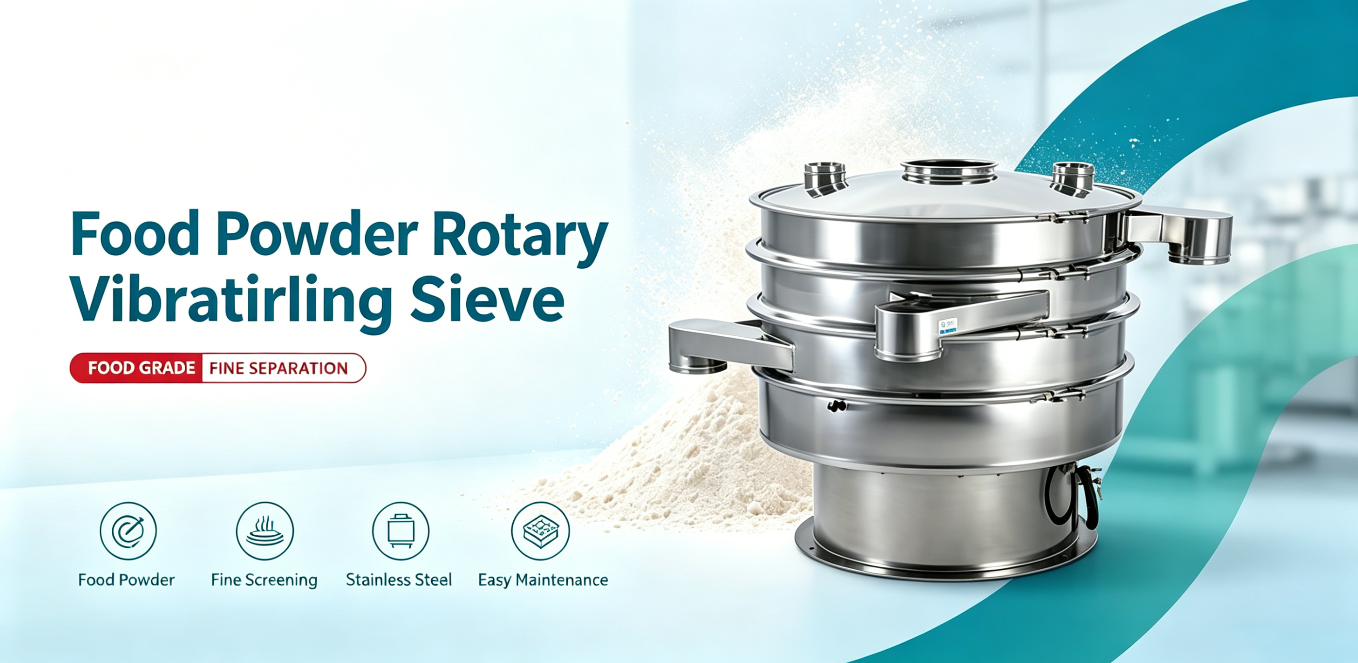
The core design of Gaofu's S49 series food powder rotary vibrating sieve lies in its fully enclosed dust‑proof structure. This is not simply "adding a cover" – it is a complete sealing system from feeding, screening, to discharging.
Fully enclosed screening chamber – dust has nowhere to escape. The equipment features a fully enclosed chamber design – from the feed inlet to each discharge outlet, all connections are sealed. Food powder remains in an enclosed environment from entering the screening chamber to finished product discharge – fine powder cannot escape through equipment gaps. The entire machine uses a clamp‑type sealed dust‑proof design, with dust‑proof covers and sealing strips effectively suppressing dust emission and improving the working environment.
Food‑grade silicone seals – eliminating leak points. All equipment connections use food‑grade silicone seals – ensuring the airtightness of the entire screening system. Feed inlets, discharge outlets, access doors, inspection windows, and all potential leakage points are securely sealed. In actual operation, dust escape rates are controlled at very low levels.
Compatible with negative‑pressure dust collection systems – active dust capture. The fully enclosed structure, combined with a negative‑pressure dust extraction interface, enables active dust collection. Fine powder particles are directionally drawn by negative‑pressure airflow as soon as they are generated – giving dust no opportunity to disperse.
In simple terms: conventional screening equipment allows powder to "escape, leak, spill, and drip" in an open environment, while Gaofu's food powder rotary vibrating sieve keeps food powder "contained" in a closed chamber throughout the screening process – fine powder has no escape route and is effectively collected.
While the enclosed dust‑proof design solves the dust emission problem, another core requirement of food powder screening – hygiene and safety – must also be ensured through materials and construction.
304/316L food‑grade stainless steel construction. All food powder‑contact parts are made of 304 or 316L food‑grade stainless steel – corrosion‑resistant, rust‑proof, and with no material contamination risk. 304 stainless steel complies with food contact metal material standards – ensuring no heavy metal contamination during screening; 316L stainless steel – with its added molybdenum content – offers even better corrosion resistance, making it suitable for production scenarios with higher hygiene requirements.
Mirror‑polished surfaces – no dead corners. Internal and external surfaces are finely mirror‑polished to a sanitary‑grade finish. All welds are finely ground – no dead corners, no recesses – preventing material residue and bacterial growth. The simple structure supports quick disassembly and cleaning – meeting food‑grade production hygiene requirements.
Compliant with GMP and food hygiene standards. The entire machine design complies with GMP (Good Manufacturing Practice) standards – meeting the clean production requirements of the food and pharmaceutical industries. The equipment is widely used in the food, pharmaceutical, chemical, and other industries, serving numerous well‑known food companies.
While the enclosed dust‑proof structure and food‑grade materials address clean production, the core requirements of food powder screening – fine grading and efficient impurity removal – must also be ensured. Gaofu's S49 series food powder rotary vibrating sieve delivers excellent fine grading capability, providing reliable quality assurance for the baking, seasoning, and other industries.
High screening accuracy – precise, controllable fineness. The equipment uses a vertical vibration motor as the excitation source. Eccentric weights installed at the top and bottom of the motor convert rotary motion into a three‑dimensional compound motion (horizontal, vertical, and inclined), which is transmitted to the screen surface. Material moves on the screen surface in a spiral outward trajectory – ensuring both high screening accuracy and considerable throughput. Screening fineness reaches up to 600 mesh (0.02 mm) , with filtration precision down to 5 microns. Screening accuracy reaches 99.56%. For typical food powder screening requirements – such as icing sugar and seasoning powders – this accuracy capability provides ample margin, ensuring consistent finished product fineness.
Multi‑deck grading – multiple specifications from one feed. The equipment supports flexible configurations of 1 to 5 screen decks , enabling a single machine to simultaneously complete 2 to 6 grades of separation or filtration. For baking and seasoning production, the upper deck intercepts lumps and foreign matter, the middle decks achieve fine grading, and the lower deck acts as a safety screen to ensure finished product purity – one feed completes multiple steps. Whether for powdered sugar impurity removal and grading, or multi‑stage classification of compound seasoning powders, precise control is achieved by adjusting screen mesh size and deck count.
Comprehensive coverage for baking and seasoning powders. The S49 series rotary vibrating sieve is widely used for screening and filtration of flour, powdered sugar, starch, milk powder, seasoning powders, salt, food additives, and various other food powders. In the baking industry, the equipment ensures fine, uniform powdered sugar – resulting in baked products with consistent colour and stable texture. In the seasoning industry, the equipment can flexibly adjust screening parameters according to the characteristics of different materials – chilli powder, pepper powder, Sichuan pepper powder, five‑spice powder, and more – achieving precise particle size grading.
The most common challenge in food powder screening is blinding – fine particles blocking the mesh cause screening efficiency to drop, and grading accuracy fluctuates accordingly. Gaofu's S49 series food powder rotary vibrating sieve provides systematic solutions across multiple levels:
Bouncing ball cleaning system – continuous knocking, real‑time blinding prevention. Food‑grade silicone bouncing balls are installed below the screen – during operation, they continuously knock against the screen, dislodging fine powder adhering to the screen and particles wedged in the mesh. This "screening‑while‑cleaning" design keeps the screen fully permeable throughout the screening process – effectively relieving food powder adhesion and blinding.
Ultrasonic cleaning system (optional) – overcoming ultra‑fine powder blinding. For ultra‑fine powdered sugar and seasoning powders above 200 mesh, conventional bouncing ball cleaning has limited effectiveness. Gaofu's rotary vibrating sieve can be optionally equipped with an ultrasonic cleaning system – high‑frequency vibration keeps fine powder in a "suspended" state on the screen surface, effectively inhibiting adhesion and blinding.
Separate mother‑screen / fine‑screen design – screen changes in just 3‑5 minutes. The equipment features a unique mother‑screen and fine‑screen separation design – the mother screen fully supports the fine screen, which does not directly bear the impact of the material. Screen changes take only 3‑5 minutes. For production lines requiring frequent changeovers between different food powder varieties, this feature significantly reduces downtime and improves equipment utilisation.
Anti‑blinding structural design. The screen tensioning structure ensures a flat screen surface, minimising material accumulation dead zones – reducing blinding from the design perspective.