Over 10,000+ customers' choice, Focus on screening industry 40+ years
Particle size classification of coconut flakes is not a one‑size‑fits‑all exercise where "finer is always better." Different end‑use applications demand distinctly different particle sizes:
Coarse coconut flakes (8‑14 mesh) – with a pronounced granular texture, they are widely used for surface decoration on bread and as biscuit fillings, requiring intact, plump particles. Medium coconut flakes (14‑30 mesh) – the primary specification for baking fillings, demanding uniform particle size with no fines contamination. Fine coconut flakes (30‑120 mesh) – used in mooncake pastes, confectionery fillings and beverage ingredients, requiring a smooth, fine texture with no coarse particles.
The same batch of raw material entering the production line must be simultaneously separated into multiple grades – coarse, medium and fine. If classification is unclear – coarse particles mixed into fine powder result in a rough texture in the finished product; fine powder mixed into coarse particles compromises the appearance. Continuous classification is not about "screening once and done" – it means "feeding at one end, discharging at the other, with coarse and fine each going to their proper place." This imposes rigid requirements on both the classification accuracy and continuous operation capability of the screening equipment.
Coconut flake screening typically requires a wide mesh range from 8 to 120 mesh, with a throughput of 300 to 800 kg/hour. These figures mean that a qualified coconut flake screening machine must operate stably across this broad particle size spectrum while maintaining high throughput – placing significant demands on screening accuracy, anti‑blinding performance and continuous operational stability.
The reason coconut flakes are considered a "difficult‑to‑screen" material lies in three overlapping characteristics:
Oil adhesion. Coconut flakes have a fat content of 40%‑60%. During screening, oily fine particles adhere to the screen surface, gradually forming a dense "oil film" that continuously reduces the effective screening area. Industry cases show that when ordinary screening machines handle high‑fat coconut flakes, screening efficiency drops sharply within hours due to blinding.
Moisture absorption and caking. Coconut flakes are highly hygroscopic and readily absorb moisture in the production environment, leading to caking. Caked material on one hand blocks the mesh openings, and on the other hand is rejected as waste, causing raw material loss.
Fibre entanglement. Coconut flakes are a mixture of granular and flocculent material, and fine fibres tend to wrap around the edges of the mesh openings during screening, further aggravating blinding.
These three problems overlap – oil adhesion forms an "oil film," moisture‑induced caking blocks the mesh, and fibre entanglement accelerates blinding – making coconut flake screening a recognised industry challenge.
Coconut flakes are used directly in baking, desserts and other food processing applications, so the material selection of screening equipment is directly related to food safety. All material‑contact parts of the Gaofu coconut flakes linear vibrating screen are made of SUS304 food‑grade stainless steel.
Why must 304 stainless steel be used for coconut flake screening?
Ordinary carbon steel is prone to rusting when exposed to the oils and moisture in coconut flakes. Rust particles mixing into the product would constitute a direct food safety hazard. 304 stainless steel offers excellent corrosion resistance and oxidation resistance. Its surfaces are finely polished to a roughness of Ra ≤ 0.8μm, with no hygiene dead corners and no areas for dirt to accumulate. This eliminates the risk of metal contamination at the material source, ensuring the purity of every batch of coconut flakes.
For production lines requiring even higher cleanliness, 316L stainless steel is also available to meet more stringent food hygiene standards.
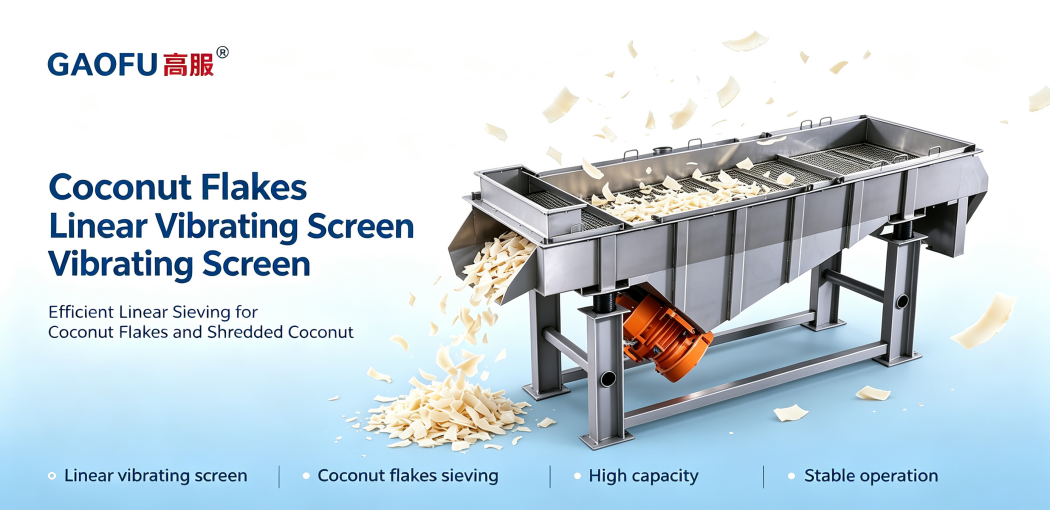
The Gaofu SZF series coconut flakes linear vibrating screen operates on the dual vibration motor synchronous counter‑rotation drive principle. When the two vibration motors rotate synchronously in opposite directions, the excitation forces generated by the eccentric blocks cancel each other out in the direction parallel to the motor axes, while adding together in the perpendicular direction, driving the screen box in a high‑frequency linear reciprocating motion. Under the combined action of the excitation force and the material's own gravity, the material is thrown up and moves forward in a parabolic jumping trajectory.
The value of this motion for continuous coconut flake classification lies in three aspects:
First, thorough material dispersion – oil does not accumulate locally. The coconut flakes continuously jump forward on the screen surface, constantly tumbling and shifting, so oily material does not easily form adhesive layers locally. Fibres are naturally loosened during the jumping motion and do not concentrate and wrap in any single area.
Second, high throughput matching line rhythm. The material moves forward in a jumping motion with high travel speed. The 300‑800 kg/h throughput requirement of coconut flake screening can be comfortably met by a single linear vibrating screen.
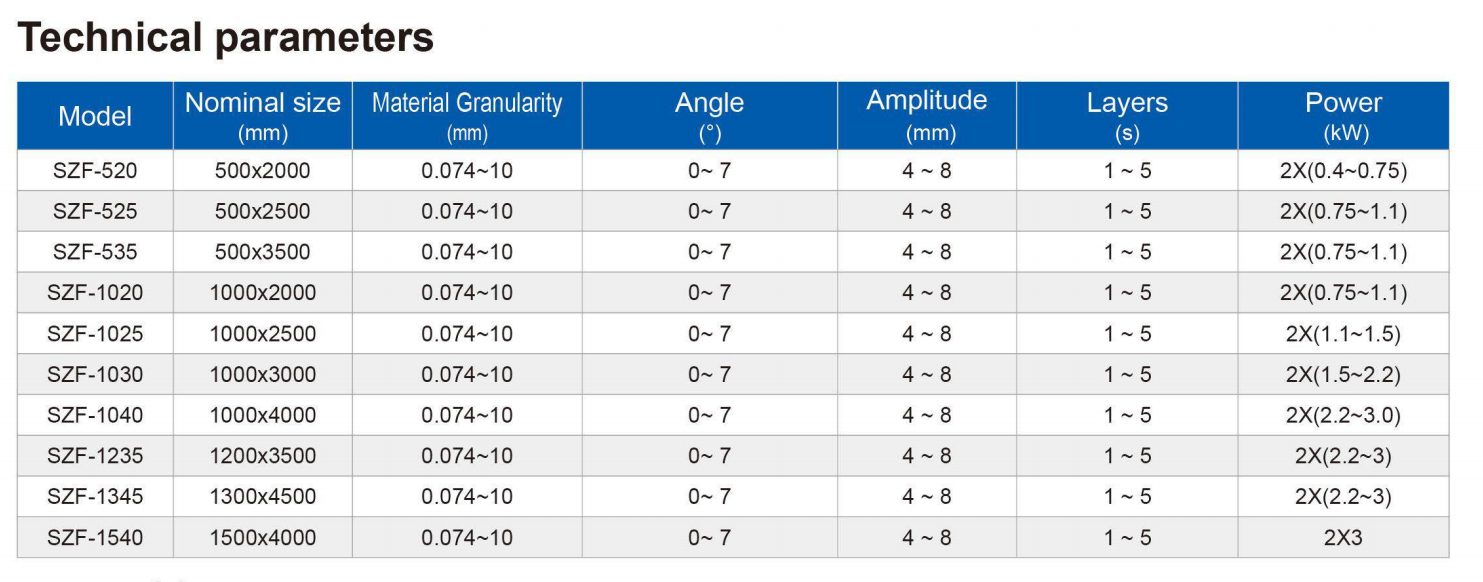
Third, multi‑deck classification – one feed, multiple grades out. The equipment supports 1 to 5 screen decks , allowing a single machine with a single feed to simultaneously complete coarse, medium and fine classification.
The requirement of coconut flake processing lines for continuous classification is: raw material enters from one end, coarse and fine products are discharged simultaneously from different outlets, with no stoppage and no waiting in between.
The Gaofu SZF series linear vibrating screen achieves this with a typical three‑deck screen configuration:
First deck (8‑14 mesh): Intercepts coarse coconut flakes and fibre impurities – coarse flakes are discharged from the top outlet and go directly to the coarse‑grade packaging line
Second deck (14‑30 mesh): Collects medium‑grade finished coconut flakes – discharged from the middle outlet and sent to the baking filling production line
Third deck (30‑120 mesh): Separates fine coconut flakes and ultra‑fine powder – discharged from the bottom outlet and sent to mooncake paste and confectionery filling production lines
Raw material enters from the feed port, three decks work simultaneously, and three product specifications are produced at the same time – coarse, medium and fine each to their proper place, without interference. One machine completes classification that would otherwise require three single‑deck screens in series.
The worst‑case scenario in coconut flake screening is "blinding halfway through." The Gaofu coconut flakes linear vibrating screen ensures continuous operation from two levels:
Anti‑blinding design. The equipment features an adjustable excitation source that enhances the jumping intensity and flowability of the material on the screen surface by optimising vibration parameters. At the same time, a unique screen mounting structure effectively reduces screen blinding and avoids cross‑contamination between grades. For fine coconut flake screening with higher blinding risk, an optional bouncing ball cleaning system can be added, which continuously taps the screen during operation to dislodge adhering material.
Fully enclosed structure. The equipment has a fully enclosed frame design, with screening taking place inside a sealed chamber. The fully enclosed design provides three assurances: preventing dust escape, improving the workshop environment; effectively blocking external moisture, reducing the risk of secondary moisture absorption of the coconut flakes during screening; and preventing foreign matter from entering the screening system, ensuring the purity of the coconut flakes.
Anti‑blinding solves the problem of "can't screen," while the fully enclosed structure solves "can't screen cleanly" – together, they ensure that the equipment can run 24 hours continuously without frequent stoppages for cleaning.
Coconut flake processors often need to switch product specifications frequently according to order demands – coarse today, fine tomorrow, half and half the day after.
Traditional screening equipment requires over half an hour for screen changes when switching products – removing the old screen, cleaning residual material, laying a new screen and refastening – a time‑consuming process. The Gaofu coconut flakes linear vibrating screen uses a mother‑child screen frame structure , allowing screen changes in just 3 to 5 minutes. The mother screen provides structural support for long‑term use, while the child screen (working screen) is responsible for screening and can be replaced independently. Switching between different mesh sizes is convenient and efficient, greatly reducing downtime for product changeovers.
From the perspective of actual production conditions in coconut flake processing, the Gaofu SZF series 304 stainless steel linear vibrating screen delivers value in four dimensions:
Material value – SUS304 food‑grade stainless steel with finely polished surfaces, no hygiene dead corners and no areas for dirt to accumulate. This eliminates the risk of metal contamination at the material source and helps enterprises present a more convincing compliance record during food safety audits.
Accuracy value – Three decks work simultaneously to separate coarse, medium and fine in a single pass, with clear classification boundaries and no cross‑contamination between grades. Coconut flake products have uniform particle size and high purity, meeting the differentiated requirements of various end‑use applications.
Efficiency value – One machine completes three‑grade classification, replacing three single‑deck screens in series; the anti‑blinding design effectively reduces screen blinding frequency; the equipment can run 24 hours continuously. The production line no longer needs to stop frequently because of blinding, and overall capacity is fully utilised.
Hygiene value – 304 stainless steel, the fully enclosed structure and dead‑corner‑free design make the equipment easy to clean with no material residue. The fully enclosed structure effectively controls dust escape and secondary moisture absorption, helping enterprises meet the hygiene requirements of food GMP and HACCP systems.
Food Industry Client Testimonials
Nestlé, CP Group, Haitian Flavour & Fragrance, Yihai Kerry, Yili, Mengniu,Shuanghui, Wahaha, Master Kong, Want Want, Anjoy Foods, Angel Yeast,Yangyuan Foods, Uni-President Enterprises, Qiaqia Food, Luhua Group,Alpenliebe, Golden Monkey, Orion, Xizhilang,Sanquan Foods, Synear Food, Oishi, Wong Lo Kat, Yanjing Beer, Seamild,Jinpai, Chubang, Hengshun Vinegar Industry, Longda Group, Beijing Daoxiangcun, Anhe Dairy,Weiwei Group, Xiangpiaopiao, Maiquer, Tianbing, Binqi Food, Ligao Okun
Fortune 500 Client Testimonials
CNPC、CSCEC、Sinochem Holdings、CRCC、China Minmetals Corporation、CNOOC、CR、Sinopharm、CHN Energy、COFCO Corporation、Huawei Technologies、PowerChina、CITIC Group、Wuchan Zhongda Group、NORINCO、Chalco、CNBM、 Shaanxi Coal and Chemical Industry Group、Ansteel Group、CETC、CSSC、CASC、CEC、Jinchuan Group、CASIC、Conch Cement、CNNC、SPH、Shanxi Coking Coal Group、 Zhongtai Chemical、GPHL、DEC、Sinosteel Corporation、MCC、China National Salt Industry Chemical、China Baowu Steel Group、China Animal Husbandry Industry Co., Ltd.、CECEP
About Gaofu
Xinxiang Gaofu Machinery Co., Ltd. was founded back in the 1980s. With over 40 years of development, it has been certified as a National-level Specialized, Refined, Unique & Innovative Little Giant Enterprise, National Green Factory, National High-tech Enterprise, and National Intellectual Property Advantage Enterprise, and serves as the President Unit of China Vibration Screening Industry Association.
The company is accredited with the Henan Provincial Industrial Design Center, Henan Provincial Engineering Technology Research Center for Intelligent On-line Screening System, and Xinxiang Municipal Engineering Technology Research Center for Fine Screening.
Gaofu has obtained more than 500 patents including invention patents, utility model patents and design patents, been awarded the Science and Technology Achievement Prize issued by the Ministry of Industry and Information Technology of China, and participated in drafting and formulating 4 national standards.
Gaofu's product portfolio covers multiple series and hundreds of specifications, including vibrating screening equipment, conveying equipment, coal crushing equipment, filtration equipment and automatic material handling systems.
Core products include vibrating screens, screening machines, vibratory sifters, rotary vibrating screens, ultrasonic vibrating screens, linear vibrating screens, airflow screens, gyratory screens, roller screens, dewatering screens, bar screens, vacuum feeding machines, dust-free feeding stations, bulk bag feeding stations, feeding systems, automatic powder feeding systems, automatic slag-discharging filters, leaf filters, clay filters, toothed roll crushers, coal crushers and other machinery.
These products are widely applied in food, pharmaceutical, chemical, metallurgy, construction materials, mining, thermal power, environmental protection and many other industries, winning recognition and trust from over 10,000 clients worldwide.
Gaofu products enjoy strong sales across Greater China, and are exported to more than 100 countries and regions such as Russia, Canada, the United States, New Zealand, Japan, Brazil and South Africa.
Upholding the corporate mission of Improving material quality & efficiency to fully satisfy customer demands, Gaofu maintains long-term partnerships with clients to achieve win-win development.
At present, Gaofu is an official qualified supplier for numerous Fortune Global 500 enterprises, including CNPC, Sinopec, Sinochem Holdings, China Resources Group, Sinopharm Group, COFCO, China National Building Material, China Aerospace Science and Technology Corporation, Jinchuan Group and more.
Gaofu Machinery ranks No.1 in global sales volume of vibrating screens.
In May 2024, Frost & Sullivan, a world-renowned international consulting firm, issued a Market Position Verification Certificate confirming that Gaofu achieved the world's largest shipment volume of vibrating screens in the global market in 2023.