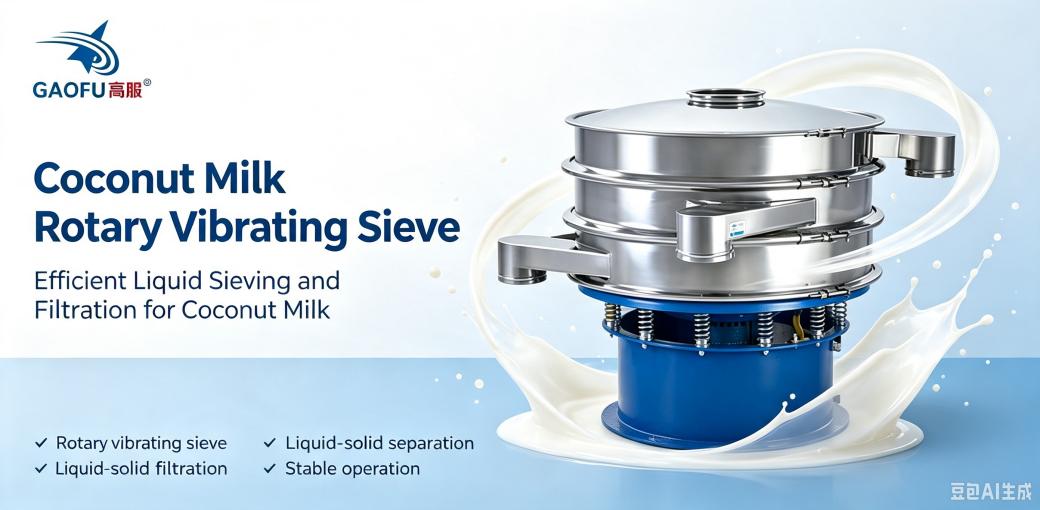
Over 10,000+ customers' choice, Focus on screening industry 40+ years
Coconut milk production mainly follows two process routes – cold‑pressed and formulated – with clear differences in material characteristics and filtration requirements.
Cold‑Pressed Coconut Milk: Pursuing natural flavour, high fibre content
Cold‑pressed coconut milk uses low‑temperature physical pressing – coconut meat is directly pressed at around 4°C without heat treatment. This process maximises the retention of natural coconut flavour and aromatic compounds, but also means the slurry contains large quantities of un‑degraded coconut meat fibres, shell particles, and protein colloids. Cold‑pressed coconut milk has higher solids content, with intact fibre structures, making filtration relatively more difficult. Additionally, cold‑pressed coconut milk is heat‑sensitive – the screening process should not generate excessive heat to avoid affecting flavour.
Formulated Coconut Milk: Pursuing consistent uniformity, finer slurry
Formulated coconut milk is produced by blending coconut cream, coconut water, emulsifiers, stabilisers, and other ingredients in specific proportions. The standardised slurry is relatively uniform with lower fibre content, but contains emulsifiers, stabilisers, and other additives – giving the slurry a certain viscosity and emulsion characteristics. Formulated coconut milk requires higher filtration precision – even fine impurity particles can affect the final product's mouthfeel and stability.
After clarifying the coconut milk type, screen selection should be evaluated from the following dimensions:
1. Screen Mesh Size – Determining Filtration Precision
Screen mesh (Mesh) refers to the number of openings per inch – the higher the mesh, the finer the openings and the higher the filtration precision. Gaofu's S49 series rotary vibrating sieve covers screen mesh from 2 to 500 mesh , with filtration precision down to 5 microns.
Recommended mesh for cold‑pressed coconut milk: Cold‑pressed coconut milk has high fibre content and coarser slurry – the standard recommendation is 60‑80 mesh. This range effectively intercepts coarse coconut fibres and shell fragments while ensuring smooth slurry passage, avoiding frequent blinding from overly fine mesh.
Recommended mesh for formulated coconut milk: Formulated coconut milk slurry is relatively fine but requires higher purity – the standard recommendation is 80‑120 mesh. For premium coconut milk products requiring higher clarity, 150‑200 mesh fine screens can be used.
Ultra‑fine filtration scenarios: Some premium coconut milk products require极致 smoothness – screens above 200 mesh can be selected, paired with an ultrasonic cleaning system to effectively resolve fine mesh blinding.
2. Number of Screen Decks – Determining Grading Capability
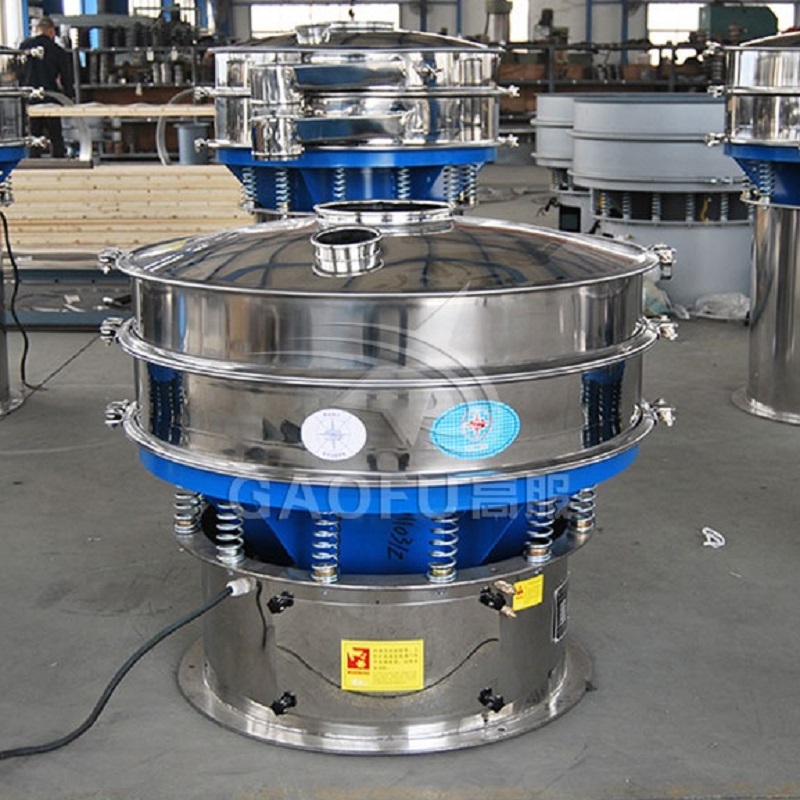
Gaofu's S49 series rotary vibrating sieve supports flexible configurations of 1 to 5 screen decks – one feed can simultaneously complete 2 to 6 grades of separation or filtration.
Single deck: Suitable for impurity removal‑focused scenarios, such as coarse filtration of cold‑pressed coconut milk. Material passes through one screen – fibres and impurities larger than the mesh openings are intercepted, and合格 slurry passes through to the next process.
Multiple decks: Suitable for scenarios requiring both coarse and fine filtration. The upper deck (e.g., 60 mesh) intercepts coarse fibres and larger impurities, while the lower deck (e.g., 120 mesh) achieves fine filtration to ensure finished product purity. Multi‑deck configurations complete multiple filtration stages in one feed – reducing material transfers between machines and contamination risks.
3. Screen Material – Food‑Grade Stainless Steel Is the Minimum
As a plant‑based protein beverage consumed directly, coconut milk‑contact screens must be made of food‑grade stainless steel. Gaofu's S49 series standard configuration uses 304 stainless steel – for production scenarios requiring higher corrosion resistance, 316L stainless steel is available. With its added molybdenum content, 316L stainless steel effectively resists long‑term attack from proteins and vegetable oils in coconut milk – preventing screen rust from contaminating the product.
4. Screen Cleaning Method – Ensuring Uninterrupted Continuous Filtration
The fibres and protein colloids in coconut milk have a certain degree of adhesion – during screening, they readily block the mesh. Gaofu's S49 series rotary vibrating sieve is equipped with a bouncing ball cleaning system – high‑frequency vibration continuously knocks against the screen surface, enabling smooth material passage and effectively solving blinding.
For ultra‑fine filtration above 200 mesh, an ultrasonic cleaning system can be selected. High‑frequency ultrasonic vibration keeps fine particles in the slurry continuously suspended – effectively inhibiting adhesion and blinding – ensuring sustained permeability of fine mesh screens.
Pay attention to material temperature. Cold‑pressed coconut milk is heat‑sensitive – the screening process should not generate excessive heat. Gaofu's rotary vibrating sieve uses high‑frequency, low‑amplitude vibration with minimal temperature rise – suitable for cold‑pressed coconut milk's low‑temperature screening requirements.
Consider screen change convenience. Coconut milk filtration screens require regular cleaning or replacement. Gaofu's S49 series rotary vibrating sieve features a unique screen frame design – screen changes take only 3‑5 minutes – significantly reducing downtime.
Consider the fully enclosed structure. Coconut milk tends to splash during screening. Gaofu's rotary vibrating sieve features a fully enclosed structure – feed inlet, liquid outlet, and slag discharge port are all sealed – effectively preventing slurry splashing and external contamination.
Food Industry Client Testimonials
Nestlé, CP Group, Haitian Flavour & Fragrance, Yihai Kerry, Yili, Mengniu,Shuanghui, Wahaha, Master Kong, Want Want, Anjoy Foods, Angel Yeast,Yangyuan Foods, Uni-President Enterprises, Qiaqia Food, Luhua Group,Alpenliebe, Golden Monkey, Orion, Xizhilang,Sanquan Foods, Synear Food, Oishi, Wong Lo Kat, Yanjing Beer, Seamild,Jinpai, Chubang, Hengshun Vinegar Industry, Longda Group, Beijing Daoxiangcun, Anhe Dairy,Weiwei Group, Xiangpiaopiao, Maiquer, Tianbing, Binqi Food, Ligao Okun
Fortune 500 Client Testimonials
CNPC、CSCEC、Sinochem Holdings、CRCC、China Minmetals Corporation、CNOOC、CR、Sinopharm、CHN Energy、COFCO Corporation、Huawei Technologies、PowerChina、CITIC Group、Wuchan Zhongda Group、NORINCO、Chalco、CNBM、 Shaanxi Coal and Chemical Industry Group、Ansteel Group、CETC、CSSC、CASC、CEC、Jinchuan Group、CASIC、Conch Cement、CNNC、SPH、Shanxi Coking Coal Group、 Zhongtai Chemical、GPHL、DEC、Sinosteel Corporation、MCC、China National Salt Industry Chemical、China Baowu Steel Group、China Animal Husbandry Industry Co., Ltd.、CECEP
About Gaofu
Xinxiang Gaofu Machinery Co., Ltd. was founded back in the 1980s. With over 40 years of development, it has been certified as a National-level Specialized, Refined, Unique & Innovative Little Giant Enterprise, National Green Factory, National High-tech Enterprise, and National Intellectual Property Advantage Enterprise, and serves as the President Unit of China Vibration Screening Industry Association.
The company is accredited with the Henan Provincial Industrial Design Center, Henan Provincial Engineering Technology Research Center for Intelligent On-line Screening System, and Xinxiang Municipal Engineering Technology Research Center for Fine Screening.
Gaofu has obtained more than 500 patents including invention patents, utility model patents and design patents, been awarded the Science and Technology Achievement Prize issued by the Ministry of Industry and Information Technology of China, and participated in drafting and formulating 4 national standards.
Gaofu's product portfolio covers multiple series and hundreds of specifications, including vibrating screening equipment, conveying equipment, coal crushing equipment, filtration equipment and automatic material handling systems.
Core products include vibrating screens, screening machines, vibratory sifters, rotary vibrating screens, ultrasonic vibrating screens, linear vibrating screens, airflow screens, gyratory screens, roller screens, dewatering screens, bar screens, vacuum feeding machines, dust-free feeding stations, bulk bag feeding stations, feeding systems, automatic powder feeding systems, automatic slag-discharging filters, leaf filters, clay filters, toothed roll crushers, coal crushers and other machinery.
These products are widely applied in food, pharmaceutical, chemical, metallurgy, construction materials, mining, thermal power, environmental protection and many other industries, winning recognition and trust from over 10,000 clients worldwide.
Gaofu products enjoy strong sales across Greater China, and are exported to more than 100 countries and regions such as Russia, Canada, the United States, New Zealand, Japan, Brazil and South Africa.
Upholding the corporate mission of Improving material quality & efficiency to fully satisfy customer demands, Gaofu maintains long-term partnerships with clients to achieve win-win development.