Over 10,000+ customers' choice, Focus on screening industry 40+ years
Creamer powder contains vegetable fat, has high fineness, and low bulk density – in conventional screening operations, it faces multiple challenges:
Diverse fineness requirements – a single machine cannot cover all needs. Different beverage formulations have different particle size distribution requirements – premium milk tea creamer demands 200 mesh or finer; standard coffee creamer typically screens at 80‑120 mesh; creamer for bakery applications has stricter uniformity standards. A machine that can only produce one specification cannot meet the needs of multi‑product production.
Fat and electrostatic adhesion cause frequent blinding. The fat in creamer generates heat through friction during screening, forming a sticky film on the screen surface. At the same time, static electricity generated by particle friction causes fines to attract each other, forming agglomerates that adhere firmly to the screen surface. The combination of these two factors makes creamer significantly more difficult to screen than ordinary powdered materials.
Lumps and impurities coexist – requiring graded treatment. Creamer may form lumps during storage or conveying, and raw materials may contain trace hard impurities. These off‑spec materials need to be effectively separated during screening, and impurities of different particle sizes require different screen decks for interception.
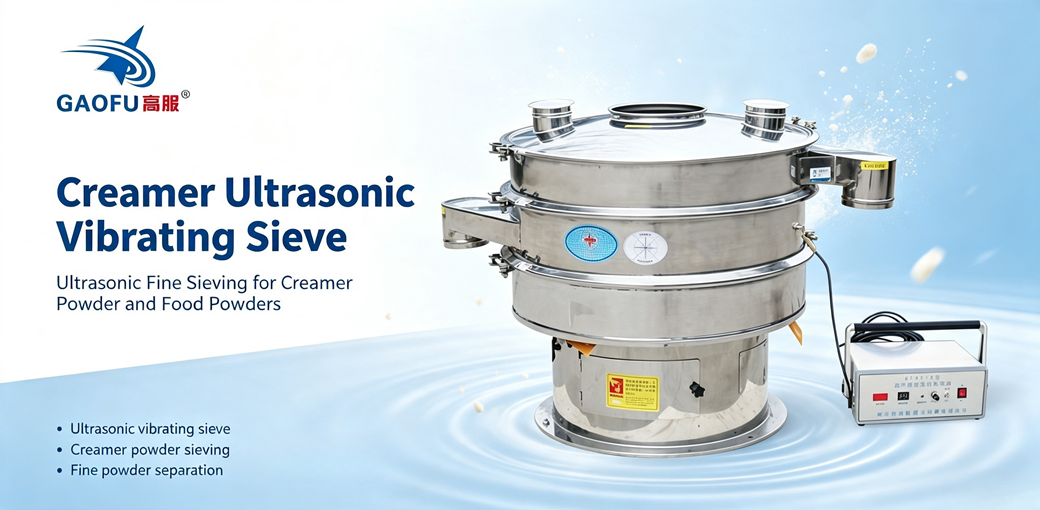
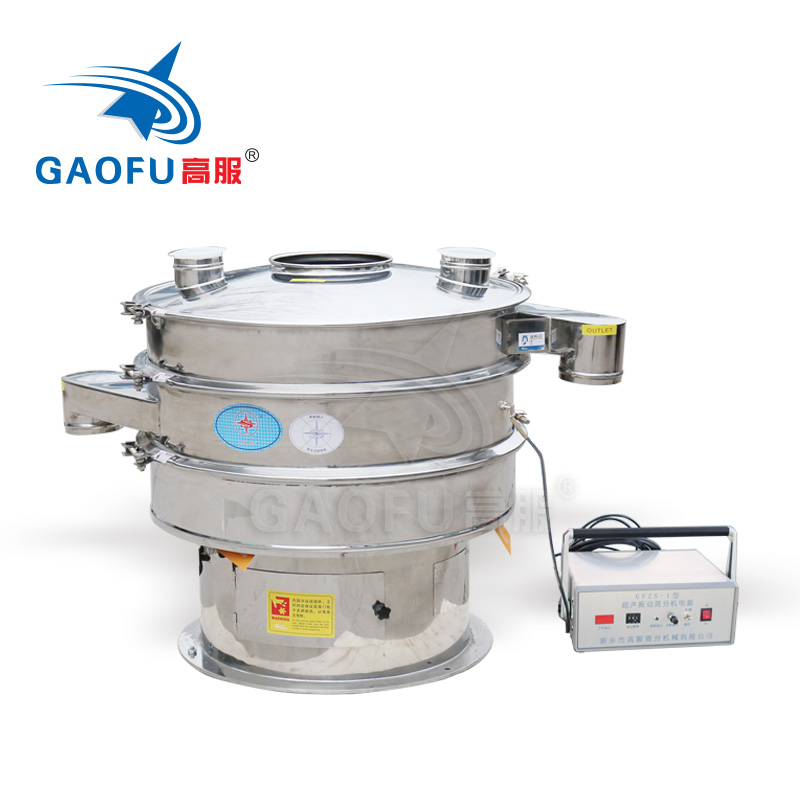
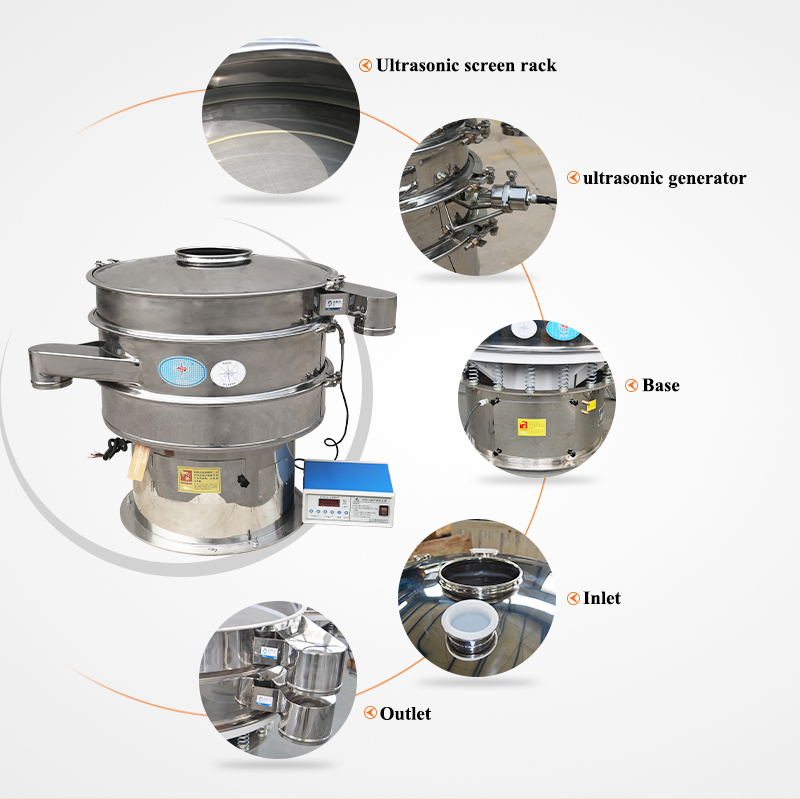
The core advantage of Gaofu's S49‑AC series ultrasonic vibrating sieve lies in its flexible multi‑deck screen configuration capability. The equipment supports 1 to 5 screen decks , enabling a single machine to simultaneously complete 2 to 6 grades of separation or filtration, with screening fineness covering 1 to 325 mesh and filtration precision down to 5 microns.
For creamer production, a typical multi‑deck configuration is as follows:
Upper deck (coarse screen) – intercepting large agglomerates and foreign matter. Larger lumps formed during storage or conveying, packaging debris, and other foreign matter are effectively intercepted – protecting material purity at the source. This deck typically uses a coarser mesh (e.g., 20‑40 mesh) and acts as the "gatekeeper."
Middle decks (grading screens) – separating different fineness specifications. This is the core of multi‑deck grading. By setting screens of different mesh sizes (e.g., 80 mesh, 120 mesh, 200 mesh), creamer is precisely separated by particle size into different specifications – fine powder for premium coffee creamer, medium particles for milk tea ingredients, and slightly coarser particles for bakery and other specific applications.
Lower deck (safety screen) – ensuring finished product purity. As the final checkpoint, it further intercepts fine impurities – ensuring reliable purity of creamer entering the packaging stage.
Vibration uniformity across all decks is specifically calibrated – deviation in vibration amplitude between different decks is controlled within 5%, so there is no over‑loading on the upper deck or insufficient vibration on the lower deck. Different product grading requirements can be quickly switched without modifying the machine body structure.
The practical value of "one feed, multiple outputs":
Combined processes, reduced material transfer. In traditional modes, different specification grading often requires multiple machines or multiple screening passes. Gaofu's ultrasonic vibrating sieve combines multiple processes into a single machine – reducing material exposure and cross‑contamination opportunities.
One machine, multiple functions – flexible adaptation to market demand. When orders for different fineness specifications are received, there is no need to replace the entire machine – simply adjust or change the corresponding screen decks. This flexibility is particularly important for multi‑product, small‑batch creamer producers.
High grading efficiency – eliminating size mixing and cross‑contamination. The precise multi‑deck grading ensures purity of each particle size grade – effectively preventing mixing between different specifications.
The efficient operation of multi‑deck grading depends on screen permeability. Fat and static electricity in creamer are the two major causes of blinding – if one deck becomes blocked, the accuracy of the entire classification system is compromised. Gaofu's S49‑AC series ultrasonic vibrating sieve deeply integrates ultrasonic screen cleaning technology with multi‑deck grading – fundamentally solving the blinding problem.
Working principle: The equipment converts 220V, 50Hz electrical energy into 36 kHz high‑frequency electrical energy – the ultrasonic transducer then converts this into high‑frequency mechanical vibration. A low‑amplitude, high‑frequency ultrasonic vibration wave is superimposed on the screen surface – subjecting ultra‑fine powder particles to ultrasonic acceleration – keeping material on the screen surface in a continuously suspended state.
In simple terms: a conventional screen processing creamer is like a "congested road" – fine particles are "stuck" to the surface by fat adhesion and static electricity; an ultrasonic vibrating sieve is like adding continuous micro‑vibration to the road – keeping material in constant motion and preventing accumulation.
How ultrasonic technology supports multi‑deck grading:
Inhibits adhesion and agglomeration. High‑frequency ultrasonic vibration effectively breaks molecular adhesion and electrostatic forces between particles – instantly disrupting electrostatic attraction and agglomeration. Agglomerates are broken apart the moment they contact the screen surface – fine particles remain dispersed and pass through the screen smoothly.
Self‑cleaning screen – no contact‑based cleaning components required. The ultrasonic system features a built‑in self‑cleaning function – without contact‑based devices such as bouncing balls or brush systems. Screen mesh openings do not block – effectively solving screening problems of highly adsorbable, easily agglomerated, sticky, static‑prone, and ultra‑fine materials.
Synchronous cleaning across all decks. Ultrasonic vibration is uniformly transmitted to each screen deck – ensuring every deck remains fully permeable. There is no "gradient blinding" where the upper deck is open while lower decks become blocked.
Dual improvement in accuracy and throughput. Screening accuracy can be improved by over 80%, and throughput increased by 2 to 5 times. For high‑value food ingredients like creamer, accuracy improvement directly relates to product quality consistency – finer particle size distribution, more thorough impurity removal, and more reliable finished product purity.
Creamer is widely used in milk tea, coffee, bakery, solid beverages, and other food applications – placing extremely strict hygiene standards on production equipment. Gaofu's S49‑AC series ultrasonic vibrating sieve uses food‑grade 304 stainless steel for all material‑contact parts (316L available on request), with finely polished surfaces and no dead corners – leaving no room for bacterial growth.
The equipment features a fully enclosed structure – powder does not disperse, liquids do not leak. The fully enclosed structure effectively prevents dust emission and material cross‑contamination during screening – improving the workshop environment while reducing material loss. The entire machine design complies with GMP standards – providing reliable food safety assurance at the equipment level for beverage ingredients.
Food Industry Client Testimonials
Nestlé, CP Group, Haitian Flavour & Fragrance, Yihai Kerry, Yili, Mengniu,Shuanghui, Wahaha, Master Kong, Want Want, Anjoy Foods, Angel Yeast,Yangyuan Foods, Uni-President Enterprises, Qiaqia Food, Luhua Group,Alpenliebe, Golden Monkey, Orion, Xizhilang,Sanquan Foods, Synear Food, Oishi, Wong Lo Kat, Yanjing Beer, Seamild,Jinpai, Chubang, Hengshun Vinegar Industry, Longda Group, Beijing Daoxiangcun, Anhe Dairy,Weiwei Group, Xiangpiaopiao, Maiquer, Tianbing, Binqi Food, Ligao Okun
Fortune 500 Client Testimonials
CNPC、CSCEC、Sinochem Holdings、CRCC、China Minmetals Corporation、CNOOC、CR、Sinopharm、CHN Energy、COFCO Corporation、Huawei Technologies、PowerChina、CITIC Group、Wuchan Zhongda Group、NORINCO、Chalco、CNBM、 Shaanxi Coal and Chemical Industry Group、Ansteel Group、CETC、CSSC、CASC、CEC、Jinchuan Group、CASIC、Conch Cement、CNNC、SPH、Shanxi Coking Coal Group、 Zhongtai Chemical、GPHL、DEC、Sinosteel Corporation、MCC、China National Salt Industry Chemical、China Baowu Steel Group、China Animal Husbandry Industry Co., Ltd.、CECEP
About Gaofu
Xinxiang Gaofu Machinery Co., Ltd. was founded back in the 1980s. With over 40 years of development, it has been certified as a National-level Specialized, Refined, Unique & Innovative Little Giant Enterprise, National Green Factory, National High-tech Enterprise, and National Intellectual Property Advantage Enterprise, and serves as the President Unit of China Vibration Screening Industry Association.
The company is accredited with the Henan Provincial Industrial Design Center, Henan Provincial Engineering Technology Research Center for Intelligent On-line Screening System, and Xinxiang Municipal Engineering Technology Research Center for Fine Screening.
Gaofu has obtained more than 500 patents including invention patents, utility model patents and design patents, been awarded the Science and Technology Achievement Prize issued by the Ministry of Industry and Information Technology of China, and participated in drafting and formulating 4 national standards.
Gaofu's product portfolio covers multiple series and hundreds of specifications, including vibrating screening equipment, conveying equipment, coal crushing equipment, filtration equipment and automatic material handling systems.
Core products include vibrating screens, screening machines, vibratory sifters, rotary vibrating screens, ultrasonic vibrating screens, linear vibrating screens, airflow screens, gyratory screens, roller screens, dewatering screens, bar screens, vacuum feeding machines, dust-free feeding stations, bulk bag feeding stations, feeding systems, automatic powder feeding systems, automatic slag-discharging filters, leaf filters, clay filters, toothed roll crushers, coal crushers and other machinery.
These products are widely applied in food, pharmaceutical, chemical, metallurgy, construction materials, mining, thermal power, environmental protection and many other industries, winning recognition and trust from over 10,000 clients worldwide.
Gaofu products enjoy strong sales across Greater China, and are exported to more than 100 countries and regions such as Russia, Canada, the United States, New Zealand, Japan, Brazil and South Africa.
Upholding the corporate mission of Improving material quality & efficiency to fully satisfy customer demands, Gaofu maintains long-term partnerships with clients to achieve win-win development.
At present, Gaofu is an official qualified supplier for numerous Fortune Global 500 enterprises, including CNPC, Sinopec, Sinochem Holdings, China Resources Group, Sinopharm Group, COFCO, China National Building Material, China Aerospace Science and Technology Corporation, Jinchuan Group and more.
Gaofu Machinery ranks No.1 in global sales volume of vibrating screens.
In May 2024, Frost & Sullivan, a world-renowned international consulting firm, issued a Market Position Verification Certificate confirming that Gaofu achieved the world's largest shipment volume of vibrating screens in the global market in 2023.