Over 10,000+ customers' choice, Focus on screening industry 40+ years
Spice powders typically range from 20 to 120 mesh, with low bulk density and a high proportion of fines. In traditional big‑bag feeding methods, dust emission mainly originates from the following areas:
Large dust release during bag opening. The moment the big‑bag discharge spout is cut open, fine powder accumulated at the spout rapidly disperses with air currents. In traditional open bag opening, dust can travel several metres.
Continuous emission during discharge. As material flows from the big bag into the feed hopper, fine powder is "squeezed" through gaps between the discharge spout and the hopper, continuously dispersing into the workshop air.
Air currents generated by material impact. When powder falls from the big bag and impacts the bottom of the feed hopper, it drives surrounding air to form localised air currents – fine powder particles are carried by these air currents and escape.
The impact of dust emission is multi‑dimensional:
Material loss. Spices are high‑value materials – every dust emission represents direct economic loss. Under manual feeding, raw material loss rates often exceed 6%.
Workshop environmental pollution. Dust accumulation causes workshops to fail cleanliness standards, increases cleaning burdens, and also fails to meet the cleanliness requirements of food production SC licensing.
Health and safety risks. Operators are exposed to dusty environments for extended periods, posing potential respiratory health risks. At the same time, high dust concentrations in the workshop also pose dust explosion safety hazards.
Compliance pressure. With increasingly stringent environmental inspections and food safety audits, inadequate dust control is often a "deduction point" during inspections.
Therefore, enclosed design and dust collection performance are two non‑negotiable baseline criteria in the selection of spice big bag feeding stations.
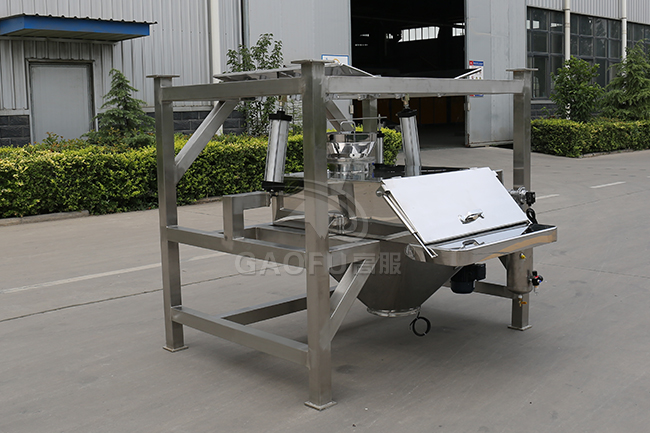
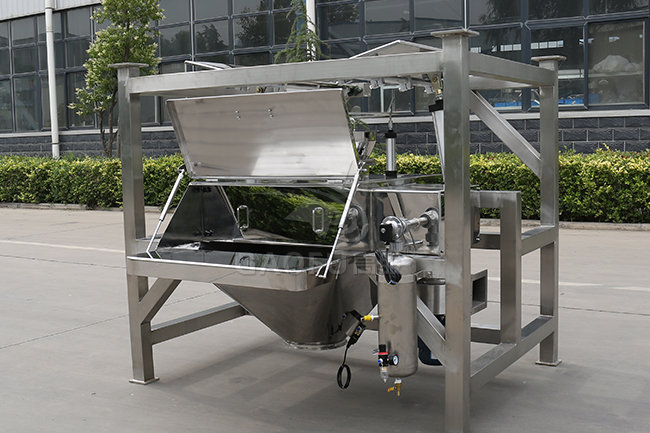
Gaofu's spice big bag feeding station's enclosed design covers the entire process from big‑bag hoisting to discharge completion:
Bag clamping mechanism seals the spout, forming an enclosed chamber. After the big bag is hoisted into position, the bag clamping mechanism seals the big‑bag discharge spout to the equipment feed inlet , forming an enclosed chamber. The entire bag opening and discharge process takes place within this enclosed environment – dust has no escape route. The bag clamping sealing method directly determines dust control effectiveness and is the foundation of dust‑free feeding.
Fully enclosed feed hopper design. The entire machine features a fully enclosed feed hopper design – from the feed inlet to the discharge outlet, all connections are sealed, completely eliminating dust leakage during production. The equipment controls dust emission at the source through its enclosed structure.
Integrated pulse‑jet dust collection system. The enclosed structure, combined with an integrated pulse‑jet dust collection system, achieves filtration precision of up to 5μm – effectively controlling dust emission, protecting the workshop environment and operator health, and complying with environmental and occupational hygiene requirements.
Fully enclosed pipe conveying integration. After feeding is completed, material can be directly conveyed through enclosed piping to the next process – achieving fully enclosed operation from feeding to conveying, without manual handling – eliminating secondary dust emission and cross‑contamination.
While enclosed design solves the structural problem of "where dust goes," the dust collection system solves the functional problem of "how dust is processed."
Negative‑pressure dust collection system – full‑process active collection. Gaofu's spice big bag feeding station is equipped with a negative‑pressure dust collection system – a dust collection fan generates a negative‑pressure environment (-0.4 to -0.6 bar), directionally drawing dust generated during feeding into the filtration device. This active collection method is more effective than simply relying on an enclosed structure – as soon as dust is generated, it is captured and processed, with no opportunity to disperse. The dust collection system operates throughout the entire feeding process, ensuring dust is "captured as it is generated."
High‑efficiency filtration – achieving complete air‑dust separation. Dust‑laden air enters the filtration system, where high‑efficiency filter elements capture dust particles. Filtration precision reaches up to 5μm – for ultra‑fine materials like spice powders, it effectively captures micron‑level dust particles, ensuring clean exhaust air. Dust is retained by the filters, and clean air is exhausted through the discharge system.
Pulse‑jet cleaning – self‑cleaning filters for sustained high efficiency. The equipment is equipped with a pulse‑jet cleaning device – after feeding is completed, the cleaning system activates, and dust adhering to the filter elements is blown back into the feed hopper, achieving material recovery and reuse. This design ensures the dust collection system maintains sustained high efficiency while minimising raw material waste.
High dust collection efficiency – compliant emissions. The fully enclosed structure, combined with the negative‑pressure dust collection system, achieves a high dust capture rate. For spice processors needing to pass environmental inspections and food safety audits, this means dust control in the feeding area can meet increasingly stringent compliance requirements.
When selecting a big bag feeding station, spice processors are advised to evaluate the following five dimensions:
Point 1: Sealing structure is the foundation.
The bag clamping sealing method directly determines dust control effectiveness. During selection, pay close attention to whether the bag clamping mechanism design is tight and easy to operate. The entire machine should feature a fully enclosed feed hopper design – from the feed inlet to the discharge outlet, all connections should be sealed. Seal materials should be food‑grade, corrosion‑resistant, and age‑resistant.
Point 2: Dust collection system is the core.
The dust collection system configuration directly affects workshop dust concentration control. Confirm whether the equipment is equipped with a negative‑pressure dust collection system , whether filtration precision meets material characteristic requirements (for spice powders, filtration precision ≤5μm is recommended), and whether it is equipped with a pulse‑jet self‑cleaning device. The dust collection fan power and negative pressure value should match the feed volume.
Point 3: Materials are the assurance of hygiene and safety.
Spices are widely used in food processing and home cooking – all material‑contact parts must be made of food‑grade stainless steel , typically 304 or 316L grade. Surface finish must meet easy‑to‑clean and residue‑free standards (Ra≤0.8μm), and the overall equipment design should comply with GMP requirements. In the food and pharmaceutical industries, carbon steel is strictly prohibited – 304 or higher grade stainless steel must be used.
Point 4: Assisted discharge devices – matching material characteristics.
Spice powders in big bags may form lumps due to compression or moisture absorption during storage, and bridging may occur during discharge. Confirm whether the equipment is equipped with a tapping device and vibration device – the tapping device helps material flow out of the big bag, and the vibration device breaks bridges. For materials with poor flowability, additional devices such as vibration discs can be optionally added.
Point 5: Integration capability with downstream equipment.
A big bag feeding station is not a standalone unit – it is an integral part of the complete production line. During selection, evaluate whether the equipment can be easily integrated with downstream pneumatic conveying systems, screening systems, metering systems, and other equipment. The equipment should support integration with automated production lines – achieving fully enclosed operation from feeding to conveying.
Food Industry Client Testimonials
Nestlé, CP Group, Haitian Flavour & Fragrance, Yihai Kerry, Yili, Mengniu,Shuanghui, Wahaha, Master Kong, Want Want, Anjoy Foods, Angel Yeast,Yangyuan Foods, Uni-President Enterprises, Qiaqia Food, Luhua Group,Alpenliebe, Golden Monkey, Orion, Xizhilang,Sanquan Foods, Synear Food, Oishi, Wong Lo Kat, Yanjing Beer, Seamild,Jinpai, Chubang, Hengshun Vinegar Industry, Longda Group, Beijing Daoxiangcun, Anhe Dairy,Weiwei Group, Xiangpiaopiao, Maiquer, Tianbing, Binqi Food, Ligao Okun
Fortune 500 Client Testimonials
CNPC、CSCEC、Sinochem Holdings、CRCC、China Minmetals Corporation、CNOOC、CR、Sinopharm、CHN Energy、COFCO Corporation、Huawei Technologies、PowerChina、CITIC Group、Wuchan Zhongda Group、NORINCO、Chalco、CNBM、 Shaanxi Coal and Chemical Industry Group、Ansteel Group、CETC、CSSC、CASC、CEC、Jinchuan Group、CASIC、Conch Cement、CNNC、SPH、Shanxi Coking Coal Group、 Zhongtai Chemical、GPHL、DEC、Sinosteel Corporation、MCC、China National Salt Industry Chemical、China Baowu Steel Group、China Animal Husbandry Industry Co., Ltd.、CECEP
About Gaofu
Originated in the 1980s, Xinxiang Gaofu Machinery Co., Ltd. has developed into a leading enterprise after more than 40 years of steady development. The company holds authoritative national qualifications including National-level Specialized, Refined, Unique and Innovative Little Giant Enterprise, National Green Factory, National High-tech Enterprise, and National Intellectual Property Advantage Enterprise, and acts as the President Unit of the Vibration Industry Association.
It has established three provincial and municipal R&D platforms: Henan Provincial Industrial Design Center, Henan Provincial Engineering Technology Research Center for Intelligent On-line Screening System, and Xinxiang Municipal Fine Screening Engineering Technology Research Center. Up to now, Gaofu has obtained more than 500 patents covering invention, utility model and design. It has been awarded the Science and Technology Achievement Prize by the Ministry of Industry and Information Technology of China and has participated in drafting and formulating 4 national standards.
Gaofu’s product portfolio covers multiple series and hundreds of specifications, mainly including vibrating screening equipment, conveying equipment and intelligent automatic material handling systems. We provide one-stop overall solutions such as automatic feeding systems, powder supply systems, pneumatic conveying systems, metering and weighing systems, batching systems, micro-ingredient batching systems, water supply systems, oil supply systems, fluid conveying systems, central kitchen powder supply systems, powder conveying systems and feeding systems.
In terms of food production lines, our mature supporting systems cover two major categories: baking production lines and pasta production lines. The baking series includes production lines for bread, cake, crisp cake, croissant, toast, pizza, biscuit and hamburger. The pasta series includes intelligent production lines for steamed buns, stuffed buns, twisted rolls, sesame paste cakes, steamed dumplings, boiled dumplings, fried dough sticks and pies.
Gaofu products sell well across Greater China and are exported to more than 100 countries and regions worldwide, including Russia, Canada, the United States, New Zealand, Japan, Brazil and South Africa. Widely applied in food, pharmaceutical, chemical, metallurgical, building materials, mining, thermal power, environmental protection and other industries, our products have won the trust and recognition of over 10,000 global customers.
Adhering to the corporate mission of improving material quality and efficiency to meet customer needs, Gaofu has long-term stable cooperative relationships with global clients to achieve harmonious and win-win development. At present, Gaofu has become an official qualified supplier of many Fortune Global 500 enterprises, including CNPC, Sinopec, Sinochem Group, China Resources Group, Sinopharm Group, COFCO, China National Building Material, China Aerospace and Jinchuan Group.