Over 10,000+ customers' choice, Focus on screening industry 40+ years
1. Dust‑Free Feeding Station: The First Line of Defence for Dust Control
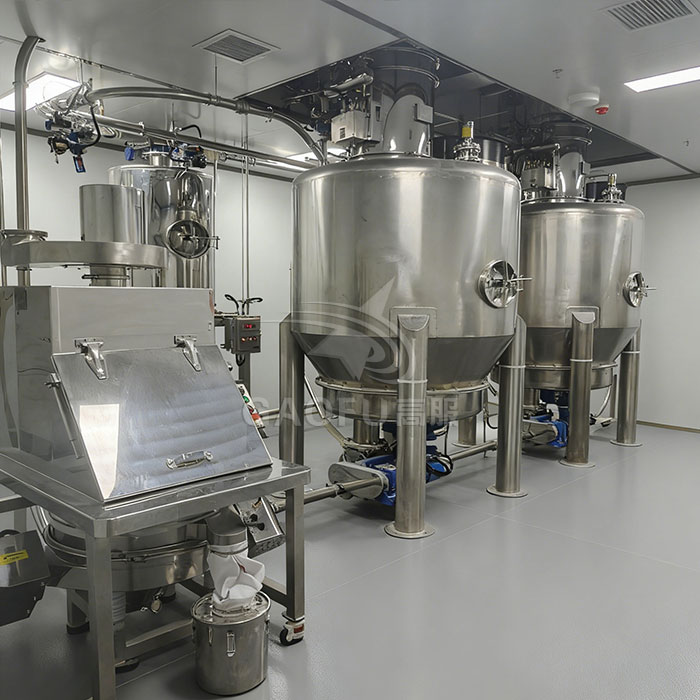
The dust‑free feeding station is the "entry point" of the feeding system, responsible for bag opening and feeding of protein powder. Operators place protein powder bags on the feeding platform – the equipment completes feeding in an enclosed negative‑pressure environment, with dust efficiently collected. The feeding platform maintains a micro‑negative pressure during operation – under the action of the exhaust fan, negative pressure is created inside the working chamber, directionally drawing dust generated during feeding into the filtration system and preventing it from escaping outside the cabinet. The dust collection fan prevents material dust from dispersing during bag opening. The feeding platform operates under negative pressure – no dust leakage, no material loss during feeding – protecting the clean environment.
Configuration highlights: All material‑contact parts should be made of 304 or 316L food‑grade stainless steel , with polished surfaces that are smooth, non‑stick, and easy to clean. The system design should fully consider GMP requirements for the food industry – with no dead corners – providing reliable food safety assurance at the equipment level. The feeding station should be equipped with a pulse‑jet cleaning device – filter elements are automatically cleaned at regular intervals, maintaining consistent filtration efficiency.
2. Intelligent Screening Module: Ensuring Raw Material Purity
Protein powder may form lumps due to moisture absorption during storage and transport, or become contaminated with packaging debris, threads, and other foreign matter. Gaofu's feeding system integrates a vibrating screening module – before entering the conveying pipe, raw materials pass through high‑efficiency screening where lumps are effectively broken and foreign matter is reliably intercepted. The online vibrating screen detects and removes impurities in real time, ensuring that protein powder entering the production process is fine and pure.
Configuration highlights: The screen mesh should be made of stainless steel, with mesh size flexibly configured according to protein powder fineness requirements (typically 80‑200 mesh). The screening module should have self‑cleaning features to reduce material adhesion.
3. Pneumatic Conveying System: The Core of Enclosed Continuous Feeding
The pneumatic conveying system is responsible for transferring protein powder from the feed point to various production workstations. The system uses a combination of positive‑pressure and negative‑pressure pneumatic conveying. Negative‑pressure vacuum conveying enables rapid material transfer and storage; positive‑pressure conveying, combined with high‑precision weighing sensors, achieves precise metering. The entire conveying process takes place in enclosed piping – the internal surfaces of conveying pipes are mirror‑polished, with no dead corners and minimal material residue. Compared with traditional screw conveying, pneumatic conveying saves approximately 40% in energy.
Configuration highlights: Select vacuum feeders of appropriate power according to conveying distance, conveying height, material characteristics, and other factors. Gaofu's GFZK series vacuum feeder covers conveying capacities of 200‑6,000 kg/h , with conveying distances of 5‑30 metres. Piping should be made of food‑grade stainless steel with smooth internal surfaces to reduce material adhesion.
4. Automatic Metering System: The Core Assurance of Precise Proportioning
Protein powder is a high‑value material – batching accuracy directly determines product quality stability. The feeding system can be optionally equipped with an automatic metering module – through the coordination of weighing sensors and a PLC control system, it achieves automatic recipe‑based batching and quantitative feeding. The system supports multiple batching methods – gain‑in‑weight, loss‑in‑weight, dynamic multi‑component, and others – with protein powder metering accuracy errors controllable within ±0.5%. Weighing and batching feature intelligent learning programmes that automatically calibrate accuracy parameters.
5. Visualisation Control Centre: Intelligent Management and Control of the Full Process
The control centre is responsible for monitoring the entire feeding system's operation and setting parameters. It is equipped with a touchscreen interface, allowing multiple product recipes to be preset and the feeding process to be started with one touch. The system monitors key information in real time – material inventory, feed rate, metering data – at a glance. It also supports remote diagnostics, equipment maintenance cycle reminders, and AI intelligent learning – automatically calibrating accuracy parameters and continuously optimising operating efficiency.
Protein powder is an ultra‑fine powder (whey protein powder can have a particle fineness of up to 43 microns) – with low bulk density, hygroscopicity, and a tendency to generate static electricity. Such materials place higher demands on equipment maintenance during feeding system operation. Regular, standardised maintenance is key to ensuring long‑term stable system operation.
1. Filter Element Inspection and Replacement
The filter element is the core component that achieves air‑powder separation in the vacuum feeder. During conveying, fine protein powder gradually accumulates on the filter surface, forming a "powder film" that blocks the micro‑porous structure, causing reduced vacuum pressure and diminished conveying capacity.
Inspection frequency: It is recommended to visually inspect the filter surface for material accumulation weekly , and perform a detailed assessment monthly. For ultra‑fine powders like protein powder, filter element contamination occurs relatively quickly – standard polyester filter elements typically last 3‑6 months , while PTFE‑coated anti‑static elements can last 6‑12 months.
Replacement criteria: The following signs indicate that the filter element needs replacement – noticeable drop in vacuum pressure, reduced conveying capacity, visible dust at the exhaust outlet, or suction power that cannot be restored after pulse‑jet cleaning.
Operating procedure: Before replacing the filter element, turn off the equipment power. Unscrew the fan base nuts, remove the fan and base, then sequentially remove the filter element assembly and protective cover. Use a clean soft cloth to clean the filter mounting seat, ensuring the sealing surface is clean. Insert the new filter element into the mounting seat in the correct orientation, ensuring it is properly seated and sealed. Reassemble in reverse order, then check all sealing points, and conduct a test run to observe whether vacuum pressure has returned to normal.
Filter selection: For protein powder, it is recommended to use PTFE‑coated anti‑static polyester filter elements or PTFE‑membrane filter elements – these have smooth surfaces that resist powder adhesion and offer good pulse‑jet cleaning performance. For production environments with explosion protection requirements, anti‑static filter elements with proper grounding should be selected.
2. Piping Cleaning
Powder accumulation in piping is the most easily overlooked problem in feeding systems. Protein powder has low bulk density and high fineness – during conveying, particle‑to‑wall friction generates static electricity, causing fine powder to adhere to the inner pipe walls and gradually form accumulation layers.
Cleaning frequency: It is recommended to perform a comprehensive inspection and cleaning of the conveying pipes monthly , with special attention to bends, reducers, tees, and other areas prone to powder accumulation. When switching product types (e.g., from whey protein to soy protein), the piping should be thoroughly cleaned to avoid cross‑contamination.
Cleaning methods: Connect compressed air to one end of the pipe and use high‑pressure airflow to blow accumulated powder out of the pipe – during purging, install a dust collection device at the pipe outlet. For bends, tees, and other areas with heavy accumulation, disassemble these sections for manual cleaning – use a soft brush or specialised cleaning tool to remove powder deposits from the pipe wall. While cleaning the piping, inspect seals at each connection for ageing or damage, and replace them promptly to avoid air leakage.
3. Seal Inspection
Seals at each connection point of the feeding system directly affect system airtightness and dust control effectiveness. Aged or damaged seals can cause reduced vacuum pressure, dust leakage, and cross‑contamination.
Inspection frequency: It is recommended to inspect seals monthly. Focus on the sealing condition of the feeding station operation door, pipe connection flanges, hopper discharge ports, and other critical locations.
Replacement criteria: Seals showing hardening, cracking, deformation, or loss of elasticity should be replaced immediately. Replacement seals should be made of food‑grade corrosion‑resistant materials, ensuring compliance with hygiene standards.
4. Pulse‑Jet Cleaning System Inspection
The pulse‑jet cleaning device is responsible for automatically cleaning filter elements at regular intervals – it is key to ensuring sustained high‑efficiency filtration. The compressed air pulse‑jet device blows back through the filters during each discharge cycle, dislodging powder adhering to the filter surfaces.
Inspection items: Regularly check that compressed air pressure is within the normal range of 0.4‑0.6 MPa. Check that the pulse‑jet valves are functioning properly and that the cleaning frequency is executing as programmed. If cleaning effectiveness declines, the valve components should be cleaned or replaced promptly.
5. The "Three‑Ones" Principle for Daily Operation
Check once daily: Before startup each day, check the sealing of the vacuum pump suction valve, pipe joints, and other connections. Verify that compressed air pressure is within the normal range. During operation, observe whether vacuum pressure is stable and conveying is smooth.
Clean once weekly: Clean the equipment surface and feed inlet weekly. Clean the viewing window of the filter chamber and inspect powder accumulation on the filter surface. Clear any residual material from the feed inlet and hopper to prevent lumping and blockage.
Inspect once monthly: Perform a detailed inspection of the filter element monthly and assess whether replacement is needed. Check the sealing of all pipe connections and clean powder deposits from bends and pipe walls. Inspect seals for ageing and replace as necessary.
Food Industry Client Testimonials
Nestlé, CP Group, Haitian Flavour & Fragrance, Yihai Kerry, Yili, Mengniu,Shuanghui, Wahaha, Master Kong, Want Want, Anjoy Foods, Angel Yeast,Yangyuan Foods, Uni-President Enterprises, Qiaqia Food, Luhua Group,Alpenliebe, Golden Monkey, Orion, Xizhilang,Sanquan Foods, Synear Food, Oishi, Wong Lo Kat, Yanjing Beer, Seamild,Jinpai, Chubang, Hengshun Vinegar Industry, Longda Group, Beijing Daoxiangcun, Anhe Dairy,Weiwei Group, Xiangpiaopiao, Maiquer, Tianbing, Binqi Food, Ligao Okun
Fortune 500 Client Testimonials
CNPC、CSCEC、Sinochem Holdings、CRCC、China Minmetals Corporation、CNOOC、CR、Sinopharm、CHN Energy、COFCO Corporation、Huawei Technologies、PowerChina、CITIC Group、Wuchan Zhongda Group、NORINCO、Chalco、CNBM、 Shaanxi Coal and Chemical Industry Group、Ansteel Group、CETC、CSSC、CASC、CEC、Jinchuan Group、CASIC、Conch Cement、CNNC、SPH、Shanxi Coking Coal Group、 Zhongtai Chemical、GPHL、DEC、Sinosteel Corporation、MCC、China National Salt Industry Chemical、China Baowu Steel Group、China Animal Husbandry Industry Co., Ltd.、CECEP
About Gaofu
Originated in the 1980s, Xinxiang Gaofu Machinery Co., Ltd. has developed into a leading enterprise after more than 40 years of steady development. The company holds authoritative national qualifications including National-level Specialized, Refined, Unique and Innovative Little Giant Enterprise, National Green Factory, National High-tech Enterprise, and National Intellectual Property Advantage Enterprise, and acts as the President Unit of the Vibration Industry Association.
It has established three provincial and municipal R&D platforms: Henan Provincial Industrial Design Center, Henan Provincial Engineering Technology Research Center for Intelligent On-line Screening System, and Xinxiang Municipal Fine Screening Engineering Technology Research Center. Up to now, Gaofu has obtained more than 500 patents covering invention, utility model and design. It has been awarded the Science and Technology Achievement Prize by the Ministry of Industry and Information Technology of China and has participated in drafting and formulating 4 national standards.
Gaofu's product portfolio covers multiple series and hundreds of specifications, mainly including vibrating screening equipment, conveying equipment and intelligent automatic material handling systems. We provide one-stop overall solutions such as automatic feeding systems, powder supply systems, pneumatic conveying systems, metering and weighing systems, batching systems, micro-ingredient batching systems, water supply systems, oil supply systems, fluid conveying systems, central kitchen powder supply systems, powder conveying systems and feeding systems.
In terms of food production lines, our mature supporting systems cover two major categories: baking production lines and pasta production lines. The baking series includes production lines for bread, cake, crisp cake, croissant, toast, pizza, biscuit and hamburger. The pasta series includes intelligent production lines for steamed buns, stuffed buns, twisted rolls, sesame paste cakes, steamed dumplings, boiled dumplings, fried dough sticks and pies.
Gaofu products sell well across Greater China and are exported to more than 100 countries and regions worldwide, including Russia, Canada, the United States, New Zealand, Japan, Brazil and South Africa. Widely applied in food, pharmaceutical, chemical, metallurgical, building materials, mining, thermal power, environmental protection and other industries, our products have won the trust and recognition of over 10,000 global customers.
Adhering to the corporate mission of improving material quality and efficiency to meet customer needs, Gaofu has long-term stable cooperative relationships with global clients to achieve harmonious and win-win development. At present, Gaofu has become an official qualified supplier of many Fortune Global 500 enterprises, including CNPC, Sinopec, Sinochem Group, China Resources Group, Sinopharm Group, COFCO, China National Building Material, China Aerospace and Jinchuan Group.