Over 10,000+ customers' choice, Focus on screening industry 40+ years
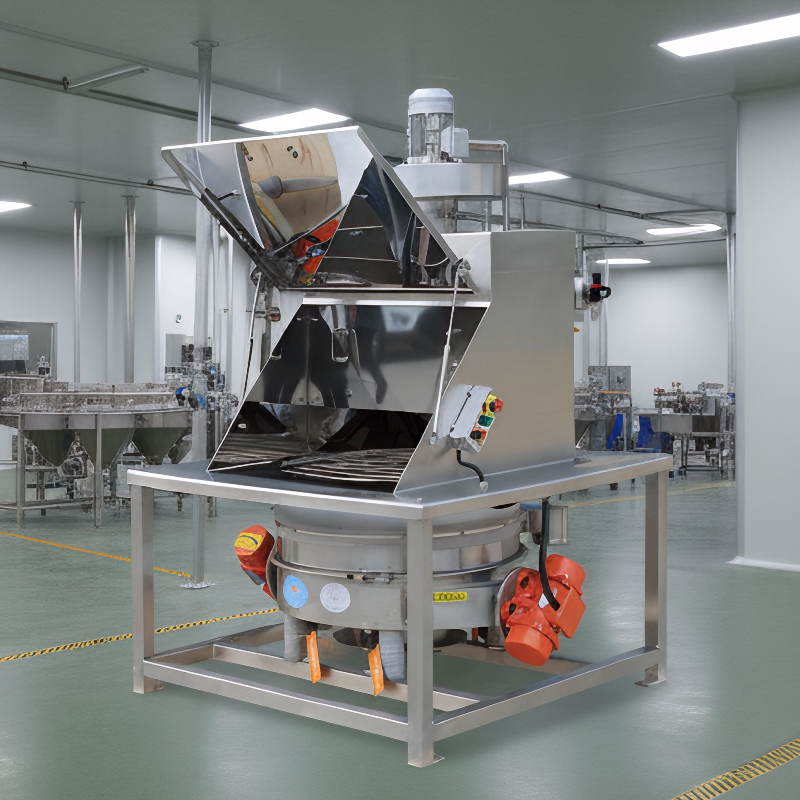
As the core raw material for sports nutrition products, protein powder presents a series of unique challenges at the feeding stage:
Dust emission makes workshop environment difficult to meet standards. Whey protein powder, isolate protein powder, and similar materials can have particle fineness down to 43 microns or even finer – extremely lightweight. The moment a bag is opened and tipped, large quantities of fine powder disperse with air currents throughout the workshop. Dust not only settles on equipment surfaces, increasing cleaning burdens, but can also migrate to other clean areas, compromising the segregation between different cleanliness zones. For sports nutrition plants seeking GMP certification, inadequate dust control is often a "deduction point" during audits.
Material loss – direct economic loss. Every dust emission represents protein powder spillage and waste. Protein powder is a high‑value material – the cumulative dust loss at the feeding stage in large‑scale production is a cost that cannot be ignored. In large‑scale production, raw material waste alone can amount to significant economic losses.
Cross‑contamination risks. Sports nutrition plants typically handle multiple product varieties and formulations – whey protein, soy protein, pea protein, collagen, and more – with frequent changeovers between different materials. If the feeding stage lacks effective enclosed and clean design, cross‑contamination between different materials will directly affect product quality and regulatory compliance.
High labour intensity and operator exposure. Traditional manual feeding requires operators to work directly in dusty environments – not only physically demanding but also posing long‑term respiratory health risks. As the sports nutrition industry places increasing demands on production environment cleanliness, improving feeding stage working conditions has become an issue that companies must address.
The design logic of Gaofu's dust‑free feeding station differs from traditional end‑of‑pipe approaches that deal with dust "after it is generated." Instead, it addresses the problem at the source – preventing dust from ever having the chance to disperse into the workshop air.
Its core design approach can be summarised in three keywords: enclosed, negative pressure, and filtration. These three keywords correspond to the three critical stages of dust control – preventing dispersion, actively collecting, and thoroughly separating.
Fully enclosed operating cabinet – physically isolating dust. Operators complete bag opening and tipping inside an enclosed operating cabinet, with the external area physically isolated from the feeding process. This design structurally blocks the path of dust dispersion into the workshop. The equipment features a fully enclosed structure with 99.9% dust collection efficiency , maintaining dust concentration at ≤0.1 mg/m³ during operation. For sports nutrition plants, this means dust control in the feeding area meets GMP clean production standards.
Negative‑pressure dust collection system – actively capturing dust. The equipment is equipped with a dust collection fan that maintains a micro‑negative pressure during feeding. Dust generated when operators open and tip bags is directionally drawn into the filtration system rather than escaping. This active collection method is more effective than simply relying on an enclosed structure – as soon as dust is generated, it is captured and processed, with no opportunity to disperse. The feeding platform operates under negative pressure – no dust leakage, no material loss during feeding – protecting the clean environment.
Pulse‑jet filtration system – achieving air‑dust separation. Dust‑laden air enters the filtration system, where high‑efficiency filter elements capture dust particles. Clean air is exhausted, while dust is retained on the filter surfaces and eventually falls back into the hopper for recovery. The equipment is equipped with a pulse‑jet dust collector that automatically cleans the filter elements at regular intervals, maintaining consistent filtration efficiency. Collected dust is 100% returned to the hopper, with material loss ≤0.5% . This design ensures sustained filtration efficiency while minimising raw material waste.
Food‑grade stainless steel construction – ensuring hygiene and safety. As a food ingredient consumed directly, protein powder places strict requirements on equipment materials and hygiene standards. Gaofu's dust‑free feeding station is designed to hygienic standards – easy to clean, residue‑free. The equipment body is made of 304 or 316L food‑grade stainless steel – smooth surfaces resist material adhesion, with no dead corners. For sports nutrition plants requiring frequent product changeovers, this design effectively prevents material residue and cross‑contamination.
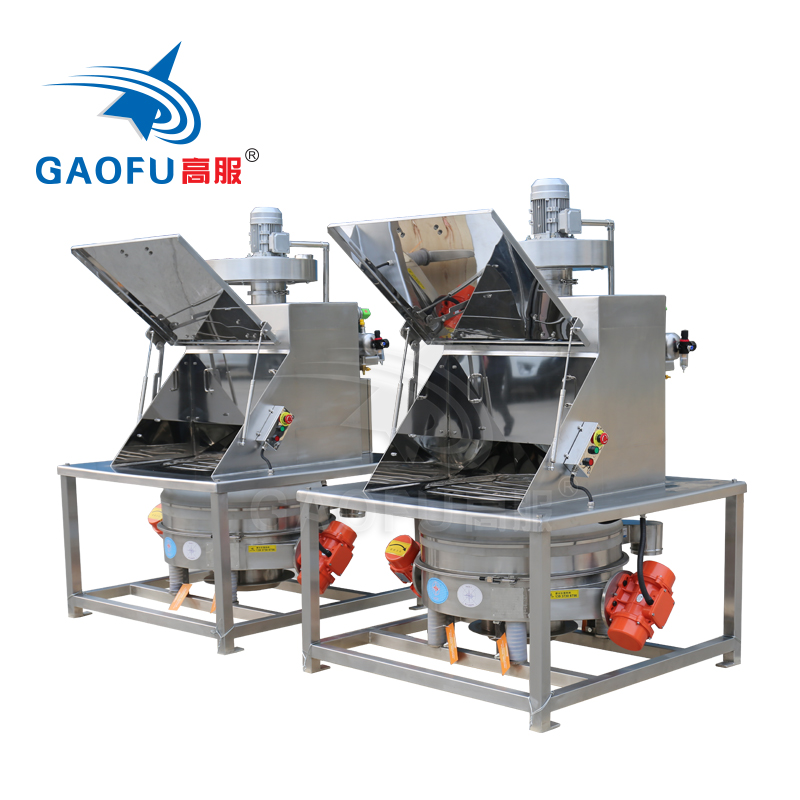
In the actual scenarios of sports nutrition plants, the design of protein powder dust‑free feeding stations should focus on the following dimensions:
1. Adapting to different packaging specifications
Protein powder raw materials in sports nutrition plants typically come in small‑bag packaging (20‑25 kg) or big‑bag (tonne bag) packaging. Gaofu's dust‑free feeding station can adapt to different packaging specifications for powder feeding. For small‑bag materials, operators complete bag opening and feeding on the enclosed feeding platform; for big‑bag materials, automated bag opening and discharging can be achieved through a matching big‑bag feeding station. The station can be connected to positive‑ or negative‑pressure conveying systems for material supply to the production line, achieving fully enclosed operation from feeding to conveying.
2. Integrated screening module – feeding and impurity removal in one step
Protein powder may form lumps due to moisture absorption during storage and transport, or become contaminated with packaging debris, threads, and other foreign matter. Gaofu's dust‑free feeding station integrates a vibrating screening module (safety screen) – as material is fed, it passes through the screen to intercept lumps and foreign matter, with lumps effectively broken and foreign matter reliably intercepted. This "feeding‑and‑screening‑in‑one" design ensures protein powder purity at the source, eliminating the need for a separate screening step and reducing equipment investment.
3. Intelligent control system – improving feeding efficiency
Gaofu's dust‑free feeding station is equipped with a PLC intelligent control system supporting one‑touch start/stop, feed rate monitoring, and automatic filter cleaning. Feeding efficiency reaches 500‑2,000 bags per hour – 3‑5 times faster than traditional manual feeding, reducing labour costs by over 60% . For large‑scale sports nutrition plants, this means the feeding stage no longer bottlenecks the entire production line.
4. Easy‑clean design – suitable for multi‑product changeover production
Sports nutrition plants typically handle multiple product varieties – whey protein, soy protein, pea protein, collagen, and more. The equipment is designed to hygienic standards – no dead corners, supporting quick disassembly and cleaning. During changeovers, the equipment can be quickly cleaned and put into service for the next product, effectively preventing cross‑contamination.
Gaofu's dust‑free feeding station delivers multiple practical improvements for sports nutrition plants in enclosed feeding design:
Significantly improved workshop environment. The fully enclosed negative‑pressure structure substantially reduces dust concentration in the feeding area – workshop air cleanliness is notably enhanced. Dust concentration can be controlled to ≤0.1 mg/m³, meeting GMP clean production standards.
Greatly reduced material loss. The negative‑pressure dust collection system returns 100% of dust generated during feeding to the hopper – material loss ≤0.5%. For high‑value materials like protein powder, this loss control accumulates into substantial long‑term savings.
Effectively reduced cross‑contamination risks. The fully enclosed design and easy‑to‑clean hygienic standards reduce cross‑contamination risks between different product types at the source. For sports nutrition plants requiring frequent product changeovers, this means more stable and controllable product quality.
Significantly improved feeding efficiency. Automated feeding is 3‑5 times faster than manual operation – one system can replace 3‑5 workers. The feeding stage no longer bottlenecks the entire production line, and production capacity is effectively released.
Easier compliance assurance. The equipment meets GMP, FDA, and other stringent standards – helping sports nutrition plants confidently pass food safety inspections and GMP certification audits.
Food Industry Client Testimonials
Nestlé, CP Group, Haitian Flavour & Fragrance, Yihai Kerry, Yili, Mengniu,Shuanghui, Wahaha, Master Kong, Want Want, Anjoy Foods, Angel Yeast,Yangyuan Foods, Uni-President Enterprises, Qiaqia Food, Luhua Group,Alpenliebe, Golden Monkey, Orion, Xizhilang,Sanquan Foods, Synear Food, Oishi, Wong Lo Kat, Yanjing Beer, Seamild,Jinpai, Chubang, Hengshun Vinegar Industry, Longda Group, Beijing Daoxiangcun, Anhe Dairy,Weiwei Group, Xiangpiaopiao, Maiquer, Tianbing, Binqi Food, Ligao Okun
Fortune 500 Client Testimonials
CNPC、CSCEC、Sinochem Holdings、CRCC、China Minmetals Corporation、CNOOC、CR、Sinopharm、CHN Energy、COFCO Corporation、Huawei Technologies、PowerChina、CITIC Group、Wuchan Zhongda Group、NORINCO、Chalco、CNBM、 Shaanxi Coal and Chemical Industry Group、Ansteel Group、CETC、CSSC、CASC、CEC、Jinchuan Group、CASIC、Conch Cement、CNNC、SPH、Shanxi Coking Coal Group、 Zhongtai Chemical、GPHL、DEC、Sinosteel Corporation、MCC、China National Salt Industry Chemical、China Baowu Steel Group、China Animal Husbandry Industry Co., Ltd.、CECEP
About Gaofu
Originated in the 1980s, Xinxiang Gaofu Machinery Co., Ltd. has developed into a leading enterprise after more than 40 years of steady development. The company holds authoritative national qualifications including National-level Specialized, Refined, Unique and Innovative Little Giant Enterprise, National Green Factory, National High-tech Enterprise, and National Intellectual Property Advantage Enterprise, and acts as the President Unit of the Vibration Industry Association.
It has established three provincial and municipal R&D platforms: Henan Provincial Industrial Design Center, Henan Provincial Engineering Technology Research Center for Intelligent On-line Screening System, and Xinxiang Municipal Fine Screening Engineering Technology Research Center. Up to now, Gaofu has obtained more than 500 patents covering invention, utility model and design. It has been awarded the Science and Technology Achievement Prize by the Ministry of Industry and Information Technology of China and has participated in drafting and formulating 4 national standards.
Gaofu’s product portfolio covers multiple series and hundreds of specifications, mainly including vibrating screening equipment, conveying equipment and intelligent automatic material handling systems. We provide one-stop overall solutions such as automatic feeding systems, powder supply systems, pneumatic conveying systems, metering and weighing systems, batching systems, micro-ingredient batching systems, water supply systems, oil supply systems, fluid conveying systems, central kitchen powder supply systems, powder conveying systems and feeding systems.
In terms of food production lines, our mature supporting systems cover two major categories: baking production lines and pasta production lines. The baking series includes production lines for bread, cake, crisp cake, croissant, toast, pizza, biscuit and hamburger. The pasta series includes intelligent production lines for steamed buns, stuffed buns, twisted rolls, sesame paste cakes, steamed dumplings, boiled dumplings, fried dough sticks and pies.
Gaofu products sell well across Greater China and are exported to more than 100 countries and regions worldwide, including Russia, Canada, the United States, New Zealand, Japan, Brazil and South Africa. Widely applied in food, pharmaceutical, chemical, metallurgical, building materials, mining, thermal power, environmental protection and other industries, our products have won the trust and recognition of over 10,000 global customers.
Adhering to the corporate mission of improving material quality and efficiency to meet customer needs, Gaofu has long-term stable cooperative relationships with global clients to achieve harmonious and win-win development. At present, Gaofu has become an official qualified supplier of many Fortune Global 500 enterprises, including CNPC, Sinopec, Sinochem Group, China Resources Group, Sinopharm Group, COFCO, China National Building Material, China Aerospace and Jinchuan Group.