Over 10,000+ customers' choice, Focus on screening industry 40+ years
Material characteristics are the primary basis for selecting a linear vibrating screen. The difficulty of protein powder screening ultimately stems from its special physical properties.
1. Plant protein powders: light density, static‑prone, and lump‑prone
Plant protein powders such as soy protein isolate and pea protein typically have high protein content and strong adhesion, making them prone to lumping and agglomeration. These materials are light in density and tend to generate static electricity from friction during screening – fine particles adhere to the screen surface and gradually accumulate, forming a "powder film" that blocks the mesh. Soy protein powder typically requires screening in the range of 24 to 120 mesh, with throughputs ranging from 80 to 1,000 kg/h.
2. Whey protein powder: high fineness, moisture‑prone, and blinding‑prone
Whey protein powder has a particle fineness of approximately 43 microns, making it an ultra‑fine powder. This material has good flowability but is prone to moisture absorption and lumping – during screening, fine powder tends to clog the screen mesh. At the same time, whey protein may contain larger sediment particles that need to be effectively separated through the screen.
3. Impact of material characteristics on screening equipment
The linear vibrating screen is primarily suitable for dry powdered or granular materials with moisture content below 7% and no stickiness , with particle sizes ranging from 0.074 to 5 mm. Protein powders typically meet these conditions, but their electrostatic adhesion and blinding‑prone nature place higher demands on screening equipment.
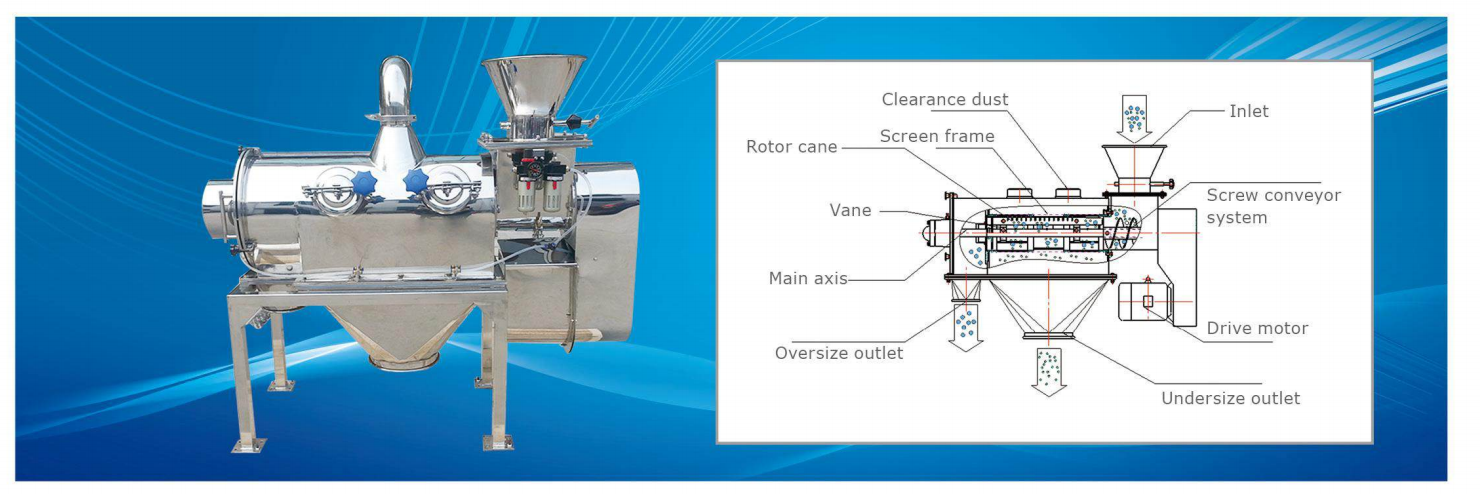
Before selection, it is necessary to define the purpose of screening: impurity removal, grading, or both?
Impurity removal‑focused. When the primary purpose is to remove threads, lumps, and foreign matter from raw materials, single‑deck or double‑deck screens can be used with coarser mesh sizes (20‑80 mesh). The screen surface can be appropriately shortened to prioritise throughput.
Grading‑focused. When protein powder needs to be separated into different particle size grades, multi‑deck screen configurations are recommended. Gaofu's linear vibrating screen supports flexible configurations of 1 to 5 screen decks, enabling a single machine to produce 2 to 6 different particle size fractions simultaneously. In soy protein powder screening, multi‑deck screens achieve simultaneous separation of coarse powder, fine powder, hulls, and dust impurities.
Impurity removal + grading combined. For scenarios requiring both impurity removal and grading, a 3‑deck configuration can be used: the upper deck removes large impurities and lumps, the middle deck separates the合格 product, and the lower deck removes excessive fines.
Equipment Parameters – Matching Production Scale
The selection of equipment parameters directly affects screening efficiency and production capacity.
Screen size. Gaofu's SZF series linear vibrating screen offers various screen sizes from 500×2000 mm to 1500×4000 mm. Screen width affects processing capacity, while length affects screening efficiency. For high‑throughput protein powder screening, "wide and short" models favour throughput, while "narrow and long" models favour accuracy.
Number of screen decks. 1 to 5 decks are available, configurable according to grading requirements. Screen inclination is typically adjustable from 0° to 10° – a larger inclination increases throughput but may slightly reduce screening accuracy.
Throughput. Gaofu's SZF series linear vibrating screen covers single‑machine throughput of 15 to 500 t/h , suitable for both small‑batch fine screening and large‑scale continuous production line operations. Protein powder processors should select the appropriate model based on their capacity requirements.
Screen mesh. Protein powder typically requires 24 to 120 mesh screening. The linear vibrating screen covers 8 to 120 mesh (up to 400 mesh) , with screen sizes flexibly selectable according to finished product fineness requirements. For ultra‑fine powders such as whey protein, fine mesh screens above 200 mesh can be selected.
As a food ingredient, protein powder places strict requirements on screening equipment materials and construction.
Material selection. All material‑contact parts must be made of 304 or 316L food‑grade stainless steel – ordinary carbon steel should not be used. 316L stainless steel offers better corrosion resistance and is suitable for production scenarios with higher hygiene standards. Gaofu's linear vibrating screen offers SUS304/SUS316L stainless steel for contact parts, with a Q235A carbon steel frame.
Fully enclosed structure. Dust emission during protein powder screening not only causes material loss but may also lead to cross‑contamination. Gaofu's linear vibrating screen features a fully enclosed frame design with a negative‑pressure dust extraction interface – effectively suppressing dust emission and improving the working environment. The fully enclosed structure also helps suppress dust dispersion and reduces dust explosion risks.
Easy‑clean design. The equipment structure should have no dead corners and be easy to clean internally and externally. Food‑grade linear screens typically use quick‑release screen structures – entire screen decks can be removed and replaced within 3‑5 minutes.
Anti‑blinding device. For ultra‑fine powders such as protein powder, conventional linear screens are prone to blinding. The ultrasonic cleaning system breaks the surface tension between powder particles through high‑frequency vibration, effectively solving the problem of fine powder blinding and improving screening accuracy to over 98%.
With over 40 years of experience in screening, Gaofu Machinery's SZF series linear vibrating screen offers five core advantages – high accuracy, large capacity, low energy consumption, easy maintenance, and strong environmental protection – making it a preferred choice for high‑efficiency grading and impurity removal in powder processing.
Dual‑motor synchronous drive for high screening accuracy. The equipment uses dual vibrating motors operating in synchronised opposite directions – lateral excitation forces cancel each other out, while the longitudinal resultant force drives the screen surface in high‑frequency linear vibration. Material moves forward in a parabolic bouncing motion on the screen surface, quickly loosening, stratifying, and passing through – screening accuracy reaches over 95%.
Flexible multi‑deck configurations – multi‑stage grading in one machine. Supports 1 to 5 screen decks – a single pass can separate 2 to 7 particle size fractions. In soy protein powder screening, multi‑deck screens achieve simultaneous separation of coarse powder, fine powder, hulls, and dust impurities.
Fully enclosed stainless steel structure – hygiene and safety assured. The entire machine is constructed of high‑quality 304/316 stainless steel – robust, corrosion‑resistant, and durable, meeting food and pharmaceutical industry hygiene standards. The fully enclosed frame, combined with a negative‑pressure dust extraction interface, effectively suppresses dust emission.
Quick screen changes – easy maintenance. Screens use a tensioned installation structure – replacements can be made quickly without special tools. The unique screen structure design allows screen changes in just 3‑5 minutes, significantly reducing downtime and maintenance costs.
Stable operation – suitable for continuous production. The vibration motors are optimised for low noise, low energy consumption, and long service life – ensuring 24‑hour continuous stable operation. Low energy consumption helps reduce long‑term operating costs.
Food Industry Client Testimonials
Nestlé, CP Group, Haitian Flavour & Fragrance, Yihai Kerry, Yili, Mengniu,Shuanghui, Wahaha, Master Kong, Want Want, Anjoy Foods, Angel Yeast,Yangyuan Foods, Uni-President Enterprises, Qiaqia Food, Luhua Group,Alpenliebe, Golden Monkey, Orion, Xizhilang,Sanquan Foods, Synear Food, Oishi, Wong Lo Kat, Yanjing Beer, Seamild,Jinpai, Chubang, Hengshun Vinegar Industry, Longda Group, Beijing Daoxiangcun, Anhe Dairy,Weiwei Group, Xiangpiaopiao, Maiquer, Tianbing, Binqi Food, Ligao Okun
Fortune 500 Client Testimonials
CNPC、CSCEC、Sinochem Holdings、CRCC、China Minmetals Corporation、CNOOC、CR、Sinopharm、CHN Energy、COFCO Corporation、Huawei Technologies、PowerChina、CITIC Group、Wuchan Zhongda Group、NORINCO、Chalco、CNBM、 Shaanxi Coal and Chemical Industry Group、Ansteel Group、CETC、CSSC、CASC、CEC、Jinchuan Group、CASIC、Conch Cement、CNNC、SPH、Shanxi Coking Coal Group、 Zhongtai Chemical、GPHL、DEC、Sinosteel Corporation、MCC、China National Salt Industry Chemical、China Baowu Steel Group、China Animal Husbandry Industry Co., Ltd.、CECEP
About Gaofu
Xinxiang Gaofu Machinery Co., Ltd. was founded back in the 1980s. With over 40 years of development, it has been certified as a National-level Specialized, Refined, Unique & Innovative Little Giant Enterprise, National Green Factory, National High-tech Enterprise, and National Intellectual Property Advantage Enterprise, and serves as the President Unit of China Vibration Screening Industry Association.
The company is accredited with the Henan Provincial Industrial Design Center, Henan Provincial Engineering Technology Research Center for Intelligent On-line Screening System, and Xinxiang Municipal Engineering Technology Research Center for Fine Screening.
Gaofu has obtained more than 500 patents including invention patents, utility model patents and design patents, been awarded the Science and Technology Achievement Prize issued by the Ministry of Industry and Information Technology of China, and participated in drafting and formulating 4 national standards.
Gaofu's product portfolio covers multiple series and hundreds of specifications, including vibrating screening equipment, conveying equipment, coal crushing equipment, filtration equipment and automatic material handling systems.
Core products include vibrating screens, screening machines, vibratory sifters, rotary vibrating screens, ultrasonic vibrating screens, linear vibrating screens, airflow screens, gyratory screens, roller screens, dewatering screens, bar screens, vacuum feeding machines, dust-free feeding stations, bulk bag feeding stations, feeding systems, automatic powder feeding systems, automatic slag-discharging filters, leaf filters, clay filters, toothed roll crushers, coal crushers and other machinery.
These products are widely applied in food, pharmaceutical, chemical, metallurgy, construction materials, mining, thermal power, environmental protection and many other industries, winning recognition and trust from over 10,000 clients worldwide.
Gaofu products enjoy strong sales across Greater China, and are exported to more than 100 countries and regions such as Russia, Canada, the United States, New Zealand, Japan, Brazil and South Africa.
Upholding the corporate mission of Improving material quality & efficiency to fully satisfy customer demands, Gaofu maintains long-term partnerships with clients to achieve win-win development.
At present, Gaofu is an official qualified supplier for numerous Fortune Global 500 enterprises, including CNPC, Sinopec, Sinochem Holdings, China Resources Group, Sinopharm Group, COFCO, China National Building Material, China Aerospace Science and Technology Corporation, Jinchuan Group and more.
Gaofu Machinery ranks No.1 in global sales volume of vibrating screens.
In May 2024, Frost & Sullivan, a world-renowned international consulting firm, issued a Market Position Verification Certificate confirming that Gaofu achieved the world's largest shipment volume of vibrating screens in the global market in 2023.