Over 10,000+ customers' choice, Focus on screening industry 40+ years
Salt's corrosiveness varies in different forms, placing different demands on conveying equipment:
Corrosion characteristics of wet salt. Wet salt contains significant moisture and dissolved salt ions, forming a high‑concentration electrolyte solution. When this solution contacts metal, it produces intense electrochemical corrosion. During wet salt conveying, brine splashing, liquid accumulation on pipe walls, and brine retention at bends – every contact point is a high‑risk corrosion area. For wet salt conveying equipment, material corrosion resistance is the first and most important line of defence. 316L stainless steel – with its added molybdenum content – offers far superior resistance to pitting and crevice corrosion compared with 304 stainless steel.
Corrosion characteristics of dry salt. Although dry salt has low moisture content, static electricity generated by particle friction during conveying attracts airborne moisture. This moisture forms an extremely thin liquid film on equipment surfaces, which dissolves salt particles to form an electrolyte solution that causes slow but continuous electrochemical corrosion. Pipe walls, bends, and valves in dry salt conveying systems, with long‑term contact with salt particles and trace moisture, experience corrosion that is less intense than wet salt but still significant. 316L stainless steel has 2‑3 times the corrosion resistance of 304 stainless steel in high‑salt environments, capable of withstanding long‑term exposure to media with pH values ranging from 3 to 11.
Additional corrosion burden of sea salt. In addition to sodium chloride, sea salt contains impurities such as magnesium chloride and calcium chloride. These components are more hygroscopic, forming electrolyte solutions with better conductivity and more aggressive corrosion. For processors handling sea salt, equipment materials require higher corrosion resistance grades.
Gaofu's corrosion‑resistant salt vacuum conveyor fully considers the different corrosion characteristics of dry and wet salt in material selection:
Entire machine in 316L food‑grade stainless steel. All parts that contact salt materials – including the main body, conveying pipes, hoppers, and discharge components – are made of 316L food‑grade stainless steel. With added molybdenum (2%‑3%), 316L stainless steel offers excellent resistance to chloride ions (the primary component of salt). It provides good corrosion resistance to acids, alkalis, and salt solutions, making it especially suitable for handling corrosive materials such as chloride‑containing sea salt and wet salt.
Mirror‑polished surfaces reduce corrosion attachment points. The internal surfaces are finely mirror‑polished to a low surface roughness. Smooth surfaces reduce material residue and corrosion medium attachment sites, lowering the risk of sustained corrosion. Smooth surfaces also resist salt particle and moisture adhesion – salt particles and moisture are the "fuel" for corrosion – reducing their residence time on equipment surfaces reduces the probability of corrosion at the physical level.
Thickened anti‑corrosion structure withstands long‑term salt spray corrosion. The entire piping system, hoppers, and discharge components are constructed of thickened, corrosion‑resistant stainless steel – capable of withstanding long‑term salt spray corrosion, preventing equipment rusting that could generate metal particles contaminating food raw materials. For salt production workshops requiring 24‑hour continuous operation, thickened structures mean longer equipment life and lower replacement frequency.
Traceable materials ensure quality assurance. All stainless steel materials are supplied with traceable material certificates, ensuring compliance and reliable quality from the source. They meet food‑grade production requirements, ensuring no heavy metal contamination during conveying.
Wet salt conveying is far more difficult than dry salt – brine corrosion, salt particle lumping blocking piping, wet salt adhering to pipe walls – these are common problems in wet salt conveying. Gaofu's corrosion‑resistant salt vacuum conveyor incorporates multiple specific design features for wet salt's special properties:
Low‑velocity dense‑phase conveying reduces impact and friction. To suit wet salt's particle characteristics and adhesion, low‑velocity dense‑phase negative‑pressure conveying technology is used, combined with large‑radius smooth piping – reducing airflow impact force and particle‑to‑wall friction. Lower conveying speed reduces salt particle impact and wear on pipe walls, and also reduces heat generated by friction – heat accelerates surface moisture evaporation from wet salt, causing salt particles to recrystallise and adhere to pipe walls.
Anti‑bridging design ensures continuous discharge. Wet salt in hoppers tends to form lumps and bridges due to gravity compaction and moisture action, causing discharge interruption. The hopper is equipped with an intelligent micro‑vibration anti‑bridging device that continuously breaks up slightly caked salt particles caused by moisture, preventing material bridging, wall adhesion, and blockage – ensuring continuous and uniform discharge. The hopper bottom features a tapered design, combined with pneumatic bridging‑breaking devices, ensuring smooth material discharge and minimising residue accumulation.
Fully enclosed negative‑pressure environment isolates moisture. Wet salt corrosion requires moisture as a medium. The fully enclosed negative‑pressure environment significantly isolates outside air and moisture, fundamentally reducing the corrosion rate of wet salt on equipment, while also reducing the probability of salt lumping due to moisture absorption. Fully enclosed pipe conveying keeps wet salt isolated from the outside from suction nozzle to receiving equipment – dust‑free and leak‑free.
"Zero" residue in piping reduces corrosion residence time. Enclosed pipe conveying means no spillage or residue during transfer. The internal surfaces of conveying pipes are mirror‑polished, leaving minimal material residue – reducing the residence time of brine and salt particles on equipment surfaces. Shorter residence time means less opportunity for corrosion.
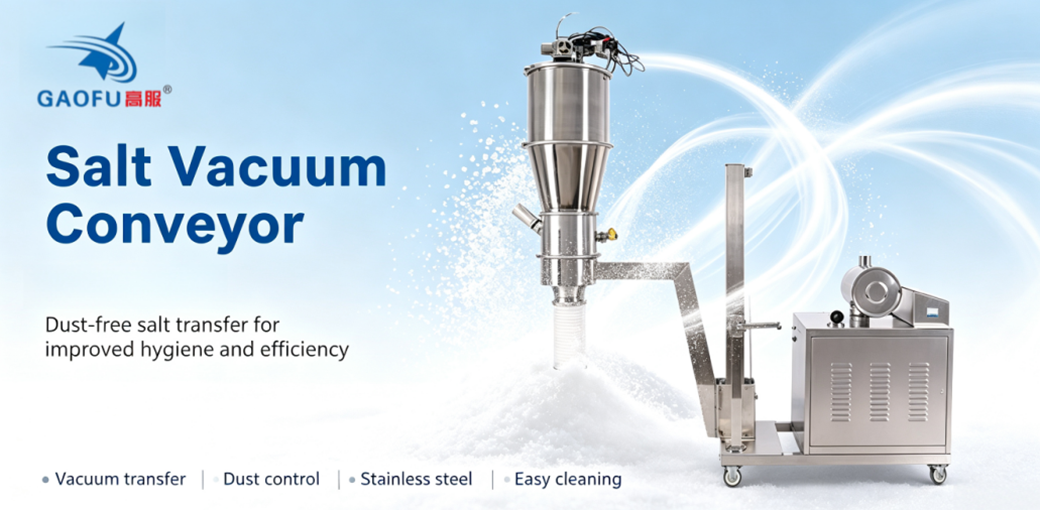
Gaofu's corrosion‑resistant salt vacuum conveyor uses the negative‑pressure vacuum conveying principle. A vacuum pump evacuates the system, creating a vacuum state. Salt particles are drawn into the suction nozzle with outside air, forming an air‑material mixture that travels through the enclosed conveying pipe to the hopper. After air‑material separation in the hopper, the separated material enters the receiving equipment.
Enclosed pipe conveying – dry and wet salt are completely isolated throughout. Whether for dry salt or wet salt, the entire conveying process takes place in a closed piping system. Material is isolated from outside air from the suction nozzle to the receiving equipment – dust‑free and leak‑free. For wet salt, the enclosed environment isolates external moisture intrusion; for dry salt, the enclosed environment prevents salt dust emission and moisture absorption.
Pulse‑jet cleaning system ensures continuous operation. The equipment is equipped with a compressed air pulse‑jet cleaning device that blows back through the filters during each discharge cycle, dislodging powder adhering to the filter surface. This design ensures the filtration system remains efficient during long‑duration continuous operation – preventing negative pressure drop or conveying interruption caused by filter clogging.
Food‑grade seals – corrosion‑resistant and hygienic. Seals are made of food‑grade corrosion‑resistant materials, ensuring the airtightness of the entire conveying system and preventing dust leakage and external contamination. In salt environments, the chemical stability of seals is critical – inferior seals harden and crack under salt corrosion, leading to seal failure.
Conveying capacity covers various production needs. Gaofu's corrosion‑resistant salt vacuum conveyor covers conveying capacities of 200‑6,000 kg/h , with conveying distances of 5‑30 metres. Flexible selection according to the actual capacity needs of salt production workshops – suitable for various scenarios from small pilot lines to large‑scale production.
Gaofu's corrosion‑resistant salt vacuum conveyor is used in the following salt production workshop applications:
Cross‑process conveying of wet salt. Enclosed conveying of wet salt after centrifugal dewatering to drying or storage processes. Wet salt has high moisture content and strong corrosiveness – the fully enclosed 316L stainless steel piping effectively resists brine corrosion, ensuring stable, leak‑free conveying.
Finished product feeding of dry salt. Enclosed conveying of refined dry salt from drying to packaging or batching systems. No dust emission throughout, ensuring finished salt purity. For edible salt production, this means product quality is protected at the transfer stage.
Corrosion‑resistant conveying of sea salt. Sea salt contains aggressive corrosive components such as magnesium chloride and calcium chloride. 316L stainless steel offers excellent resistance to chloride ions, capable of withstanding long‑term sea salt corrosion – preventing equipment rusting and material contamination.
Cross‑contamination prevention in multi‑product changeover production. Quick‑release structural design with no dead corners, easy to inspect and clean – particularly suitable for multi‑product changeover production, effectively preventing cross‑contamination.
Food Industry Client Testimonials
Nestlé, CP Group, Haitian Flavour & Fragrance, Yihai Kerry, Yili, Mengniu,Shuanghui, Wahaha, Master Kong, Want Want, Anjoy Foods, Angel Yeast,Yangyuan Foods, Uni-President Enterprises, Qiaqia Food, Luhua Group,Alpenliebe, Golden Monkey, Orion, Xizhilang,Sanquan Foods, Synear Food, Oishi, Wong Lo Kat, Yanjing Beer, Seamild,Jinpai, Chubang, Hengshun Vinegar Industry, Longda Group, Beijing Daoxiangcun, Anhe Dairy,Weiwei Group, Xiangpiaopiao, Maiquer, Tianbing, Binqi Food, Ligao Okun
Fortune 500 Client Testimonials
CNPC、CSCEC、Sinochem Holdings、CRCC、China Minmetals Corporation、CNOOC、CR、Sinopharm、CHN Energy、COFCO Corporation、Huawei Technologies、PowerChina、CITIC Group、Wuchan Zhongda Group、NORINCO、Chalco、CNBM、 Shaanxi Coal and Chemical Industry Group、Ansteel Group、CETC、CSSC、CASC、CEC、Jinchuan Group、CASIC、Conch Cement、CNNC、SPH、Shanxi Coking Coal Group、 Zhongtai Chemical、GPHL、DEC、Sinosteel Corporation、MCC、China National Salt Industry Chemical、China Baowu Steel Group、China Animal Husbandry Industry Co., Ltd.、CECEP
About Gaofu
Xinxiang Gaofu Machinery Co., Ltd. was founded back in the 1980s. With over 40 years of development, it has been certified as a National-level Specialized, Refined, Unique & Innovative Little Giant Enterprise, National Green Factory, National High-tech Enterprise, and National Intellectual Property Advantage Enterprise, and serves as the President Unit of China Vibration Screening Industry Association.
The company is accredited with the Henan Provincial Industrial Design Center, Henan Provincial Engineering Technology Research Center for Intelligent On-line Screening System, and Xinxiang Municipal Engineering Technology Research Center for Fine Screening.
Gaofu has obtained more than 500 patents including invention patents, utility model patents and design patents, been awarded the Science and Technology Achievement Prize issued by the Ministry of Industry and Information Technology of China, and participated in drafting and formulating 4 national standards.
Gaofu's product portfolio covers multiple series and hundreds of specifications, including vibrating screening equipment, conveying equipment, coal crushing equipment, filtration equipment and automatic material handling systems.
Core products include vibrating screens, screening machines, vibratory sifters, rotary vibrating screens, ultrasonic vibrating screens, linear vibrating screens, airflow screens, gyratory screens, roller screens, dewatering screens, bar screens, vacuum feeding machines, dust-free feeding stations, bulk bag feeding stations, feeding systems, automatic powder feeding systems, automatic slag-discharging filters, leaf filters, clay filters, toothed roll crushers, coal crushers and other machinery.
These products are widely applied in food, pharmaceutical, chemical, metallurgy, construction materials, mining, thermal power, environmental protection and many other industries, winning recognition and trust from over 10,000 clients worldwide.
Gaofu products enjoy strong sales across Greater China, and are exported to more than 100 countries and regions such as Russia, Canada, the United States, New Zealand, Japan, Brazil and South Africa.
Upholding the corporate mission of Improving material quality & efficiency to fully satisfy customer demands, Gaofu maintains long-term partnerships with clients to achieve win-win development.
At present, Gaofu is an official qualified supplier for numerous Fortune Global 500 enterprises, including CNPC, Sinopec, Sinochem Holdings, China Resources Group, Sinopharm Group, COFCO, China National Building Material, China Aerospace Science and Technology Corporation, Jinchuan Group and more.
Gaofu Machinery ranks No.1 in global sales volume of vibrating screens.
In May 2024, Frost & Sullivan, a world-renowned international consulting firm, issued a Market Position Verification Certificate confirming that Gaofu achieved the world's largest shipment volume of vibrating screens in the global market in 2023.