Over 10,000+ customers' choice, Focus on screening industry 40+ years
Salt dust generated during transfer – commonly referred to as "salt dust" – has impacts far beyond just being "dirty":
Equipment corrosion. Salt dust is hygroscopic. When it settles on equipment surfaces, it absorbs moisture from the air, forming salt deposits that accelerate electrochemical corrosion of metal equipment. Over time, equipment surfaces rust, structural strength degrades, and maintenance frequency and replacement costs increase.
Material loss. Every dust emission represents raw material spillage and waste. In large‑scale production, the cumulative salt dust loss during transfer is a cost that cannot be ignored – not only product loss but also increased cleaning labour input.
Workshop environmental pollution. Salt dust suspended in the workshop air settles on walls, floors, and equipment surfaces – affecting workshop cleanliness and increasing cleaning burdens. For food production workshops, salt dust accumulation can also become a breeding ground for microorganisms.
Employee health impact. Long‑term exposure to high‑concentration salt dust environments can irritate operators' respiratory systems. Salt dust also irritates skin and eyes. Improving dust control at the transfer stage is a basic health protection measure for frontline workers.
Traditional salt transfer methods – whether manual handling, screw conveyors, or bucket elevators – struggle to fundamentally solve dust emission problems. Their common limitation is that material is exposed to air during transfer, or the equipment itself cannot be fully enclosed.
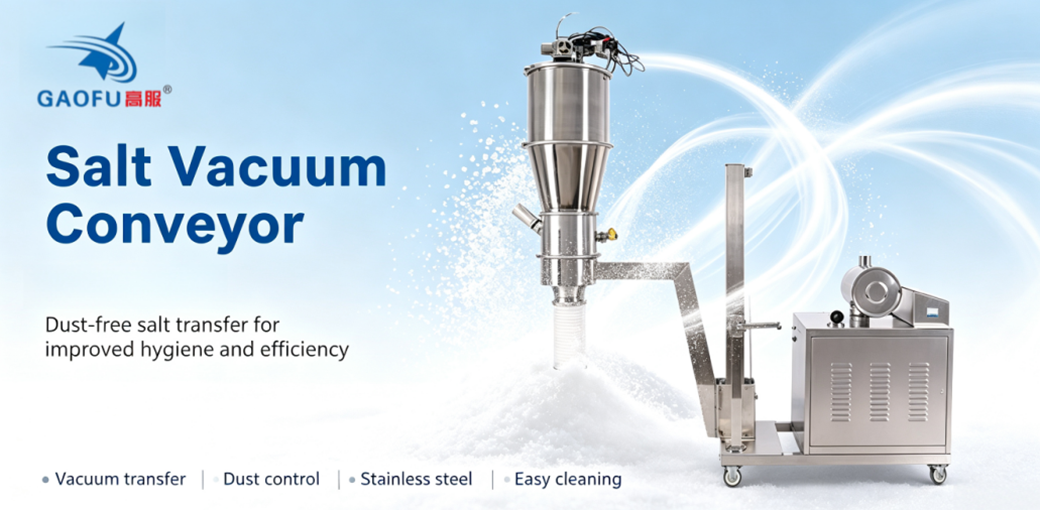
Gaofu's salt vacuum conveyor takes a completely different technical path: using negative pressure as the driving force and piping as the channel, salt is "automatically transported" to the target location in an enclosed environment.
Working principle. The vacuum pump evacuates the system, creating a vacuum state at the suction nozzle inlet and throughout the system. Salt particles are drawn into the suction nozzle with outside air, forming an air‑material mixture that travels through the enclosed conveying pipe to the hopper. After air‑material separation in the hopper, the separated material enters the receiving equipment. Conveying and discharge are controlled by pneumatic three‑way valves that open and close automatically, managed by a central control unit.
The equipment is equipped with a compressed air pulse‑jet cleaning system that blows back through the filters during each discharge cycle, dislodging powder adhering to the filter surface to ensure continuous and stable conveying.
The key difference is: salt is no longer exposed to workshop air – it is transferred from one point to another entirely within enclosed piping. The entire conveying process takes place in a sealed system with no powder leakage. This fundamental difference gives vacuum conveying inherent advantages over traditional transfer methods when handling fine powders like salt.
The dust prevention capability of Gaofu's salt vacuum conveyor comes from systematic design across multiple levels:
Fully enclosed pipe conveying completely eliminates dust emission. The equipment uses a fully enclosed negative‑pressure conveying system – the entire transfer process is completed within enclosed piping, completely eliminating material "spillage, leakage, emission, and drip" during transfer. Fully enclosed pipe conveying is dust‑free and leak‑free, keeping the workshop clean. For dust‑prone materials like salt, this means dust has no opportunity to disperse at the transfer source.
Negative‑pressure environment – active collection rather than passive defence. Unlike open transfer where dust "passively disperses," the negative‑pressure environment of vacuum conveying means dust is "actively collected" – material is drawn into the piping by negative‑pressure airflow rather than escaping. This active collection method is more effective than simply relying on an enclosed structure.
Food‑grade stainless steel construction – corrosion‑resistant and hygienic. All parts that directly contact salt are made of 304 or 316L food‑grade stainless steel – offering excellent corrosion resistance against salt material attack. The equipment has no gaps or dead corners where material can accumulate, and surfaces are easy to inspect and clean.
Anti‑static and explosion‑proof design for salt material characteristics. During conveying, salt may generate static electricity from friction, creating a risk of static dust accumulation. Gaofu's vacuum conveyor can be customised with anti‑static and explosion‑proof features specifically for salt materials – core equipment meets both dust explosion and gas explosion certification standards.
"Zero" residue in piping reduces material loss. Enclosed pipe conveying means no spillage or waste during transfer. Compared with traditional open transfer methods, raw material loss rates are significantly reduced.
Gaofu's salt vacuum conveyor is used in the following salt processing applications:
Cross‑process transfer of finished salt. Enclosed conveying of refined salt from the drying stage to the packaging stage – no dust emission throughout, ensuring finished salt purity.
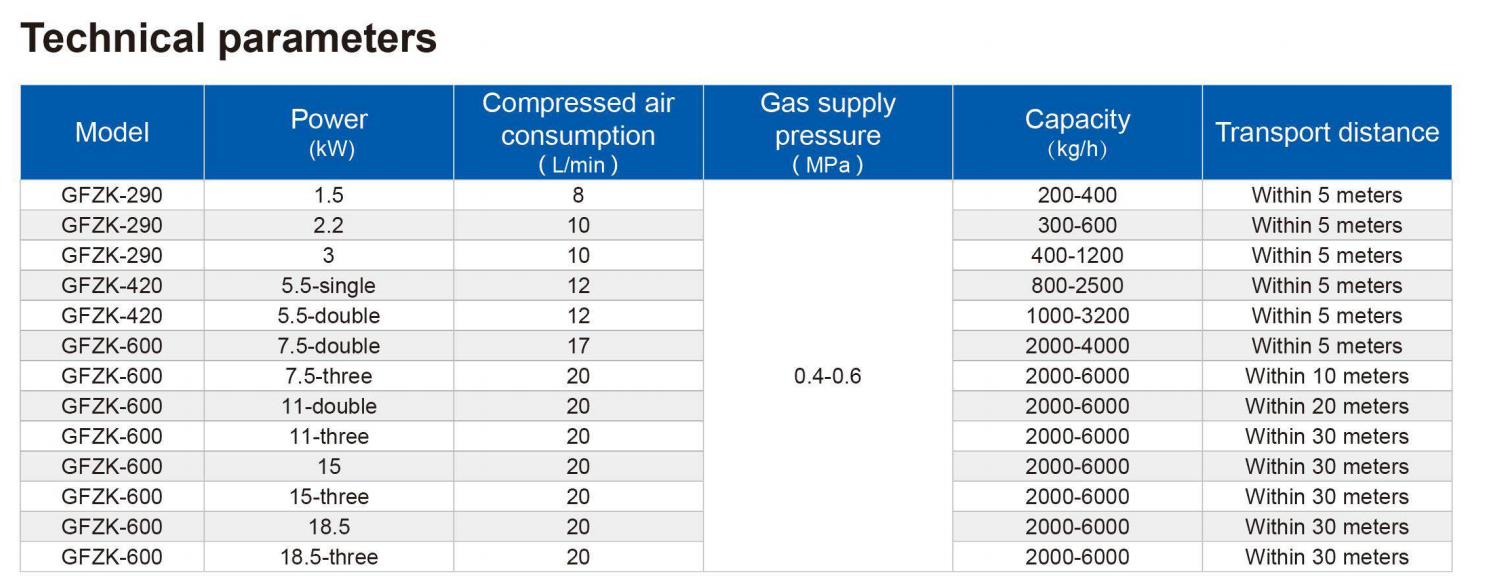
Cross‑area transfer of industrial salt. Enclosed conveying of industrial salt from storage areas to production areas – conveying distances of 5‑30 metres, unrestricted by workshop layout.
Precise feeding in seasoning production. Automatic conveying of salt to seasoning batching systems at set rates – conveying capacity covers 200‑6000 kg/h. Combined with intelligent control systems for precise feeding, avoiding material waste and ensuring batching accuracy.
Cross‑contamination prevention in multi‑product changeover production. Quick‑release structural design with no dead corners, easy to inspect and clean – particularly suitable for multi‑product changeover production, effectively preventing cross‑contamination.
Food Industry Client Testimonials
Nestlé, CP Group, Haitian Flavour & Fragrance, Yihai Kerry, Yili, Mengniu,Shuanghui, Wahaha, Master Kong, Want Want, Anjoy Foods, Angel Yeast,Yangyuan Foods, Uni-President Enterprises, Qiaqia Food, Luhua Group,Alpenliebe, Golden Monkey, Orion, Xizhilang,Sanquan Foods, Synear Food, Oishi, Wong Lo Kat, Yanjing Beer, Seamild,Jinpai, Chubang, Hengshun Vinegar Industry, Longda Group, Beijing Daoxiangcun, Anhe Dairy,Weiwei Group, Xiangpiaopiao, Maiquer, Tianbing, Binqi Food, Ligao Okun
Fortune 500 Client Testimonials
CNPC、CSCEC、Sinochem Holdings、CRCC、China Minmetals Corporation、CNOOC、CR、Sinopharm、CHN Energy、COFCO Corporation、Huawei Technologies、PowerChina、CITIC Group、Wuchan Zhongda Group、NORINCO、Chalco、CNBM、 Shaanxi Coal and Chemical Industry Group、Ansteel Group、CETC、CSSC、CASC、CEC、Jinchuan Group、CASIC、Conch Cement、CNNC、SPH、Shanxi Coking Coal Group、 Zhongtai Chemical、GPHL、DEC、Sinosteel Corporation、MCC、China National Salt Industry Chemical、China Baowu Steel Group、China Animal Husbandry Industry Co., Ltd.、CECEP
About Gaofu
Xinxiang Gaofu Machinery Co., Ltd. was founded back in the 1980s. With over 40 years of development, it has been certified as a National-level Specialized, Refined, Unique & Innovative Little Giant Enterprise, National Green Factory, National High-tech Enterprise, and National Intellectual Property Advantage Enterprise, and serves as the President Unit of China Vibration Screening Industry Association.
The company is accredited with the Henan Provincial Industrial Design Center, Henan Provincial Engineering Technology Research Center for Intelligent On-line Screening System, and Xinxiang Municipal Engineering Technology Research Center for Fine Screening.
Gaofu has obtained more than 500 patents including invention patents, utility model patents and design patents, been awarded the Science and Technology Achievement Prize issued by the Ministry of Industry and Information Technology of China, and participated in drafting and formulating 4 national standards.
Gaofu's product portfolio covers multiple series and hundreds of specifications, including vibrating screening equipment, conveying equipment, coal crushing equipment, filtration equipment and automatic material handling systems.
Core products include vibrating screens, screening machines, vibratory sifters, rotary vibrating screens, ultrasonic vibrating screens, linear vibrating screens, airflow screens, gyratory screens, roller screens, dewatering screens, bar screens, vacuum feeding machines, dust-free feeding stations, bulk bag feeding stations, feeding systems, automatic powder feeding systems, automatic slag-discharging filters, leaf filters, clay filters, toothed roll crushers, coal crushers and other machinery.
These products are widely applied in food, pharmaceutical, chemical, metallurgy, construction materials, mining, thermal power, environmental protection and many other industries, winning recognition and trust from over 10,000 clients worldwide.
Gaofu products enjoy strong sales across Greater China, and are exported to more than 100 countries and regions such as Russia, Canada, the United States, New Zealand, Japan, Brazil and South Africa.
Upholding the corporate mission of Improving material quality & efficiency to fully satisfy customer demands, Gaofu maintains long-term partnerships with clients to achieve win-win development.
At present, Gaofu is an official qualified supplier for numerous Fortune Global 500 enterprises, including CNPC, Sinopec, Sinochem Holdings, China Resources Group, Sinopharm Group, COFCO, China National Building Material, China Aerospace Science and Technology Corporation, Jinchuan Group and more.
Gaofu Machinery ranks No.1 in global sales volume of vibrating screens.
In May 2024, Frost & Sullivan, a world-renowned international consulting firm, issued a Market Position Verification Certificate confirming that Gaofu achieved the world's largest shipment volume of vibrating screens in the global market in 2023.