Over 10,000+ customers' choice, Focus on screening industry 40+ years
Salt is a crystalline particle composed primarily of sodium chloride, with a brittle crystal structure. During conventional vibrating screen operation, the equipment subjects material to high‑frequency, high‑amplitude mechanical vibration – causing salt particles to bounce on the screen surface. While this intense motion can push material through the screen quickly, it also creates continuous impact and abrasion on salt crystals.
Increasing throughput comes at the cost of higher breakage rates. To increase throughput per unit time, conventional vibrating screens typically require higher vibration intensity and frequency. Stronger vibration means salt particles bounce more violently on the screen surface – particles collide with each other and rub against the screen mesh. Intact crystals develop cracks from repeated impact until they break. The higher the vibration intensity, the higher the breakage rate.
Protecting particle integrity comes at the cost of lower throughput. If vibration intensity is reduced to minimise breakage, material moves more slowly on the screen surface, screening efficiency drops, and throughput per unit time decreases. In large‑scale production, this means more equipment or longer operating hours – driving up investment and operating costs.
This dilemma is difficult to reconcile on conventional vibrating screens. The salt probability screen offers a different technical path – achieving large‑volume screening without relying on high‑intensity vibration.
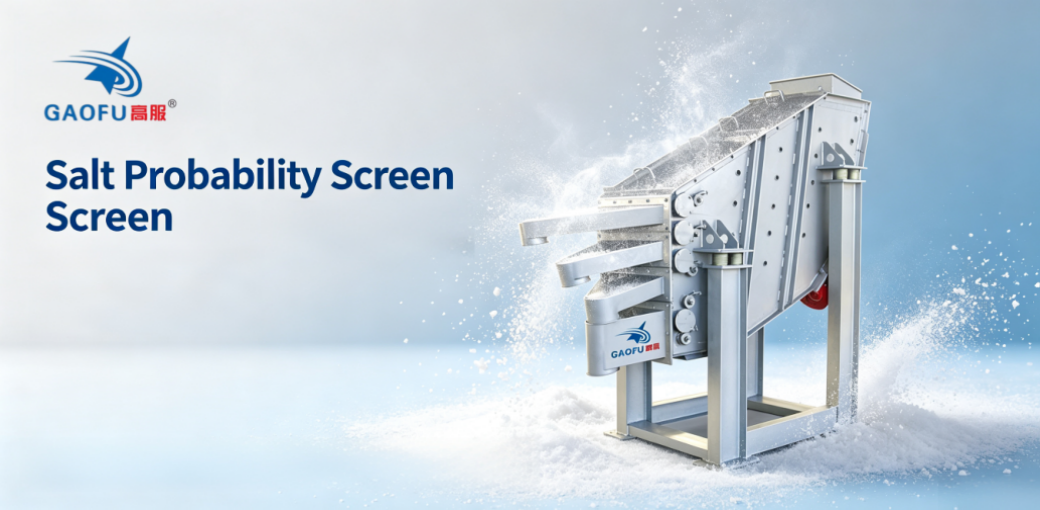
Gaofu's GLS series salt probability screen differs fundamentally from conventional vibrating screens in its underlying logic.
Conventional vibrating screens operate on a logic similar to "individual inspection" – each particle must bounce repeatedly on the screen surface to find a mesh opening. When the material bed is thick and throughput is high, congestion occurs and screening efficiency drops sharply. The probability screen uses a completely different logic: increasing the probability of passage and shortening the material's residence time on the screen surface.
Probability screening theory states that: the residence time of particles on the screen surface is inversely proportional to their particle size – fine particles pass through the screen quickly, while particles close to the mesh size have extended residence time. The probability screen actively leverages this principle, allowing fine particles to "pass quickly" and coarse particles to "discharge rapidly," completing screening in an extremely short time.
The advantage of this principle in practice is: the screening time required for material is only 1/3 to 1/20 of that of conventional vibrating screens, and the processing capacity per unit screen area is 5 to 10 times that of conventional vibrating screens. For salt production lines requiring large‑volume continuous screening, this means the same equipment footprint can yield several times the output of traditional equipment.
Gaofu's GLS series salt probability screen achieves its large throughput through the following three core design features:
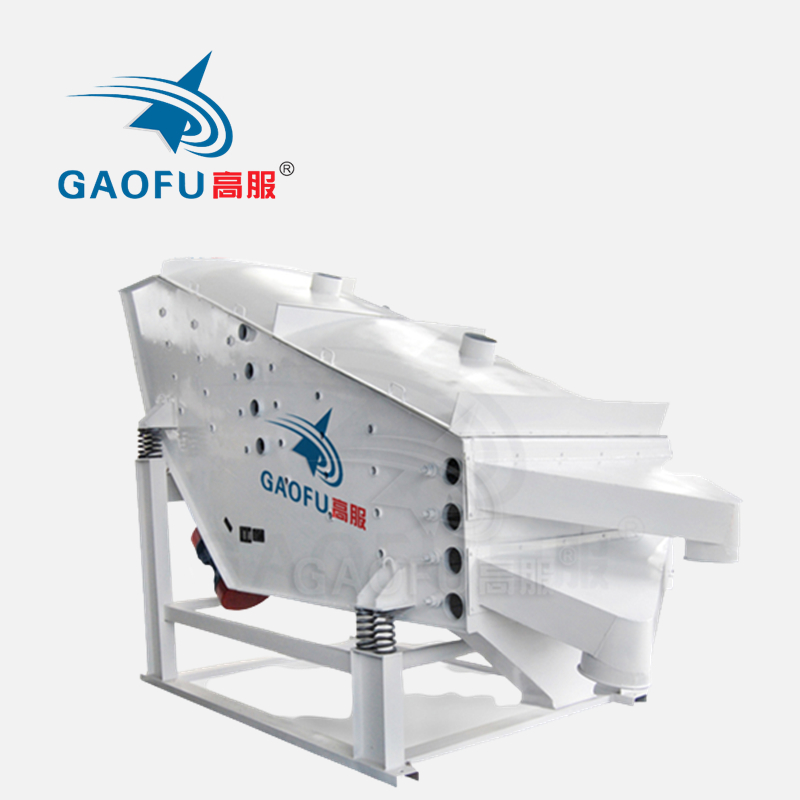
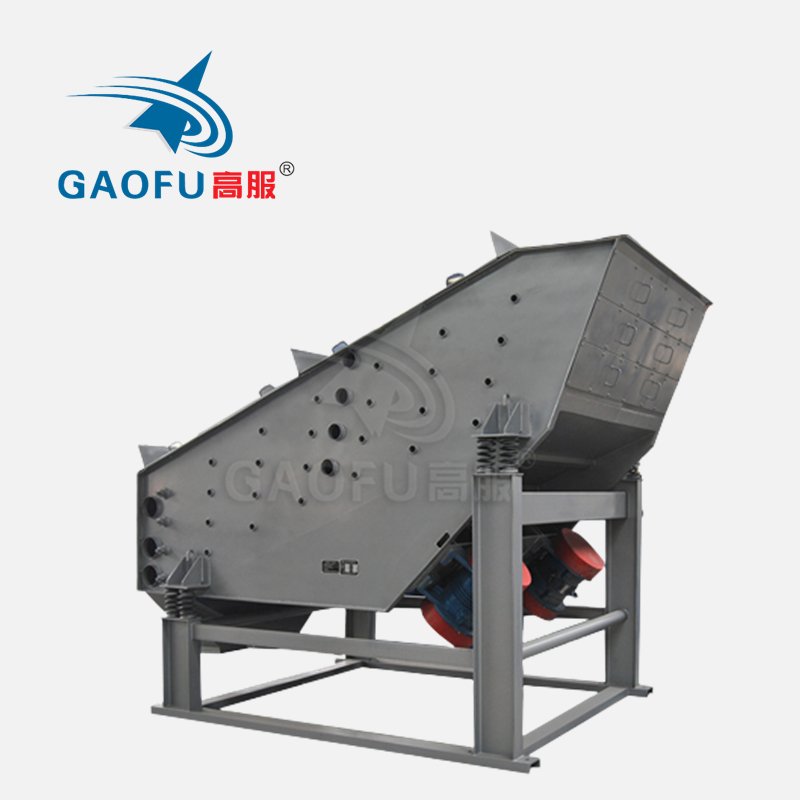
High‑inclination screen surface for rapid material passage without accumulation. The screen inclination is far greater than conventional screens (typically 15° to 30°), giving material high initial velocity at the feed end – the material bed rapidly thins and moves forward quickly. Salt particles move rapidly across the screen surface like "riding a slide" – fine particles have sufficient opportunity to pass through quickly, while coarse particles are discharged rapidly without accumulating on the screen surface.
Large‑aperture screen mesh effectively reduces blinding. The screen aperture is designed at 1.2 to 2.2 times the separation particle size. Because the mesh openings are larger than the target particles, particles are less likely to become wedged – greatly reducing blinding probability. Combined with high‑frequency low‑amplitude vibration and self‑cleaning screen surfaces, this effectively alleviates wedging caused by irregular salt crystal shapes.
Multi‑deck grading – multiple specifications from one feed. The equipment is configured with 2 to 5 screen decks , with screening mesh covering 5 mm down to 0.075 mm (200 mesh) . Coarse salt, medium salt, fine salt, and ultra‑fine salt powder are produced simultaneously in one feed. In coarse sand screening of manufactured sand and natural sand, the probability screen achieves 3‑6 times the throughput of conventional screens, with single‑machine hourly output reaching 10‑300 tonnes. For salt processing, this means a single probability screen can match the screening requirements of high‑capacity salt production lines.
Large throughput does not necessarily mean high breakage rates. The salt probability screen effectively controls salt crystal breakage while achieving large throughput through the following design features:
Rapid material passage reduces collision frequency. In conventional vibrating screens, salt particles bounce repeatedly on the screen surface, enduring multiple collisions before passing through. The probability screen's high inclination means material passes through the screen quickly – the residence time of salt particles on the screen surface is greatly shortened, and the number of particle‑to‑particle collisions and particle‑to‑screen friction events is correspondingly reduced. Every collision is a potential cause of breakage – fewer collisions directly translate to lower breakage rates.
Low‑frequency, low‑amplitude vibration with controlled impact. Unlike the high‑frequency, high‑amplitude vibration of conventional screens, the probability screen uses low‑frequency, low‑amplitude vibration. While maintaining screening efficiency, the impact force on salt crystals is gentler. For brittle crystalline particles like salt, reduced impact force directly results in lower breakage rates.
Arched screen surface design disperses impact forces. Gaofu's probability screen features an arched screen surface that disperses impact forces by changing the material impact point angle. The impact energy of salt particles landing on the screen surface is dispersed and absorbed rather than concentrated on the crystal surface. This design protects salt crystal integrity while extending screen service life.
Short screening path means less abrasion. The probability screen's rapid screening characteristic means material travels a much shorter path on the screen surface than conventional vibrating screens. A shorter path means less friction and abrasion – salt crystal edges and surfaces are better preserved.
External ratchet tensioning keeps the screen flat, preventing particle damage. The external ratchet tensioning device allows operators to easily control screen tension, keeping the screen flat and secure. A flat screen surface reduces extra friction and collision caused by unevenness, further lowering breakage rates.
In actual salt screening applications, Gaofu's GLS series salt probability screen has demonstrated its "high throughput, low breakage" performance:
In terms of throughput, a single probability screen achieves 3‑6 times the capacity of conventional screens. For salt production lines processing hundreds of tonnes per day, a single probability screen matches the capacity rhythm of the entire line – no need for multiple machines in parallel. The screening stage no longer becomes the "weak link" constraining the efficiency of the entire production line.
In terms of breakage, because material passes through quickly, impact forces are controlled, and screen surface design is optimised, salt crystal breakage rates are significantly lower than conventional vibrating screens. Intact salt crystals are uniform with distinct edges – finished product appearance and grade are protected.
In terms of overall benefit, the combination of high throughput and low breakage means: for the same output, fewer machines are needed, floor space is smaller, and maintenance points are fewer; for the same material input, the proportion of qualified product is higher, and the proportion of downgraded product is lower.
Food Industry Client Testimonials
Nestlé, CP Group, Haitian Flavour & Fragrance, Yihai Kerry, Yili, Mengniu,Shuanghui, Wahaha, Master Kong, Want Want, Anjoy Foods, Angel Yeast,Yangyuan Foods, Uni-President Enterprises, Qiaqia Food, Luhua Group,Alpenliebe, Golden Monkey, Orion, Xizhilang,Sanquan Foods, Synear Food, Oishi, Wong Lo Kat, Yanjing Beer, Seamild,Jinpai, Chubang, Hengshun Vinegar Industry, Longda Group, Beijing Daoxiangcun, Anhe Dairy,Weiwei Group, Xiangpiaopiao, Maiquer, Tianbing, Binqi Food, Ligao Okun
Fortune 500 Client Testimonials
CNPC、CSCEC、Sinochem Holdings、CRCC、China Minmetals Corporation、CNOOC、CR、Sinopharm、CHN Energy、COFCO Corporation、Huawei Technologies、PowerChina、CITIC Group、Wuchan Zhongda Group、NORINCO、Chalco、CNBM、 Shaanxi Coal and Chemical Industry Group、Ansteel Group、CETC、CSSC、CASC、CEC、Jinchuan Group、CASIC、Conch Cement、CNNC、SPH、Shanxi Coking Coal Group、 Zhongtai Chemical、GPHL、DEC、Sinosteel Corporation、MCC、China National Salt Industry Chemical、China Baowu Steel Group、China Animal Husbandry Industry Co., Ltd.、CECEP
About Gaofu
Xinxiang Gaofu Machinery Co., Ltd. was founded back in the 1980s. With over 40 years of development, it has been certified as a National-level Specialized, Refined, Unique & Innovative Little Giant Enterprise, National Green Factory, National High-tech Enterprise, and National Intellectual Property Advantage Enterprise, and serves as the President Unit of China Vibration Screening Industry Association.
The company is accredited with the Henan Provincial Industrial Design Center, Henan Provincial Engineering Technology Research Center for Intelligent On-line Screening System, and Xinxiang Municipal Engineering Technology Research Center for Fine Screening.
Gaofu has obtained more than 500 patents including invention patents, utility model patents and design patents, been awarded the Science and Technology Achievement Prize issued by the Ministry of Industry and Information Technology of China, and participated in drafting and formulating 4 national standards.
Gaofu's product portfolio covers multiple series and hundreds of specifications, including vibrating screening equipment, conveying equipment, coal crushing equipment, filtration equipment and automatic material handling systems.
Core products include vibrating screens, screening machines, vibratory sifters, rotary vibrating screens, ultrasonic vibrating screens, linear vibrating screens, airflow screens, gyratory screens, roller screens, dewatering screens, bar screens, vacuum feeding machines, dust-free feeding stations, bulk bag feeding stations, feeding systems, automatic powder feeding systems, automatic slag-discharging filters, leaf filters, clay filters, toothed roll crushers, coal crushers and other machinery.
These products are widely applied in food, pharmaceutical, chemical, metallurgy, construction materials, mining, thermal power, environmental protection and many other industries, winning recognition and trust from over 10,000 clients worldwide.
Gaofu products enjoy strong sales across Greater China, and are exported to more than 100 countries and regions such as Russia, Canada, the United States, New Zealand, Japan, Brazil and South Africa.
Upholding the corporate mission of Improving material quality & efficiency to fully satisfy customer demands, Gaofu maintains long-term partnerships with clients to achieve win-win development.
At present, Gaofu is an official qualified supplier for numerous Fortune Global 500 enterprises, including CNPC, Sinopec, Sinochem Holdings, China Resources Group, Sinopharm Group, COFCO, China National Building Material, China Aerospace Science and Technology Corporation, Jinchuan Group and more.
Gaofu Machinery ranks No.1 in global sales volume of vibrating screens.
In May 2024, Frost & Sullivan, a world-renowned international consulting firm, issued a Market Position Verification Certificate confirming that Gaofu achieved the world's largest shipment volume of vibrating screens in the global market in 2023.