Over 10,000+ customers' choice, Focus on screening industry 40+ years
To understand the value of an enclosed feeding system, we must first understand where flour dust comes from and what impact it has.
The root cause of dust lies in "open handling" and "manual operation." In traditional flour feeding methods, operators cut open flour bags and pour the contents into the feed opening in an open environment – dust rapidly disperses with air currents. During handling, flour dust on the bag surface is dislodged by friction and vibration, creating secondary dust emission. Every manual operation is an opportunity for dust release.
The impact of dust is multi‑dimensional. Flour dust is not just a "dirt" issue – flour dust is a combustible dust. When dust concentration in the workshop accumulates to a certain level, it poses a safety hazard. At the same time, flour dust is a potential carrier of microorganisms and pests – dust adhering to equipment surfaces and settling in crevices can become a breeding ground for microorganisms. Furthermore, every dust emission represents raw material spillage and waste – the cumulative loss in large‑scale production is not negligible.
Traditional dust control methods treat the symptoms, not the root cause. Installing exhaust fans, regular cleaning, and requiring employees to wear masks – these measures are all "passive responses" after dust has been generated. They cannot fundamentally solve the dust problem. Truly effective dust control should start at the source – preventing dust from ever having the chance to disperse into the workshop air.
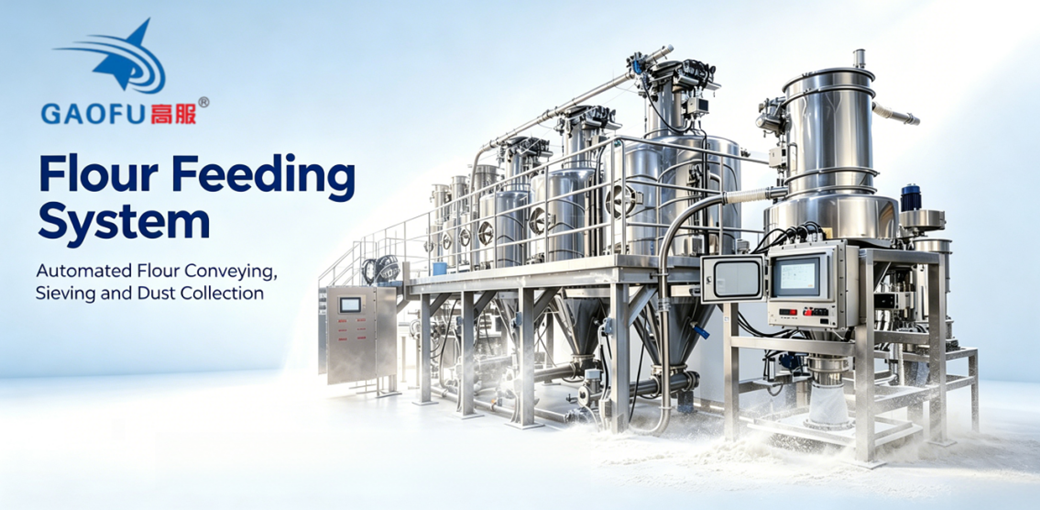
The design logic of Gaofu's enclosed flour feeding system can be summarised in three keywords: enclosed, negative pressure, and filtration. These three keywords correspond to the three critical stages of dust control – preventing dispersion, actively collecting, and thoroughly separating.
Fully enclosed feeding – structurally blocking the path of dust dispersion.
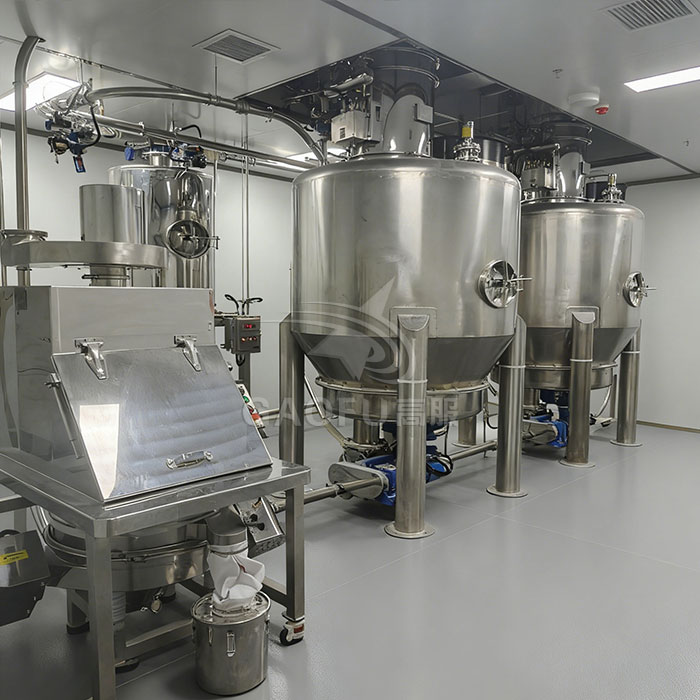
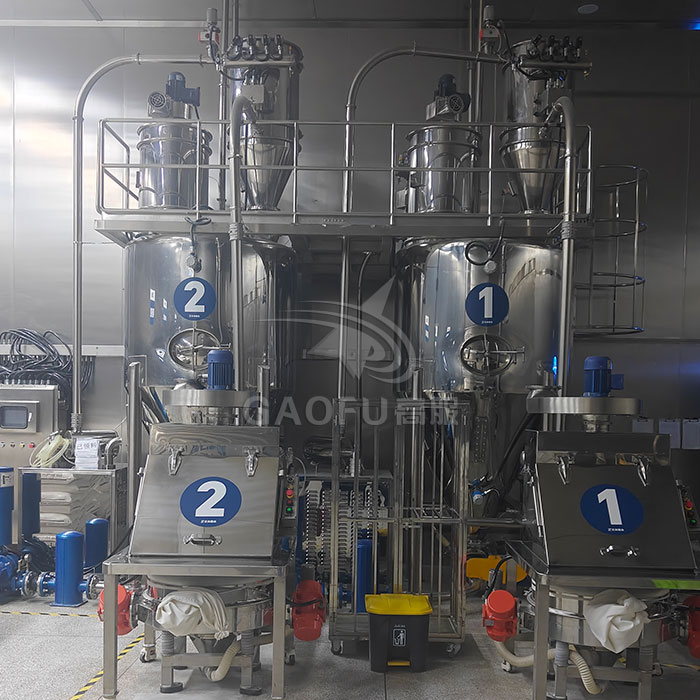
Gaofu's feeding system is equipped with a dust‑free feeding station. Operators complete bag opening and tipping inside an enclosed operating cabinet. The external area is physically isolated from the feeding process – dust has no escape route and must be processed within the enclosed space. Raw materials never contact air or personnel from feeding through conveying.
Negative‑pressure dust collection – active capture rather than passive defence.
The dust‑free feeding station maintains a micro‑negative pressure during feeding. Dust generated when operators open and tip bags is directionally drawn into the filtration system rather than escaping. This active collection method is more effective than simply relying on an enclosed structure – as soon as dust is generated, it is captured and processed, with no opportunity to disperse.
Fully enclosed pipe conveying – leaving dust "nowhere to escape."
The system uses a combination of pneumatic conveying and vacuum feeding, delivering flour through enclosed piping to mixers, storage tanks, or the next process. The entire conveying process takes place in an enclosed environment, effectively preventing material contact with the outside. The internal surfaces of conveying pipes are mirror‑polished, with no dead corners and minimal material residue. The piping can achieve "zero" material residue.
High‑efficiency filtration and pulse‑jet cleaning – continuously ensuring clean emissions.
The system is equipped with high‑efficiency filtration devices and a pulse‑jet dust collection system. Dust‑laden air enters the filtration system, where high‑efficiency filter elements capture dust particles. Clean air is exhausted from the equipment, while dust is retained on the filter surfaces. The pulse‑jet cleaning device automatically cleans the filter elements at regular intervals, maintaining consistent filtration efficiency.
From actual production data, the difference in dust control between the enclosed feeding system and manual handling is order‑of‑magnitude:
Workshop dust concentration is significantly reduced. Gaofu's feeding system uses fully enclosed pneumatic conveying design, effectively controlling workshop dust concentration to ≤10 mg/m³, complying with the requirements of the General Hygiene Standard for Food Production (GB 14881‑2013). The dust‑free feeding station uses negative‑pressure dust collection technology to control dust emission below 0.1 mg/m³.
Dust dispersion range is greatly reduced. During traditional manual feeding, dust can travel several metres and disperse throughout the workshop. The enclosed feeding system contains dust within the enclosed equipment – no emission.
Material loss rate is notably reduced. Traditional manual feeding has a flour loss rate of approximately 2%‑8%. Gaofu's enclosed feeding system reduces raw material loss rate to below 0.5%. After adopting Gaofu's flour dust‑free feeding system, one medium‑sized bakery saw annual raw material loss rates drop significantly, with total annual cost savings of RMB 3.6 million.
Workshop cleaning frequency is greatly reduced. Walls, equipment, and floors no longer accumulate powder frequently – cleaning cycles are significantly extended, and cleaning labour and material costs decline simultaneously.
The dust reduction capability of the enclosed feeding system comes not only from the equipment's enclosed design but also from the fundamental shift of "replacing manual labour with machinery":
Reducing manual handling steps reduces dust generation opportunities at the source. Traditional feeding requires manual handling, bag opening, and tipping – each step is an opportunity for dust release. The enclosed feeding system dramatically simplifies this process: operators simply place flour bags on the feeding platform – once the equipment starts, feeding and conveying are completed automatically. Fewer manual handling steps directly mean fewer dust generation opportunities.
Automated feeding avoids dust dispersion caused by human error. In manual operation, variations in bag‑opening angle, pouring speed, and bag cleaning thoroughness all affect the amount of dust generated. Automated equipment runs according to standardised programmes, eliminating the uncertainty in dust control caused by operational variations.
Fully enclosed operation eliminates secondary dust emission. In traditional methods, flour dust on the bag surface is dislodged during handling, creating secondary dust. In the enclosed feeding system, flour enters enclosed piping from the feed point and never contacts the outside environment – there is no opportunity for secondary dust emission.
For dust control during flour feeding, measures must start at the source to prevent dust from dispersing into workshop air in the first place. Gaofu Machinery's enclosed flour feeding system adopts systematic designs including fully sealed feeding, negative pressure dust collection, enclosed pipeline conveying and high-efficiency filtration. It maintains workshop dust concentration at a low level, providing food manufacturers with an automated conveying unit that minimizes powder dust emission.
Food Industry Client Testimonials
Nestlé, CP Group, Haitian Flavour & Fragrance, Yihai Kerry, Yili, Mengniu,Shuanghui, Wahaha, Master Kong, Want Want, Anjoy Foods, Angel Yeast,Yangyuan Foods, Uni-President Enterprises, Qiaqia Food, Luhua Group,Alpenliebe, Golden Monkey, Orion, Xizhilang,Sanquan Foods, Synear Food, Oishi, Wong Lo Kat, Yanjing Beer, Seamild,Jinpai, Chubang, Hengshun Vinegar Industry, Longda Group, Beijing Daoxiangcun, Anhe Dairy,Weiwei Group, Xiangpiaopiao, Maiquer, Tianbing, Binqi Food, Ligao Okun
Fortune 500 Client Testimonials
CNPC、CSCEC、Sinochem Holdings、CRCC、China Minmetals Corporation、CNOOC、CR、Sinopharm、CHN Energy、COFCO Corporation、Huawei Technologies、PowerChina、CITIC Group、Wuchan Zhongda Group、NORINCO、Chalco、CNBM、 Shaanxi Coal and Chemical Industry Group、Ansteel Group、CETC、CSSC、CASC、CEC、Jinchuan Group、CASIC、Conch Cement、CNNC、SPH、Shanxi Coking Coal Group、 Zhongtai Chemical、GPHL、DEC、Sinosteel Corporation、MCC、China National Salt Industry Chemical、China Baowu Steel Group、China Animal Husbandry Industry Co., Ltd.、CECEP
About Gaofu
Xinxiang Gaofu Machinery Co., Ltd. was founded back in the 1980s. With over 40 years of development, it has been certified as a National-level Specialized, Refined, Unique & Innovative Little Giant Enterprise, National Green Factory, National High-tech Enterprise, and National Intellectual Property Advantage Enterprise, and serves as the President Unit of China Vibration Screening Industry Association.
The company is accredited with the Henan Provincial Industrial Design Center, Henan Provincial Engineering Technology Research Center for Intelligent On-line Screening System, and Xinxiang Municipal Engineering Technology Research Center for Fine Screening.
Gaofu has obtained more than 500 patents including invention patents, utility model patents and design patents, been awarded the Science and Technology Achievement Prize issued by the Ministry of Industry and Information Technology of China, and participated in drafting and formulating 4 national standards.
Gaofu's product portfolio covers multiple series and hundreds of specifications, including vibrating screening equipment, conveying equipment, coal crushing equipment, filtration equipment and automatic material handling systems.
Core products include vibrating screens, screening machines, vibratory sifters, rotary vibrating screens, ultrasonic vibrating screens, linear vibrating screens, airflow screens, gyratory screens, roller screens, dewatering screens, bar screens, vacuum feeding machines, dust-free feeding stations, bulk bag feeding stations, feeding systems, automatic powder feeding systems, automatic slag-discharging filters, leaf filters, clay filters, toothed roll crushers, coal crushers and other machinery.
These products are widely applied in food, pharmaceutical, chemical, metallurgy, construction materials, mining, thermal power, environmental protection and many other industries, winning recognition and trust from over 10,000 clients worldwide.
Gaofu products enjoy strong sales across Greater China, and are exported to more than 100 countries and regions such as Russia, Canada, the United States, New Zealand, Japan, Brazil and South Africa.
Upholding the corporate mission of Improving material quality & efficiency to fully satisfy customer demands, Gaofu maintains long-term partnerships with clients to achieve win-win development.
At present, Gaofu is an official qualified supplier for numerous Fortune Global 500 enterprises, including CNPC, Sinopec, Sinochem Holdings, China Resources Group, Sinopharm Group, COFCO, China National Building Material, China Aerospace Science and Technology Corporation, Jinchuan Group and more.
Gaofu Machinery ranks No.1 in global sales volume of vibrating screens.
In May 2024, Frost & Sullivan, a world-renowned international consulting firm, issued a Market Position Verification Certificate confirming that Gaofu achieved the world's largest shipment volume of vibrating screens in the global market in 2023.