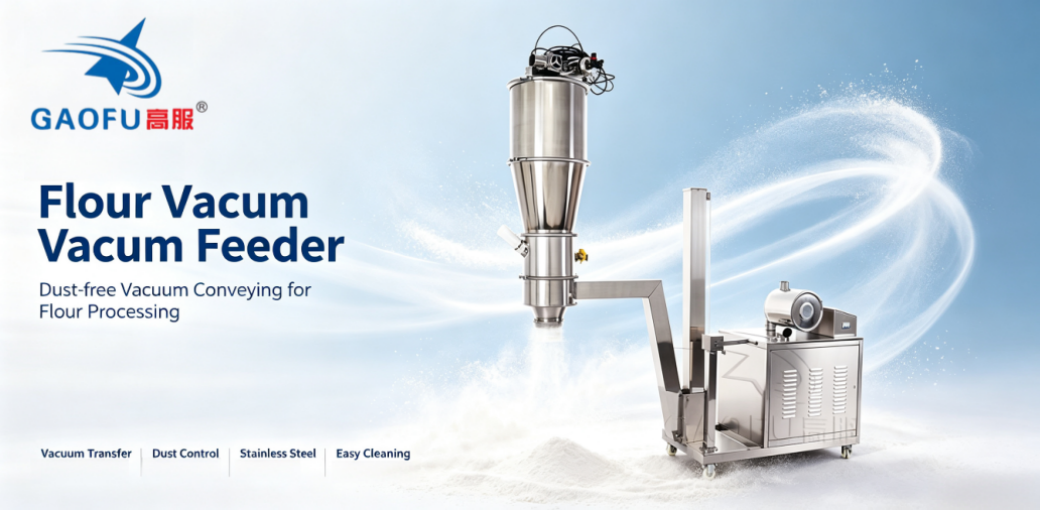
Over 10,000+ customers' choice, Focus on screening industry 40+ years
In traditional manual flour feeding, operators must carry, open, tip, and clean – each bag (25kg or 50kg) of flour generates and disperses dust during feeding.
Dust is released in large quantities the moment a bag is opened and tipped.
Flour particles are typically 80 mesh or finer and very lightweight. The moment a bag is opened and tipped, air disturbance carries a large quantity of fine particles into suspension. In traditional open feeding, operators cut open bags and pour the contents into the feed hopper in an open environment – dust rapidly disperses throughout the workshop. Data shows that during traditional manual bag opening, dust can travel several metres.
Secondary dust emission during handling.
During handling, flour dust on the bag surface is dislodged by friction and vibration, creating secondary dust. This suspended dust settles on walls, equipment, and pipes, affecting workshop cleanliness and increasing cleaning workloads and costs.
The chain effects of dust accumulation.
Flour dust is not just a "dirt" issue. Flour dust is a combustible dust – accumulation to a certain concentration in the workshop poses a safety hazard. At the same time, flour dust is a potential carrier of microorganisms and pests – dust adhering to equipment surfaces and settling in crevices can become a breeding ground for microorganisms, increasing food safety risks.
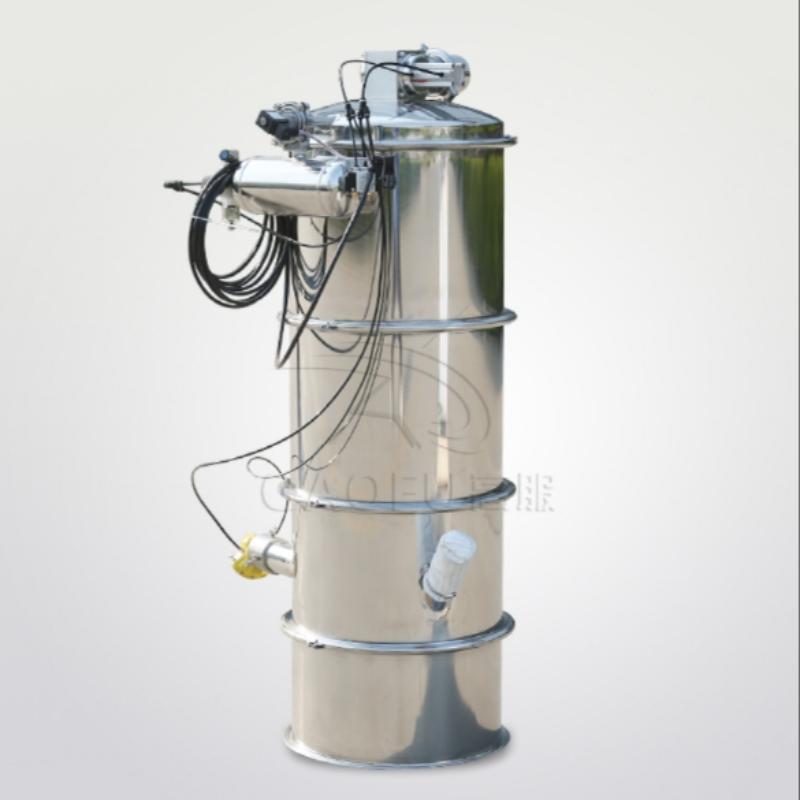
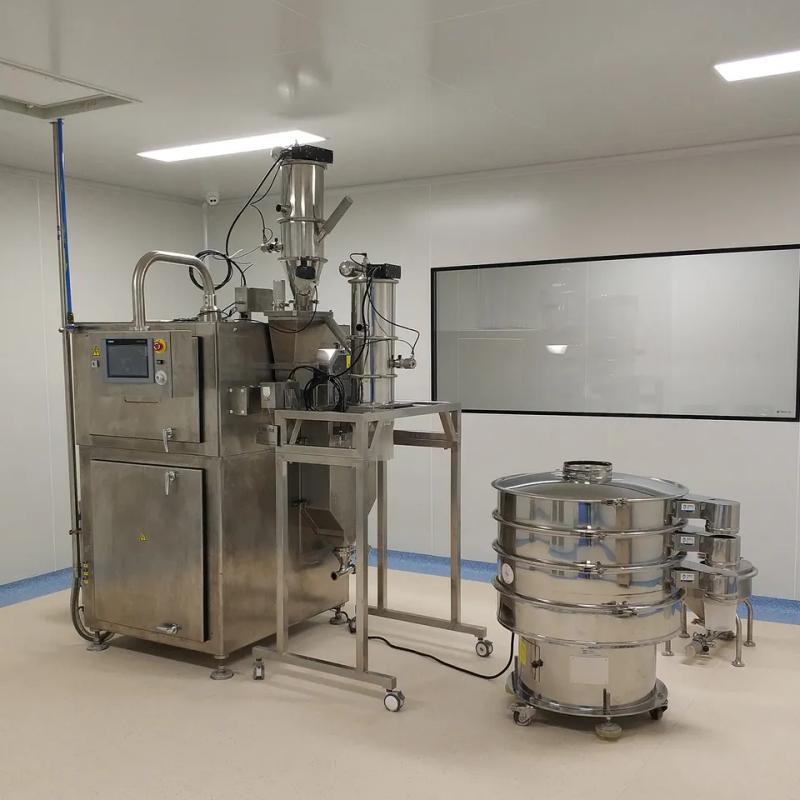
Unlike manual handling, which deals with dust "after it is generated," the vacuum feeder is designed to "prevent dust from ever being generated or dispersed."
Enclosed feeding physically isolates dust.
The dust‑free feeding station features a fully enclosed structure. Operators complete bag opening and tipping inside an enclosed cabinet, with the external area physically isolated from the feeding process. This design structurally blocks the path of dust dispersion – dust has no escape route and must be processed within the enclosed space.
Negative‑pressure dust collection actively captures dust.
The dust‑free feeding station maintains a micro‑negative pressure during feeding. Dust generated when operators open and tip bags is directionally drawn into the filtration system rather than escaping. Gaofu's dust‑free feeding station uses negative‑pressure dust collection technology, controlling dust emission to below 0.1 mg/m³. This active collection method is more effective than simply relying on an enclosed structure – as soon as dust is generated, it is captured and processed.
Vacuum conveying – fully enclosed, dust‑free transfer.
The vacuum feeder uses a vacuum pump to create a vacuum state. Powdered material is drawn into the suction nozzle with outside air, forming an air‑material mixture that travels through the conveying pipe to the hopper, where air and material are separated. Fully enclosed pipe conveying – dust‑free, leak‑free – keeps the workshop clean. Raw materials never contact air or personnel from feeding through conveying.
Pulse‑jet reverse cleaning maintains sustained high‑efficiency filtration.
The equipment is equipped with a pulse‑jet cleaning device that automatically cleans filter elements at regular intervals, maintaining consistent filtration efficiency. Dust collection efficiency reaches over 99%, with emission concentration controlled below 10 mg/m³.
Based on actual production data, the difference in dust control between vacuum feeders and manual handling is order‑of‑magnitude:
| Comparison Dimension | Manual Handling | Vacuum Feeder |
| Dust concentration at feeding area | Visibly hazy (typically >10 mg/m³) | ≤10 mg/m³ (compliant with GB 14881) |
| Dust emission at feeding station | —— | ≤0.1 mg/m³ |
| Dust dispersion range | Several metres to entire workshop | Contained within equipment, no emission |
| Material loss rate | Approximately 2%‑8% | ≤0.5%‑0.8% |
| Workshop cleaning frequency | Multiple times daily | Significantly reduced |
Gaofu's vacuum feeding system effectively controls workshop dust concentration to ≤10 mg/m³, complying with the requirements of the General Hygiene Standard for Food Production (GB 14881‑2013). The dust‑free feeding station uses negative‑pressure dust collection technology to control dust emission below 0.1 mg/m³. Food companies using vacuum feeding systems have reduced raw material loss rates to below 0.8%.
Reduced dust concentration brings not only a cleaner workshop environment but a series of positive chain benefits:
Employee health is protected.
Operators no longer work in a dusty environment or wear heavy protective gear. The long‑term respiratory health risks associated with high‑concentration dust exposure are greatly reduced. Feeding work shifts from "dirty, tiring, and unpleasant" to "clean and orderly" – improving work experience and directly contributing to employee stability and motivation.
Food safety risks are reduced.
Flour dust is a potential carrier of microorganisms and pests. Dust adhering to equipment surfaces and settling in crevices can become a breeding ground for microorganisms. The vacuum feeder's fully enclosed design and hygienic standards reduce food safety risks at the source.
Environmental compliance is more assured.
Workshop dust concentration is kept at low levels, giving companies greater confidence during environmental inspections and food safety audits. Gaofu's feeding system uses fully enclosed pneumatic conveying design, helping food companies easily meet increasingly stringent environmental and food safety requirements.
Cleaning costs are significantly reduced.
Improved dust control directly reduces workshop cleaning frequency and workload. Walls, equipment, and floors no longer accumulate powder frequently – cleaning cycles are significantly extended, and cleaning labour and material costs decline simultaneously.
The improvement in workshop dust provided by the vacuum feeder is only part of its value. The shift from manual handling to automated feeding represents a comprehensive upgrade in production methods:
Efficiency improvement. Automated feeding is 3‑5 times faster than manual operation, increasing single‑line capacity by over 30%.
Cost reduction. One system can replace 3‑5 workers – no manual handling, weighing, or dumping of ingredients, significantly reducing labour costs. One medium‑sized baked snack manufacturer, after introducing the system, needed only 3 operators to complete the feeding work that previously required 8 people – production efficiency increased by over 50%.
Quality stability. Precise metering and batching ensure consistent product composition batch after batch, fundamentally solving flavour inconsistency issues caused by inaccurate batching.
Food Industry Client Testimonials
Nestlé, CP Group, Haitian Flavour & Fragrance, Yihai Kerry, Yili, Mengniu,Shuanghui, Wahaha, Master Kong, Want Want, Anjoy Foods, Angel Yeast,Yangyuan Foods, Uni-President Enterprises, Qiaqia Food, Luhua Group,Alpenliebe, Golden Monkey, Orion, Xizhilang,Sanquan Foods, Synear Food, Oishi, Wong Lo Kat, Yanjing Beer, Seamild,Jinpai, Chubang, Hengshun Vinegar Industry, Longda Group, Beijing Daoxiangcun, Anhe Dairy,Weiwei Group, Xiangpiaopiao, Maiquer, Tianbing, Binqi Food, Ligao Okun
Fortune 500 Client Testimonials
CNPC、CSCEC、Sinochem Holdings、CRCC、China Minmetals Corporation、CNOOC、CR、Sinopharm、CHN Energy、COFCO Corporation、Huawei Technologies、PowerChina、CITIC Group、Wuchan Zhongda Group、NORINCO、Chalco、CNBM、 Shaanxi Coal and Chemical Industry Group、Ansteel Group、CETC、CSSC、CASC、CEC、Jinchuan Group、CASIC、Conch Cement、CNNC、SPH、Shanxi Coking Coal Group、 Zhongtai Chemical、GPHL、DEC、Sinosteel Corporation、MCC、China National Salt Industry Chemical、China Baowu Steel Group、China Animal Husbandry Industry Co., Ltd.、CECEP
About Gaofu
Xinxiang Gaofu Machinery Co., Ltd. was founded back in the 1980s. With over 40 years of development, it has been certified as a National-level Specialized, Refined, Unique & Innovative Little Giant Enterprise, National Green Factory, National High-tech Enterprise, and National Intellectual Property Advantage Enterprise, and serves as the President Unit of China Vibration Screening Industry Association.
The company is accredited with the Henan Provincial Industrial Design Center, Henan Provincial Engineering Technology Research Center for Intelligent On-line Screening System, and Xinxiang Municipal Engineering Technology Research Center for Fine Screening.
Gaofu has obtained more than 500 patents including invention patents, utility model patents and design patents, been awarded the Science and Technology Achievement Prize issued by the Ministry of Industry and Information Technology of China, and participated in drafting and formulating 4 national standards.
Gaofu's product portfolio covers multiple series and hundreds of specifications, including vibrating screening equipment, conveying equipment, coal crushing equipment, filtration equipment and automatic material handling systems.
Core products include vibrating screens, screening machines, vibratory sifters, rotary vibrating screens, ultrasonic vibrating screens, linear vibrating screens, airflow screens, gyratory screens, roller screens, dewatering screens, bar screens, vacuum feeding machines, dust-free feeding stations, bulk bag feeding stations, feeding systems, automatic powder feeding systems, automatic slag-discharging filters, leaf filters, clay filters, toothed roll crushers, coal crushers and other machinery.
These products are widely applied in food, pharmaceutical, chemical, metallurgy, construction materials, mining, thermal power, environmental protection and many other industries, winning recognition and trust from over 10,000 clients worldwide.
Gaofu products enjoy strong sales across Greater China, and are exported to more than 100 countries and regions such as Russia, Canada, the United States, New Zealand, Japan, Brazil and South Africa.
Upholding the corporate mission of Improving material quality & efficiency to fully satisfy customer demands, Gaofu maintains long-term partnerships with clients to achieve win-win development.
At present, Gaofu is an official qualified supplier for numerous Fortune Global 500 enterprises, including CNPC, Sinopec, Sinochem Holdings, China Resources Group, Sinopharm Group, COFCO, China National Building Material, China Aerospace Science and Technology Corporation, Jinchuan Group and more.
Gaofu Machinery ranks No.1 in global sales volume of vibrating screens.
In May 2024, Frost & Sullivan, a world-renowned international consulting firm, issued a Market Position Verification Certificate confirming that Gaofu achieved the world's largest shipment volume of vibrating screens in the global market in 2023.