Over 10,000+ customers' choice, Focus on screening industry 40+ years
Traditional small bag feeding: Flour arrives at the plant in 25kg or 50kg small bags. Operators manually carry, open, and tip bags into the feed hopper. This method is still widely used in small and medium‑sized food plants – equipment investment is low, but labour costs are high, physical labour is intense, and dust control is difficult.
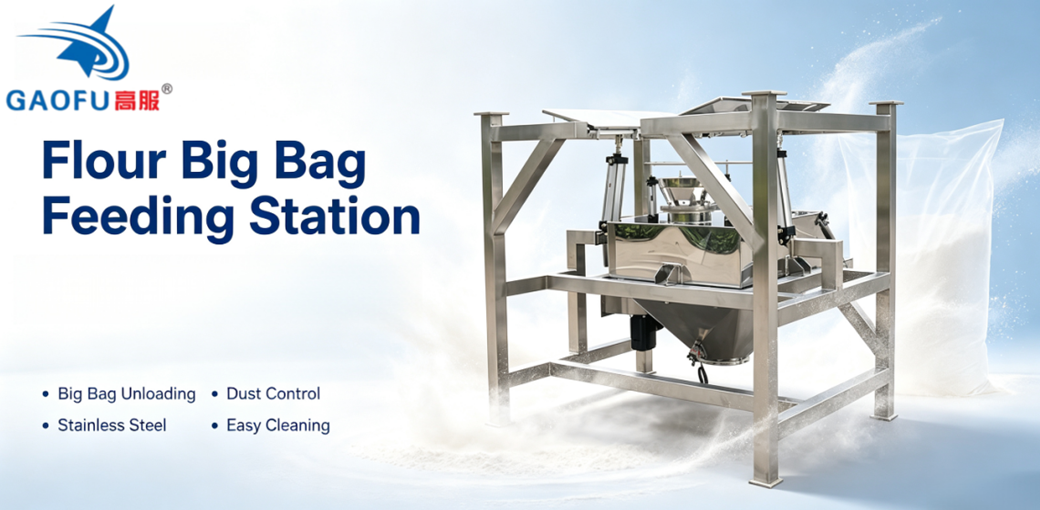
Big bag feeding station: Flour arrives at the plant in big bags (typically 500‑2000kg per bag). An electric hoist or forklift transports the big bag to the feeding station, where bag opening, discharging, and conveying are completed in an enclosed system. Equipment investment is higher, but automation is greater, labour requirements are lower, and dust control is superior.
Small bag feeding efficiency bottlenecks. In traditional small bag feeding, operators must carry, open, tip, and clean residue – repeating this sequence for every bag. For 25kg bags, processing 1 tonne of flour requires handling 40 bags; processing 10 tonnes requires 400 bags. This repetitive labour not only consumes physical energy but also limits the amount of material that can be fed per unit time. Data shows that manual handling and feeding is slow – a single big bag discharge plus feeding may take over half an hour. Although each small bag is lighter, the extremely high bag‑opening frequency makes overall efficiency lower.
Big bag feeding efficiency advantages. The big bag feeding station uses an electric hoist or forklift to transport the big bag to the discharging position – a single lift prepares 1 tonne or more of material for feeding. Gaofu's big bag feeding station features an enclosed bag opening design with integrated bag opening, tapping, and dust collection – compact structure and convenient operation. The tapping device helps material flow out of the big bag, and the vibration device breaks bridges, ensuring smooth material flow to the next process. Feeding efficiency reaches 5‑15 t/h – far higher than traditional small‑bag manual feeding.
From a time perspective, for the same quantity of flour, the feeding time required by a big bag feeding station is only a fraction of that required by small‑bag manual feeding. In large‑scale production, this efficiency difference directly translates into increased capacity and labour cost savings.
Labour costs. This is the most obvious cost difference. Small bag feeding requires multiple operators to continuously handle and open bags – labour demand is high in large‑scale production. The big bag feeding station significantly reduces manual intervention – operators only need to complete hoisting, positioning, and spout connection; the discharging process is automatically completed by the equipment. For a medium‑sized food processing enterprise with an annual flour requirement of 20,000 tonnes, total cost savings can reach RMB 3.6 million per year.
Material loss. Flour dust dispersion is a significant hidden cost in traditional small bag feeding that cannot be ignored. During traditional manual bag opening, dust can travel several metres – not only wasting raw material (nearly 2% loss per tonne) but also adhering to equipment and promoting bacterial growth. The big bag feeding station uses an enclosed bag opening design – material flows in a confined space with no dust leakage. The feeding platform operates under negative pressure with no dust leakage and no material loss during feeding. The material savings accumulated over long‑term operation are considerable.
Cleaning and maintenance costs. The dust dispersion caused by small bag feeding means not only material loss but also additional cleaning costs – walls, equipment, and floors accumulate powder frequently, requiring significant labour for cleaning. The big bag feeding station's enclosed design effectively controls dust dispersion – cleaning frequency and costs are significantly reduced.
Equipment maintenance costs. Although the simple equipment used with small bag feeding has lower initial investment, frequent manual operation and dust ingress accelerate equipment wear. The big bag feeding station uses stainless steel construction and precision manufacturing – equipment life is longer and maintenance costs are lower.
Dust control. This is the most significant difference between the two feeding methods. Small‑bag manual feeding takes place in an open environment – flour dust rapidly disperses throughout the workshop. The big bag feeding station completes bag opening and discharging in an enclosed system, equipped with a high‑energy pulse‑jet dust collection system that effectively controls dust emission concentration.
Physical labour and occupational health. In small bag feeding, operators are exposed to dusty environments for extended periods and must perform continuous heavy physical labour. The big bag feeding station replaces manual labour with machinery, significantly reducing physical labour intensity – operators are transformed from "manual labourers" to "equipment operators." The feeding process is safe, reduces physical labour, and protects personnel safety.
Food safety. Flour dust is not just an environmental issue – it is a food safety hazard. Dust adhering to equipment surfaces and settling in crevices can become a breeding ground for microorganisms. The big bag feeding station's enclosed design and easy‑to‑clean hygienic standards reduce food safety risks at the source.
Applicable Scenario Analysis
Scenarios where small bag feeding remains suitable:
Small‑to‑medium batch, multi‑product, frequent changeover production scenarios;
Small‑scale production with low flour usage (daily throughput below 5 tonnes);
Companies with established small‑bag supply chains where switching costs are high.
Scenarios where big bag feeding stations have greater advantages:
Large‑scale, continuous production (daily throughput above 5 tonnes);
Companies with strict workshop cleanliness requirements;
Regions with high labour costs where labour reduction is needed;
Companies planning new production lines or expansions (big bag feeding systems can be incorporated at the design stage).
For companies transitioning from small bag feeding to big bag feeding, a phased implementation approach is recommended:
Step 1: Assess existing production line compatibility. Evaluate whether workshop space, existing equipment layout, and material flow paths support the installation and operation of a big bag feeding station.
Step 2: Select the appropriate big bag feeding station type. Choose fixed, mobile, or horizontal based on production needs – fixed for stable production lines, mobile for greater flexibility.
Step 3: Integrate downstream equipment. The big bag feeding station can be connected to positive‑ or negative‑pressure conveying systems for material supply to the production line, achieving fully enclosed operation from feeding to conveying. Screening, metering, and mixing modules can be integrated as needed.
Step 4: Train operators. The transition from manual feeding to equipment operation requires systematic training for operators to ensure safe and standardised equipment use.
Food Industry Client Testimonials
Nestlé, CP Group, Haitian Flavour & Fragrance, Yihai Kerry, Yili, Mengniu,Shuanghui, Wahaha, Master Kong, Want Want, Anjoy Foods, Angel Yeast,Yangyuan Foods, Uni-President Enterprises, Qiaqia Food, Luhua Group,Alpenliebe, Golden Monkey, Orion, Xizhilang,Sanquan Foods, Synear Food, Oishi, Wong Lo Kat, Yanjing Beer, Seamild,Jinpai, Chubang, Hengshun Vinegar Industry, Longda Group, Beijing Daoxiangcun, Anhe Dairy,Weiwei Group, Xiangpiaopiao, Maiquer, Tianbing, Binqi Food, Ligao Okun
Fortune 500 Client Testimonials
CNPC、CSCEC、Sinochem Holdings、CRCC、China Minmetals Corporation、CNOOC、CR、Sinopharm、CHN Energy、COFCO Corporation、Huawei Technologies、PowerChina、CITIC Group、Wuchan Zhongda Group、NORINCO、Chalco、CNBM、 Shaanxi Coal and Chemical Industry Group、Ansteel Group、CETC、CSSC、CASC、CEC、Jinchuan Group、CASIC、Conch Cement、CNNC、SPH、Shanxi Coking Coal Group、 Zhongtai Chemical、GPHL、DEC、Sinosteel Corporation、MCC、China National Salt Industry Chemical、China Baowu Steel Group、China Animal Husbandry Industry Co., Ltd.、CECEP
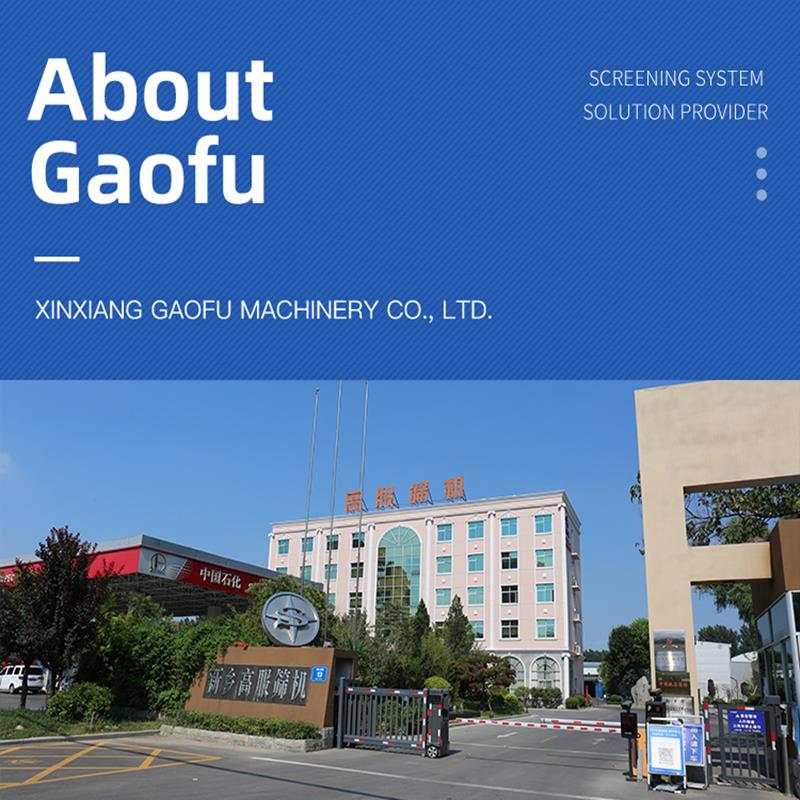
About Gaofu
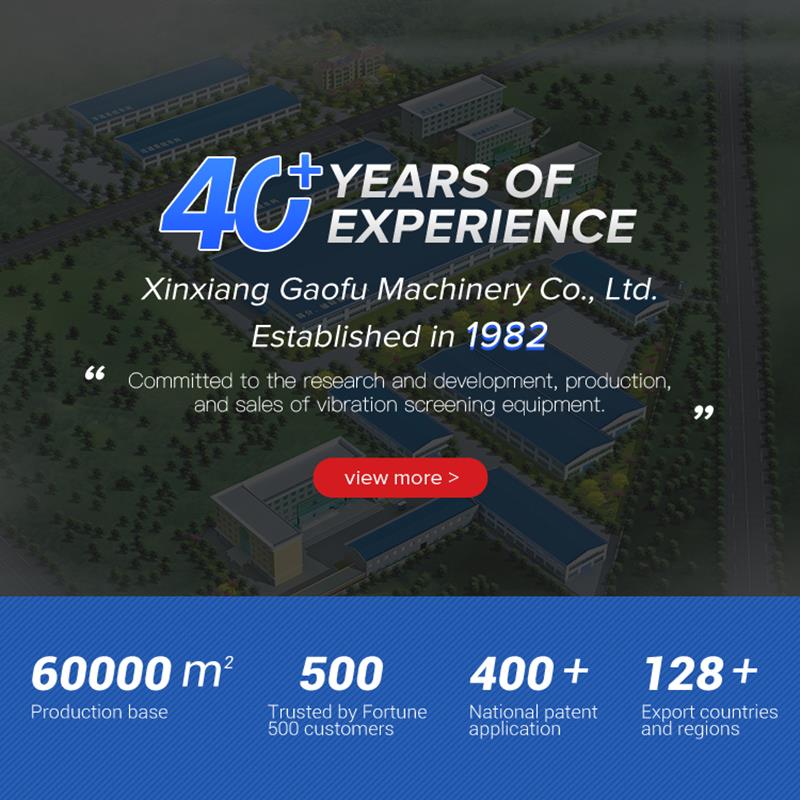
Xinxiang Gaofu Machinery Co., Ltd. was founded back in the 1980s. With over 40 years of development, it has been certified as a National-level Specialized, Refined, Unique & Innovative Little Giant Enterprise, National Green Factory, National High-tech Enterprise, and National Intellectual Property Advantage Enterprise, and serves as the President Unit of China Vibration Screening Industry Association.
The company is accredited with the Henan Provincial Industrial Design Center, Henan Provincial Engineering Technology Research Center for Intelligent On-line Screening System, and Xinxiang Municipal Engineering Technology Research Center for Fine Screening.
Gaofu has obtained more than 500 patents including invention patents, utility model patents and design patents, been awarded the Science and Technology Achievement Prize issued by the Ministry of Industry and Information Technology of China, and participated in drafting and formulating 4 national standards.
Gaofu's product portfolio covers multiple series and hundreds of specifications, including vibrating screening equipment, conveying equipment, coal crushing equipment, filtration equipment and automatic material handling systems.
Core products include vibrating screens, screening machines, vibratory sifters, rotary vibrating screens, ultrasonic vibrating screens, linear vibrating screens, airflow screens, gyratory screens, roller screens, dewatering screens, bar screens, vacuum feeding machines, dust-free feeding stations, bulk bag feeding stations, feeding systems, automatic powder feeding systems, automatic slag-discharging filters, leaf filters, clay filters, toothed roll crushers, coal crushers and other machinery.
These products are widely applied in food, pharmaceutical, chemical, metallurgy, construction materials, mining, thermal power, environmental protection and many other industries, winning recognition and trust from over 10,000 clients worldwide.
Gaofu products enjoy strong sales across Greater China, and are exported to more than 100 countries and regions such as Russia, Canada, the United States, New Zealand, Japan, Brazil and South Africa.
Upholding the corporate mission of Improving material quality & efficiency to fully satisfy customer demands, Gaofu maintains long-term partnerships with clients to achieve win-win development.
At present, Gaofu is an official qualified supplier for numerous Fortune Global 500 enterprises, including CNPC, Sinopec, Sinochem Holdings, China Resources Group, Sinopharm Group, COFCO, China National Building Material, China Aerospace Science and Technology Corporation, Jinchuan Group and more.
Gaofu Machinery ranks No.1 in global sales volume of vibrating screens.
In May 2024, Frost & Sullivan, a world-renowned international consulting firm, issued a Market Position Verification Certificate confirming that Gaofu achieved the world's largest shipment volume of vibrating screens in the global market in 2023.