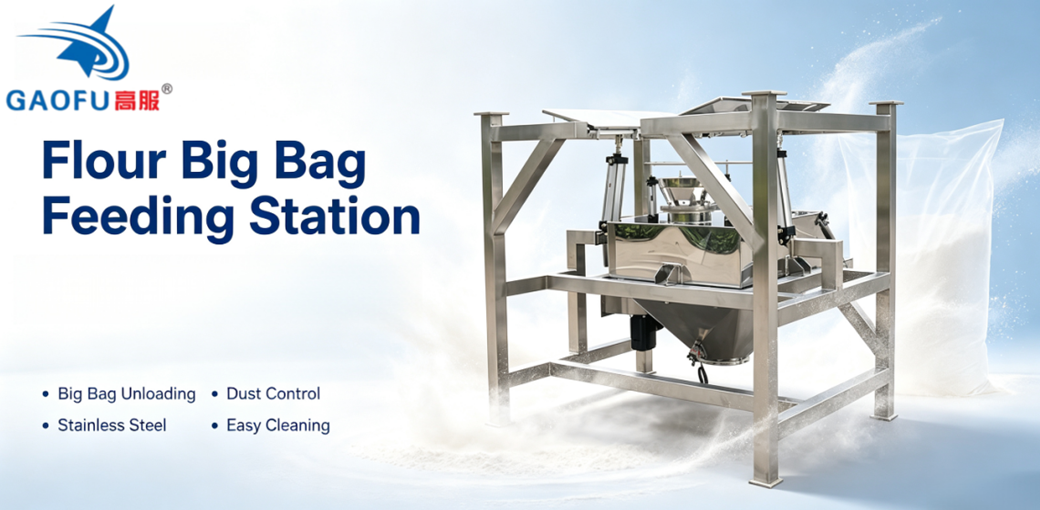
Over 10,000+ customers' choice, Focus on screening industry 40+ years
Flour, as one of the most fundamental powdered raw materials in food processing, has physical characteristics that present unique challenges at the feeding stage, different from other materials.
High fineness, low bulk density – extremely prone to dust emission. Flour particles are typically 80 mesh or finer, with some specialty flours requiring 200 mesh or above. Particles are fine and lightweight – the moment a bag is opened and tipped, air disturbance carries a large quantity of fine particles into suspension. In traditional open bag opening, flour dust can travel several metres.
Hygroscopic, prone to lumping and bridging. Flour has a certain degree of hygroscopicity. If not properly sealed during storage and transport, it can absorb moisture from the air and form lumps. If these lumps are not effectively handled during feeding, they may block the discharge channel, affecting feeding continuity and smoothness.
High hygiene requirements – equipment must meet food‑grade standards. Flour is used directly in food production, placing strict hygiene requirements on equipment materials and construction that contact materials. Equipment must use food‑grade stainless steel with smooth, dead‑corner‑free surfaces for easy cleaning and sanitisation.
High throughput – equipment capacity must meet production demands. Large‑scale flour processors handle dozens or even hundreds of tonnes per day – feeding equipment capacity directly affects the operating efficiency of the entire production line.
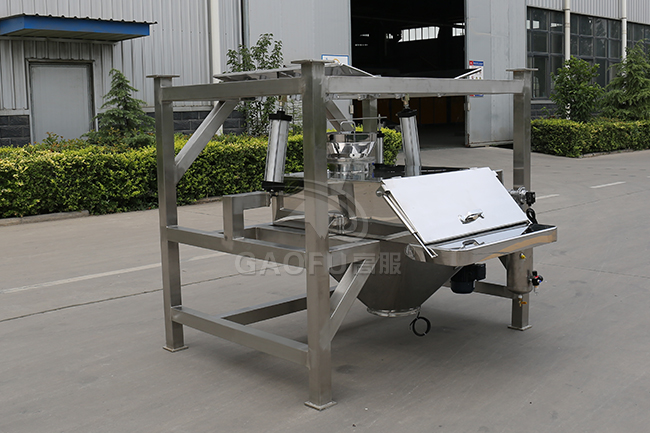
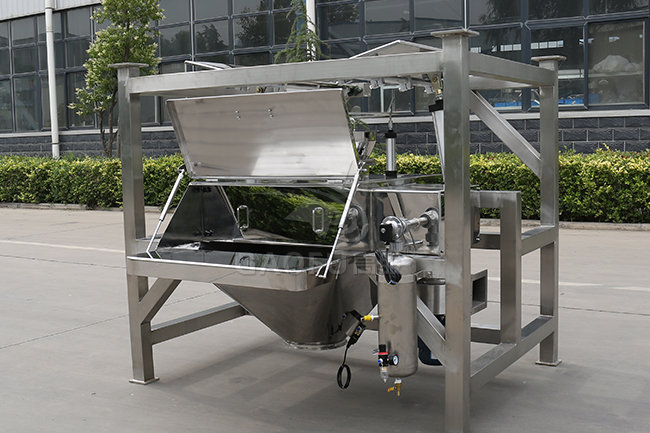
Gaofu's big bag feeding station is a semi‑automatic device for discharging bulk materials from bags. Its basic operating process is as follows:
Hoisting and positioning. The bag is lifted by an electric hoist, with the bag's sling loops hung on a rigid frame. The operator manually controls the hoist's lifting and travel, moving it along the guide rail to above the discharge area and lowering it, placing the bag on the support tray in the discharge position. Electric hoists or forklifts can easily transport big bags to the discharging station.
Bag opening sealing. The operator pulls the bag's discharge spout into the sealing device and presses the bag‑clamping button. The clamping cylinder tightens and seals the spout. The discharge spout is then pulled down from the discharge position, covering the outside of the discharge pipe inside the sealed enclosure. The operator activates the pneumatic clamp mechanism, causing the sealing flange to descend and press firmly against the end of the discharge pipe, sealing the discharge channel to prevent dust leakage during discharging.
Bag opening and discharging. After manually opening the bag, the operator closes the operation door and manually opens the valve on the ventilation and dust extraction pipe connected to the sealing enclosure. The operator then activates the clamping mechanism inside the discharge valve – the bag's discharge spout opens, and material begins discharging under gravity along the chute.
Assisted discharge. During discharging, to ensure smooth material flow from the bag and through the chute, the equipment is equipped with auxiliary devices such as a bag tapping mechanism. The tapping device helps material flow out of the big bag, and the vibration device can break bridges. Tapping and bag‑paddling actions can also be controlled by PLC for periodic operation – the sequence is to tap the middle of the big bag first, then the bottom.
Discharge complete. When discharging is complete, the operator opens the discharge valve operation door, manually ties the bag, releases the clamping mechanism, raises the sealing flange, and operates the electric hoist to lift and remove the empty bag.
When selecting a flour big bag feeding station, food plants should evaluate the following five dimensions:
Point 1: Equipment Type – Fixed or Mobile?
Big bag feeding stations can be divided into fixed, mobile, and horizontal types based on application scenarios. Fixed units are installed in a permanent position, suitable for applications with stable material input requirements in production lines or warehouses. Mobile units offer portability and can be flexibly repositioned according to production line changes. Horizontal units are suitable for overhead operations or limited‑space applications.
For flour processors: if the production line layout is fixed and material demand is stable, a fixed big bag feeding station is the more appropriate choice. If workshop space is limited or equipment needs to be moved between different workstations, mobile or horizontal units offer greater flexibility.
Point 2: Material and Hygiene Standards – Food‑Grade is the Minimum Requirement
For food plant flour feeding equipment, material selection directly affects food safety. The equipment body should be made of 304 or 316L stainless steel with mirror or satin polishing, and all corners should use rounded transitions – no dead corners, easy to clean. Gaofu's big bag feeding station is suitable for discharging dry powder and granular materials from large bags in the food, pharmaceutical, chemical, and other industries. Parts that contact materials can be made of high‑quality SUS304 stainless steel, with finely polished surfaces that are smooth, burr‑free, and easy to clean.
Point 3: Dust Collection System – The Core of Clean Environment Assurance
Flour is a classic dust‑prone material – dust control during feeding is a core selection consideration. The big bag feeding station is equipped with a high‑energy pulse‑jet dust collection system that effectively controls dust emission concentration, prevents workshop contamination, and protects operator respiratory health. The feeding platform operates under negative pressure with no dust leakage – no material loss during feeding, protecting the clean environment. Dust is filtered by the integrated dust collection device, allowing operators to work in a clean environment.
During selection, pay attention to the filtration efficiency of the dust collection system, the automatic cleaning capability of the pulse‑jet system, and the convenience of filter element replacement. For extremely fine powders like flour, the filtration system's accuracy must be capable of capturing micron‑level dust particles.
Point 4: Assisted Discharge Devices – Dealing with Flour Lumping and Bridging
Flour is prone to moisture absorption and lumping during storage and transport. During discharge, bridging may occur – material forms an arch structure inside the big bag and cannot flow out by gravity alone. Gaofu's big bag feeding station is equipped with a tapping device to help material flow out of the big bag, and a vibration device to break bridges. The tapping mechanism can periodically tap the middle and lower sections of the big bag, effectively "activating" material stagnant inside the bag.
For big bag feeding stations handling flour, it is recommended to prioritise models with vibration bridging‑breaking devices and tapping mechanisms to ensure smooth, uninterrupted discharge.
Point 5: Capacity and System Integration – Matching Production Line Rhythm
Big bag feeding throughput is a key selection criterion. Big bag feeding stations in the food industry can achieve throughput of 5‑15 t/h. Gaofu's big bag feeding station can be used in conjunction with pneumatic conveying systems to achieve dust‑free feeding and discharging. The equipment can be connected to positive‑ or negative‑pressure conveying systems for material supply to the production line, achieving fully enclosed operation from feeding to conveying.
During selection, choose the appropriate capacity model based on the production line's daily throughput and peak demand, and evaluate whether the equipment can be easily integrated with existing downstream equipment such as conveyors, screens, and mixers.
In the practice of selecting flour big bag feeding stations, there are several common misconceptions worth noting:
Misconception 1: Blindly pursuing maximum throughput. Bigger is not always better. Selection should match equipment capacity to actual production needs – oversizing not only increases investment but may also cause unnecessary energy consumption and wear from frequent start‑stop cycles.
Misconception 2: Ignoring material characteristics. Flour's fineness, hygroscopicity, flowability, and other properties directly affect equipment configuration requirements. Poorly flowing powders require vibration bridging‑breaking devices. Flour is a dust‑prone material and must be equipped with efficient dust collection devices.
Misconception 3: Overlooking system integration. The big bag feeding station is not a standalone unit but part of the complete production line. Selection should fully consider integration with upstream and downstream equipment to avoid the awkward situation of "buying equipment that doesn't connect."
Food Industry Client Testimonials
Nestlé, CP Group, Haitian Flavour & Fragrance, Yihai Kerry, Yili, Mengniu,Shuanghui, Wahaha, Master Kong, Want Want, Anjoy Foods, Angel Yeast,Yangyuan Foods, Uni-President Enterprises, Qiaqia Food, Luhua Group,Alpenliebe, Golden Monkey, Orion, Xizhilang,Sanquan Foods, Synear Food, Oishi, Wong Lo Kat, Yanjing Beer, Seamild,Jinpai, Chubang, Hengshun Vinegar Industry, Longda Group, Beijing Daoxiangcun, Anhe Dairy,Weiwei Group, Xiangpiaopiao, Maiquer, Tianbing, Binqi Food, Ligao Okun
Fortune 500 Client Testimonials
CNPC、CSCEC、Sinochem Holdings、CRCC、China Minmetals Corporation、CNOOC、CR、Sinopharm、CHN Energy、COFCO Corporation、Huawei Technologies、PowerChina、CITIC Group、Wuchan Zhongda Group、NORINCO、Chalco、CNBM、 Shaanxi Coal and Chemical Industry Group、Ansteel Group、CETC、CSSC、CASC、CEC、Jinchuan Group、CASIC、Conch Cement、CNNC、SPH、Shanxi Coking Coal Group、 Zhongtai Chemical、GPHL、DEC、Sinosteel Corporation、MCC、China National Salt Industry Chemical、China Baowu Steel Group、China Animal Husbandry Industry Co., Ltd.、CECEP
About Gaofu
Xinxiang Gaofu Machinery Co., Ltd. was founded back in the 1980s. With over 40 years of development, it has been certified as a National-level Specialized, Refined, Unique & Innovative Little Giant Enterprise, National Green Factory, National High-tech Enterprise, and National Intellectual Property Advantage Enterprise, and serves as the President Unit of China Vibration Screening Industry Association.
The company is accredited with the Henan Provincial Industrial Design Center, Henan Provincial Engineering Technology Research Center for Intelligent On-line Screening System, and Xinxiang Municipal Engineering Technology Research Center for Fine Screening.
Gaofu has obtained more than 500 patents including invention patents, utility model patents and design patents, been awarded the Science and Technology Achievement Prize issued by the Ministry of Industry and Information Technology of China, and participated in drafting and formulating 4 national standards.
Gaofu's product portfolio covers multiple series and hundreds of specifications, including vibrating screening equipment, conveying equipment, coal crushing equipment, filtration equipment and automatic material handling systems.
Core products include vibrating screens, screening machines, vibratory sifters, rotary vibrating screens, ultrasonic vibrating screens, linear vibrating screens, airflow screens, gyratory screens, roller screens, dewatering screens, bar screens, vacuum feeding machines, dust-free feeding stations, bulk bag feeding stations, feeding systems, automatic powder feeding systems, automatic slag-discharging filters, leaf filters, clay filters, toothed roll crushers, coal crushers and other machinery.
These products are widely applied in food, pharmaceutical, chemical, metallurgy, construction materials, mining, thermal power, environmental protection and many other industries, winning recognition and trust from over 10,000 clients worldwide.
Gaofu products enjoy strong sales across Greater China, and are exported to more than 100 countries and regions such as Russia, Canada, the United States, New Zealand, Japan, Brazil and South Africa.
Upholding the corporate mission of Improving material quality & efficiency to fully satisfy customer demands, Gaofu maintains long-term partnerships with clients to achieve win-win development.
At present, Gaofu is an official qualified supplier for numerous Fortune Global 500 enterprises, including CNPC, Sinopec, Sinochem Holdings, China Resources Group, Sinopharm Group, COFCO, China National Building Material, China Aerospace Science and Technology Corporation, Jinchuan Group and more.
Gaofu Machinery ranks No.1 in global sales volume of vibrating screens.
In May 2024, Frost & Sullivan, a world-renowned international consulting firm, issued a Market Position Verification Certificate confirming that Gaofu achieved the world's largest shipment volume of vibrating screens in the global market in 2023.