Over 10,000+ customers' choice, Focus on screening industry 40+ years
In the process of milling paddy into polished rice, the husk and approximately 10% of the total weight—comprising the seed coat, pericarp, outer endosperm, aleurone layer and germ—are removed. This mixture of separated bran layers, germ and a small amount of residual endosperm is rice bran. A modern rice processing line with a daily output of several hundred tonnes of polished rice can produce several to several tens of tonnes of rice bran by‑product per hour.
However, rice bran is not immediately a usable finished product.
The rice bran freshly separated from the rice mill contains impurities such as broken rice grains, rice husk fragments, sand and dirt. If these impurities are not removed in time, they will directly affect the quality, storage stability and downstream processing value of the rice bran. In rice bran oil processing, impurity content directly affects oil yield and finished oil quality. In feed production, impurities reduce the nutritional value and palatability of the feed.
Rice bran de‑dusting may seem like just a "screening" step on the production line, but it plays a critical connecting role. Upstream rice mills continuously output material, while downstream collection and packaging systems require a stable feed supply – if the screening step's capacity is not matched, either upstream material will accumulate and block, or downstream equipment will run idle waiting for material, and the overall efficiency of the entire line will be compromised.
Rice bran screening is not straightforward. Rice bran has three distinctive characteristics that present real challenges to screening operations.
High oil content leading to screen adhesion and blinding. Rice bran is rich in oil, typically containing 12% to 20% oil. This natural oil causes the powder to adhere to the screen surface during screening, gradually forming a sticky film. After ordinary screening equipment runs for several hours, the screen becomes "pasted over" by the oily material, and screening efficiency drops sharply. In the industry, this is known as "wet blinding" – materials containing oil or sticky components adhere to the screen wires or accumulate and harden in the apertures.
Irregular particle shape and poor flowability. Rice bran particles have a wide size distribution, ranging from fine dust‑like particles to relatively large flakes or chunks. The particles are irregular in shape, have a rough surface and strong adsorption properties, making them prone to agglomeration. In addition, rice bran has a low bulk density and poor flowability, which can cause blockages and bridging during conveying and screening.
Complex impurity composition and high de‑dusting requirements. Rice bran contains a variety of impurities – broken rice, rice husk fragments, sand and dirt. These impurities differ in form – broken rice grains are hard, husk fragments are flaky, and sand particles are extremely fine – making it difficult for ordinary screens to remove all of them in a single screening pass.
Oil adhesion, particle agglomeration and diverse impurities – these three challenges combined make rice bran a recognised "difficult‑to‑screen" material. Ordinary screening equipment often falls into the repetitive cycle of "blinding – stoppage – cleaning – blinding again," and every unscheduled stoppage represents lost capacity on the production line.
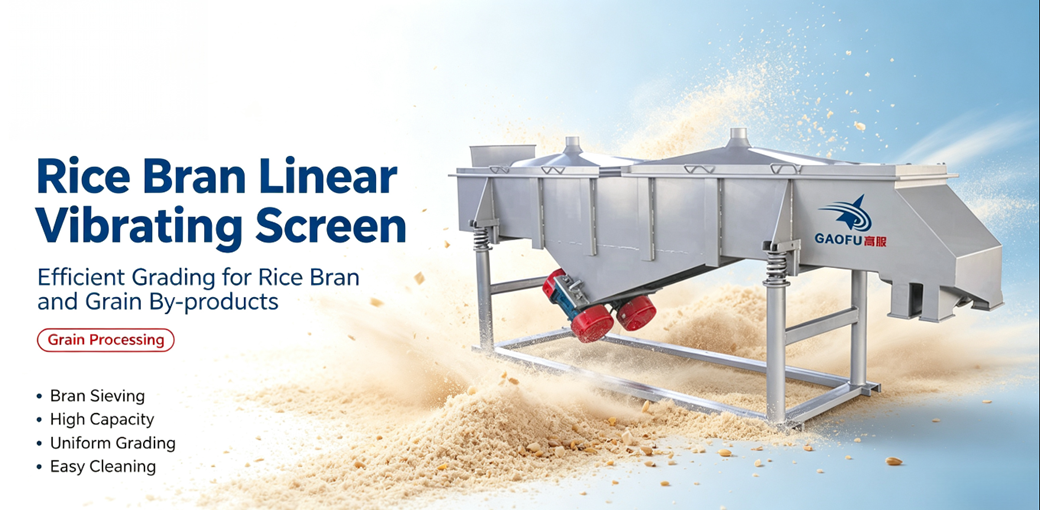
The Gaofu SZF series rice bran linear vibrating screen operates on the dual vibration motor synchronous counter‑rotation drive principle. When the two vibration motors rotate synchronously in opposite directions, the excitation forces generated by the eccentric blocks cancel each other out in the direction parallel to the motor axes, while adding together in the perpendicular direction, driving the screen box in a high‑frequency linear reciprocating motion. The motor axes are set at an inclination angle relative to the screen surface. Under the combined action of the excitation force and the material's own gravity, the material is thrown up on the screen surface and moves forward in a parabolic jumping trajectory.
This motion pattern offers three aspects of matching value for rice bran screening:
First, thorough material dispersion to prevent agglomeration and blinding. The rice bran moves forward in a parabolic jumping motion on the screen surface, and particles are fully dispersed during the jumping process. Oily material does not easily form adhesive layers locally, and agglomerates are naturally broken apart during the jumping motion.
Second, high processing capacity matching line rhythm. The single‑unit throughput of the linear vibrating screen covers a wide range from several hundred kilograms to several tens of tonnes per hour depending on the model configuration. Rice bran output from grain processing lines is continuous, and the processing capacity of the linear vibrating screen can be precisely matched to ensure that the screening step does not become a capacity bottleneck.
Third, multi‑deck classification completing multiple steps in a single pass. The equipment supports 1 to 5 screen decks , allowing a single machine with a single feed to simultaneously complete broken rice separation, husk fragment removal and fine powder classification. Separating broken rice from bran (top deck), removing husk fragments (middle deck), and obtaining pure rice bran powder (bottom deck) – one machine completes what would otherwise require multiple screens in series.
The rice bran output of a grain processing plant is directly related to its rice milling capacity. A plant with a daily output of 100 tonnes of polished rice produces approximately 10 tonnes of rice bran by‑product per day. Continuous line operation with 24‑hour uninterrupted production requires that the screening equipment has matching continuous operation capability and stable throughput.
The Gaofu SZF series linear vibrating screen achieves precise capacity matching in the following dimensions:
Wide model coverage, selected on demand. The Gaofu SZF series linear vibrating screen offers a range of screen widths and lengths, with single‑unit throughput ranging from a few hundred kilograms per hour to over 20 tonnes per hour , adapting to different capacity needs from small rice mills to large grain processing enterprises.
Multi‑deck screen configuration – no wasted capacity. In traditional screening methods, a single‑deck screen can only perform one classification, and multi‑stage classification requires multiple screens in series – more equipment, larger floor space, and multiple material transfers. The Gaofu linear vibrating screen supports 1 to 5 screen decks, allowing a single machine to complete multi‑stage classification. With fewer machines, reduced floor space, and fewer material transfer points, the overall efficiency of the production line is released.
Anti‑blinding design for continuous operation. To address the high oil content and blinding tendency of rice bran, the Gaofu linear vibrating screen is equipped with a bouncing ball cleaning system. Food‑grade silicone balls continuously tap the underside of the screen during operation, dislodging adhering oily material and keeping the mesh clear. The equipment can run 24 hours continuously without frequent stoppages for cleaning, effectively supporting the continuous production rhythm of grain processing plants.
Food‑grade materials for grain processing hygiene requirements. As a by‑product of grain processing, rice bran goes directly into feed or food processing, so equipment materials must meet clear requirements. The Gaofu rice bran linear vibrating screen can be equipped with 304 food‑grade stainless steel for material‑contact parts, with finely polished surfaces, no hygiene dead corners, and easy to clean. For more corrosive materials, an all‑stainless‑steel structure is available.
The role of the Gaofu SZF series linear vibrating screen in rice bran processing lines goes far beyond "de‑dusting."
Role 1: Broken rice and bran separation. The rice bran output from the rice mill often contains broken rice grains. Through precise screen mesh configuration, the linear vibrating screen retains broken rice on the top deck while allowing pure rice bran to pass through the lower decks. The separated broken rice can be sold as a by‑product or reused, improving overall raw material utilisation.
Role 2: Rice husk fragment removal. Rice husk fragments are light and flaky. When mixed with rice bran, they affect its purity. The jumping linear motion of the linear vibrating screen naturally separates the flaky husk fragments from the rice bran powder on the screen surface, discharging them from the reject port.
Role 3: Fine classification of rice bran. Different application fields have different particle size requirements for rice bran. Food processing requires uniform, low‑impurity rice bran powder; feed production also requires classification by appropriate particle size according to the digestive capacity of different animals. The multi‑deck configuration of the linear vibrating screen completes coarse, medium and fine classification in a single pass, with different particle sizes discharged from their respective outlets.
Role 4: Automated line integration. The continuous operation capability and automatic discharge design of the linear vibrating screen allow it to be seamlessly integrated into the production line – material from the upstream rice mill goes directly into the linear vibrating screen, and the screened pure rice bran automatically falls into the collection system or conveying equipment, requiring no manual intervention throughout. From milling to screening to collection, the line runs smoothly in one continuous flow.
From the perspective of actual production conditions in grain processing plants, the Gaofu SZF series rice bran linear vibrating screen delivers value in four dimensions:
Capacity value – Single‑unit throughput covers a wide range from hundreds of kilograms to over 20 tonnes per hour, precisely matching the rice bran output rhythm of grain processing plants of different scales. The screening step does not become a capacity bottleneck, and the overall efficiency of the production line is fully utilised.
Quality value – Broken rice, rice husk fragments, sand and other impurities are effectively separated, significantly improving the purity of the rice bran. Pure rice bran yields higher oil extraction rates in rice bran oil processing and better nutritional value in feed production, enhancing product added value and market competitiveness.
Efficiency value – Multi‑deck screens complete multi‑stage classification with a single feed, replacing multiple machines in series; the bouncing ball cleaning system effectively reduces screen blinding frequency; the equipment can run 24 hours continuously. The production line no longer needs to stop frequently because of screen blinding, and overall capacity is fully utilised.
Hygiene value – Food‑grade 304 stainless steel, the fully enclosed structure and dead‑corner‑free design make the equipment easy to clean with no material residue. The fully enclosed structure effectively controls dust escape, helping enterprises meet the hygiene and environmental requirements of the grain processing industry.
Food Industry Client Testimonials
Nestlé, CP Group, Haitian Flavour & Fragrance, Yihai Kerry, Yili, Mengniu,Shuanghui, Wahaha, Master Kong, Want Want, Anjoy Foods, Angel Yeast,Yangyuan Foods, Uni-President Enterprises, Qiaqia Food, Luhua Group,Alpenliebe, Golden Monkey, Orion, Xizhilang,Sanquan Foods, Synear Food, Oishi, Wong Lo Kat, Yanjing Beer, Seamild,Jinpai, Chubang, Hengshun Vinegar Industry, Longda Group, Beijing Daoxiangcun, Anhe Dairy,Weiwei Group, Xiangpiaopiao, Maiquer, Tianbing, Binqi Food, Ligao Okun
About Gaofu
Xinxiang Gaofu Machinery Co., Ltd. was founded back in the 1980s. With over 40 years of development, it has been certified as a National-level Specialized, Refined, Unique & Innovative Little Giant Enterprise, National Green Factory, National High-tech Enterprise, and National Intellectual Property Advantage Enterprise, and serves as the President Unit of China Vibration Screening Industry Association.
The company is accredited with the Henan Provincial Industrial Design Center, Henan Provincial Engineering Technology Research Center for Intelligent On-line Screening System, and Xinxiang Municipal Engineering Technology Research Center for Fine Screening.
Gaofu has obtained more than 500 patents including invention patents, utility model patents and design patents, been awarded the Science and Technology Achievement Prize issued by the Ministry of Industry and Information Technology of China, and participated in drafting and formulating 4 national standards.
Gaofu's product portfolio covers multiple series and hundreds of specifications, including vibrating screening equipment, conveying equipment, coal crushing equipment, filtration equipment and automatic material handling systems.
Core products include vibrating screens, screening machines, vibratory sifters, rotary vibrating screens, ultrasonic vibrating screens, linear vibrating screens, airflow screens, gyratory screens, roller screens, dewatering screens, bar screens, vacuum feeding machines, dust-free feeding stations, bulk bag feeding stations, feeding systems, automatic powder feeding systems, automatic slag-discharging filters, leaf filters, clay filters, toothed roll crushers, coal crushers and other machinery.
These products are widely applied in food, pharmaceutical, chemical, metallurgy, construction materials, mining, thermal power, environmental protection and many other industries, winning recognition and trust from over 10,000 clients worldwide.
Gaofu products enjoy strong sales across Greater China, and are exported to more than 100 countries and regions such as Russia, Canada, the United States, New Zealand, Japan, Brazil and South Africa.
Upholding the corporate mission of Improving material quality & efficiency to fully satisfy customer demands, Gaofu maintains long-term partnerships with clients to achieve win-win development.
At present, Gaofu is an official qualified supplier for numerous Fortune Global 500 enterprises, including CNPC, Sinopec, Sinochem Holdings, China Resources Group, Sinopharm Group, COFCO, China National Building Material, China Aerospace Science and Technology Corporation, Jinchuan Group and more.
Gaofu Machinery ranks No.1 in global sales volume of vibrating screens.
In May 2024, Frost & Sullivan, a world-renowned international consulting firm, issued a Market Position Verification Certificate confirming that Gaofu achieved the world's largest shipment volume of vibrating screens in the global market in 2023.