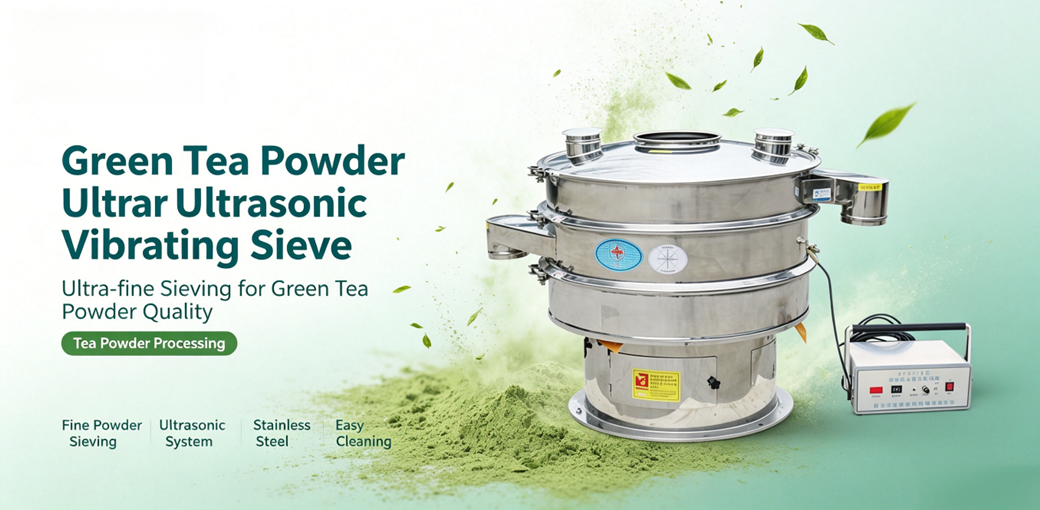
Over 10,000+ customers' choice, Focus on screening industry 40+ years
Green tea powder, also known as matcha powder, is an ultra‑fine powder produced by superfine grinding of tea leaves. Depending on the application, particle size requirements vary widely – baking powders typically range from 200‑400 mesh, while instant beverage powders can require processing to 800 mesh or finer.
When screening mesh size exceeds 400 mesh, standard rotary vibrating screens begin to lose their effectiveness.
The aperture of a 400‑mesh screen is only 38 microns – finer than a human hair. Green tea powder particles have low self‑weight and high buoyancy in air, making it difficult for them to pass through screens above 300 mesh by gravity alone. Green tea powder is also highly adsorptive, prone to agglomeration, and tends to generate static electricity during screening. These characteristics combined make green tea powder screening above 400 mesh a recognised technical challenge.
Standard rotary vibrating screens and ultrasonic vibrating screens show markedly different screening performance when handling this challenge.
Standard rotary vibrating screens use a vertical vibration motor as the excitation source. Eccentric weights at the upper and lower ends of the motor shaft convert rotational motion into horizontal, vertical and tilting three‑dimensional compound motion, which is then transmitted to the screen deck. Material moves in a spiral outward trajectory on the screen surface, achieving separation by particle size through the mesh openings.
Ultrasonic vibrating screens build on the standard rotary vibrating screen by adding an ultrasonic system. This system converts 220V, 50Hz electrical energy into high‑frequency electrical energy, which is then transformed into high‑frequency mechanical vibration by an ultrasonic transducer. The equipment introduces a low‑amplitude, high‑frequency ultrasonic vibration wave (mechanical wave) to the screen surface, subjecting ultra‑fine particles to significant ultrasonic acceleration.
The essential difference is that standard rotary vibrating screens have only one vibration system – material undergoes three‑dimensional mechanical motion on the screen surface. Ultrasonic vibrating screens have a dual vibration system – while the material undergoes low‑frequency three‑dimensional vibration, the screen itself also vibrates at high‑frequency ultrasound. The material on the screen surface remains in a suspended state, effectively inhibiting adhesion, friction, wedging and other blinding factors.
In terms of screening accuracy, the two types of equipment show significant differences.
Standard rotary vibrating screens are primarily suitable for screening powder materials below 200 mesh. For fine powders above 300 mesh, standard rotary vibrating screens deliver unsatisfactory results and are prone to blinding.
Ultrasonic vibrating screens are specifically designed for powder materials below 500 mesh. A single machine can be flexibly adjusted from 200 mesh to 600 mesh. In ultra‑fine powder screening above 400 mesh, ultrasonic vibrating screens achieve stable and efficient screening performance.
Comparative test data : Using the same specification φ500 model for pollen screening with a 400‑mesh screen, the standard rotary vibrating screen failed to produce any fine powder within 15 minutes, while the ultrasonic vibrating screen produced 20% fine powder within 15 minutes while also completing effective classification.
For ultra‑fine powders such as green tea powder, standard rotary vibrating screens often "cannot screen" above 400 mesh, while ultrasonic vibrating screens can consistently produce compliant products.
In ultra‑fine screening above 400 mesh, the throughput difference between the two equipment types is particularly significant.
When handling ultra‑fine powders, standard rotary vibrating screens suffer from severe blinding due to material adhesion and electrostatic attraction, causing screening efficiency to decline continuously and throughput to drop substantially.
Ultrasonic vibrating screens can increase throughput by 0.5 to 10 times. Using the same specification φ1000 model for manganese sulfate screening as an example: the standard rotary vibrating screen with a 125μm mesh achieved a throughput of 50 kg/hour, while the ultrasonic vibrating screen with a finer 53μm mesh still achieved a throughput of 140 kg/hour.
Finer screen mesh, higher throughput – this comparison shows that ultrasonic vibrating screens have a clear capacity advantage in ultra‑fine screening above 400 mesh.
Blinding is the core challenge in ultra‑fine screening above 400 mesh, and the two equipment types have fundamentally different cleaning approaches.
Standard rotary vibrating screens use bouncing ball cleaning as the primary method. Bouncing balls continuously tap the screen during screening, dislodging adhering material. This method works well for materials with low adhesion and relatively large particle sizes. However, for ultra‑fine powders such as green tea powder that are sticky, easily agglomerated and electrostatic, bouncing ball cleaning is insufficient.
Ultrasonic vibrating screens use an ultrasonic self‑cleaning system. The ultrasound causes every wire of the screen to vibrate at high frequency, separating fine particles adhering to the screen surface. This cleaning method is highly effective for sticky, agglomerating, electrostatic and other difficult‑to‑screen materials, effectively preventing screen blinding.
Practical application results : In matcha powder (green tea powder) screening, once the ultrasonic system is activated, the green tea powder remains in a fluidised suspended state on the screen. The screen remains completely open with no blockage, achieving 24‑hour continuous stable operation with an actual throughput of 100‑120 kg/hour. In contrast, the standard rotary vibrating screen began to blind severely within 10 minutes of operation, requiring frequent stoppages for manual cleaning.
Material Protection Comparison: Ultrasonic Vibration Does Not Alter Material Properties
Green tea powder contains active ingredients such as vitamin C and flavonoids. Excessive friction or heat generation during screening may damage these nutrients.
The ultrasonic vibrating screen superimposes a low‑amplitude, high‑frequency micro‑vibration on the screen surface, with gentle and controllable mechanical action on the material. The Gaofu S49‑AC series ultrasonic vibrating sieve can be used with single or multiple decks. A single intelligent ultrasonic generator can simultaneously power three transducers and ensures that the physical properties of the processed material remain unchanged.
For high‑value ultra‑fine green tea powder, preserving active ingredients while maintaining screening accuracy is another important advantage of ultrasonic vibrating screens over standard rotary vibrating screens.
The Gaofu S49‑AC series ultrasonic vibrating sieve integrates a complete ultrasonic system onto the standard rotary vibrating screen, providing a systematic solution for green tea powder screening above 400 mesh:
High‑frequency ultrasonic system. Converts electrical energy into 18‑40KHz high‑frequency mechanical energy, uniformly transmitted to the screen surface through transducers. The screen itself vibrates at tens of thousands of times per second, instantly breaking up agglomerated green tea powder and keeping particles in a suspended state – effectively inhibiting adhesion, friction, wedging and other blinding factors.
Food‑grade stainless steel. Screen frames and mesh are made of 304 food‑grade stainless steel, with seals made of food‑grade silicone, meeting the requirements of food and pharmaceutical industries. For production lines requiring even higher cleanliness, 316L stainless steel is available.
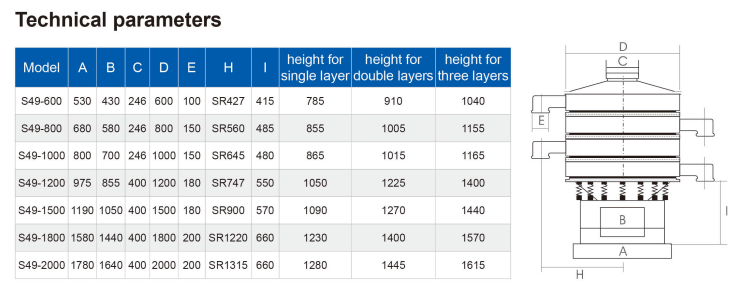
Flexible screen configuration. Can accommodate screens with apertures from 0.01 mm to 4 mm, covering the full range from conventional impurity removal to ultra‑fine classification above 400 mesh. Screen sizes from 400 mm to 2000 mm are available, selected according to throughput requirements.
Quick screen change design. The mother‑child screen frame structure allows screen changes in just 3 to 5 minutes, with convenient and efficient switching between different mesh sizes, greatly reducing downtime.
Food Industry Client Testimonials
Nestlé, CP Group, Haitian Flavour & Fragrance, Yihai Kerry, Yili, Mengniu,Shuanghui, Wahaha, Master Kong, Want Want, Anjoy Foods, Angel Yeast,Yangyuan Foods, Uni-President Enterprises, Qiaqia Food, Luhua Group,Alpenliebe, Golden Monkey, Orion, Xizhilang,Sanquan Foods, Synear Food, Oishi, Wong Lo Kat, Yanjing Beer, Seamild,Jinpai, Chubang, Hengshun Vinegar Industry, Longda Group, Beijing Daoxiangcun, Anhe Dairy,Weiwei Group, Xiangpiaopiao, Maiquer, Tianbing, Binqi Food, Ligao Okun
About Gaofu
Xinxiang Gaofu Machinery Co., Ltd. was founded back in the 1980s. With over 40 years of development, it has been certified as a National-level Specialized, Refined, Unique & Innovative Little Giant Enterprise, National Green Factory, National High-tech Enterprise, and National Intellectual Property Advantage Enterprise, and serves as the President Unit of China Vibration Screening Industry Association.
The company is accredited with the Henan Provincial Industrial Design Center, Henan Provincial Engineering Technology Research Center for Intelligent On-line Screening System, and Xinxiang Municipal Engineering Technology Research Center for Fine Screening.
Gaofu has obtained more than 500 patents including invention patents, utility model patents and design patents, been awarded the Science and Technology Achievement Prize issued by the Ministry of Industry and Information Technology of China, and participated in drafting and formulating 4 national standards.
Gaofu's product portfolio covers multiple series and hundreds of specifications, including vibrating screening equipment, conveying equipment, coal crushing equipment, filtration equipment and automatic material handling systems.
Core products include vibrating screens, screening machines, vibratory sifters, rotary vibrating screens, ultrasonic vibrating screens, linear vibrating screens, airflow screens, gyratory screens, roller screens, dewatering screens, bar screens, vacuum feeding machines, dust-free feeding stations, bulk bag feeding stations, feeding systems, automatic powder feeding systems, automatic slag-discharging filters, leaf filters, clay filters, toothed roll crushers, coal crushers and other machinery.
These products are widely applied in food, pharmaceutical, chemical, metallurgy, construction materials, mining, thermal power, environmental protection and many other industries, winning recognition and trust from over 10,000 clients worldwide.
Gaofu products enjoy strong sales across Greater China, and are exported to more than 100 countries and regions such as Russia, Canada, the United States, New Zealand, Japan, Brazil and South Africa.
Upholding the corporate mission of Improving material quality & efficiency to fully satisfy customer demands, Gaofu maintains long-term partnerships with clients to achieve win-win development.
At present, Gaofu is an official qualified supplier for numerous Fortune Global 500 enterprises, including CNPC, Sinopec, Sinochem Holdings, China Resources Group, Sinopharm Group, COFCO, China National Building Material, China Aerospace Science and Technology Corporation, Jinchuan Group and more.
Gaofu Machinery ranks No.1 in global sales volume of vibrating screens.
In May 2024, Frost & Sullivan, a world-renowned international consulting firm, issued a Market Position Verification Certificate confirming that Gaofu achieved the world's largest shipment volume of vibrating screens in the global market in 2023.