Over 10,000+ customers' choice, Focus on screening industry 40+ years
Rice flour is one of the most widely used basic raw materials in the food processing industry. Whether it is wet‑milled rice flour feeding for fresh wet rice noodles (rice rolls, Cheung fun) or dry rice flour feeding for dried rice noodles (Guilin rice noodles, Yunnan rice noodles), the feeding step is the first process that every batch must go through.
However, this step is fraught with problems in actual production.
Under traditional manual feeding methods, workers open bags of rice flour and pour them into the feed port, causing large amounts of fine powder to instantly disperse into the workshop air, forming a visible "dust cloud". Rice flour is rich in starch and fibre, with fine particles, low bulk density and high dispersibility. This dispersed rice flour dust not only causes raw material loss – the powder that drifts away from each tonne of raw material represents a direct economic loss – but also directly threatens workshop cleanliness and food safety. Dust settling on equipment surfaces and workshop corners creates conditions for microbial growth and cross‑contamination.
Even more challenging is the issue of production line integration. In actual rice flour processing, feeding is often just the starting point – after feeding, the rice flour needs to go through screening to remove lumps and impurities, and then enter the mixing (kneading) process for further processing. Under traditional feeding methods, feeding, screening and mixing are each separate, scattered operations. Every time the material is transferred, it faces dust escape, contamination risk and manual intervention. There is a lack of coordination between the steps, causing the feeding speed to fluctuate – downstream equipment either waits for material or receives too much at once.
Feeding dust, material loss and poor line integration – these three challenges overlap, making rice flour feeding a key bottleneck constraining line efficiency and product quality.
Traditional dust‑free feeding stations are mostly fixed installations that cannot be moved once installed. For large factories with fixed production line layouts and clear material flow paths, fixed feeding stations are adequate. But for rice flour processors that need to flexibly adjust line layouts or switch feeding operations between different workstations, the limitations of fixed feeding stations become apparent – the equipment cannot move, so the production line has to be arranged around it.
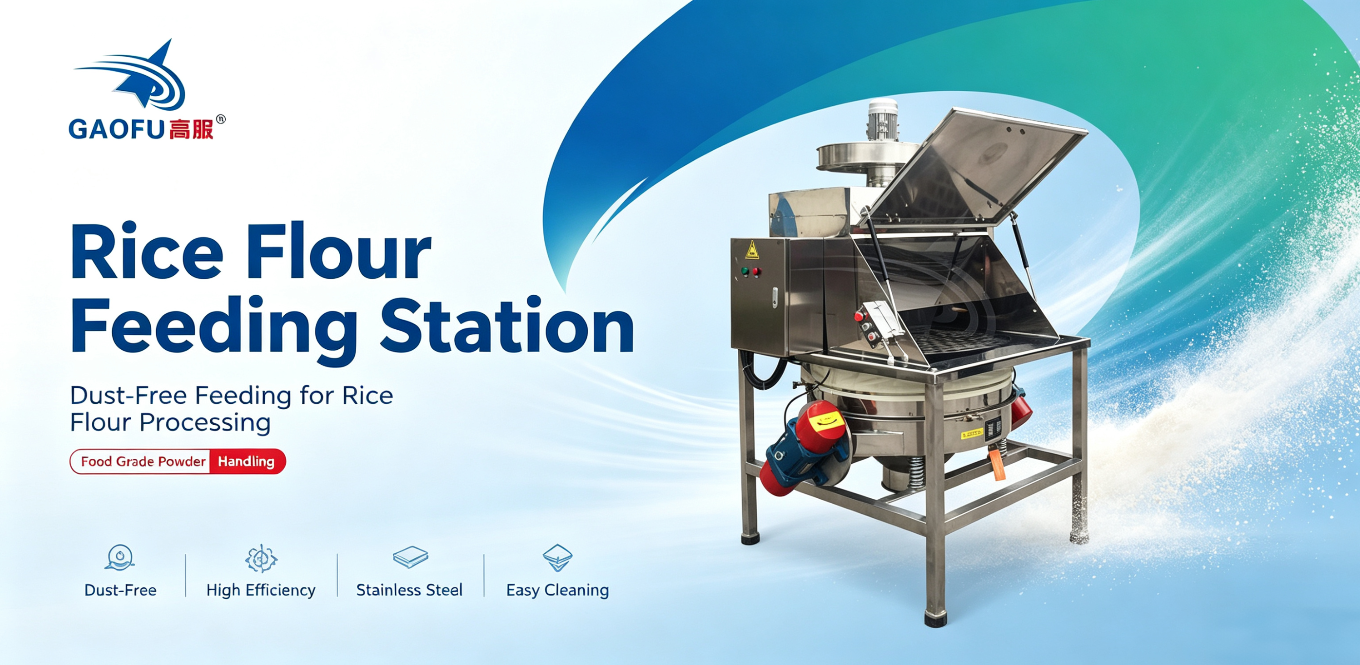
The design logic of the Gaofu mobile rice flour dust‑free feeding station is precisely to break this limitation.
The equipment features an integrated mobile structure with castors at the base, allowing flexible positioning according to production line layout. Whether for new production lines or retrofits of existing workshops, the equipment can be quickly deployed without complex civil construction or equipment hoisting. When the line is adjusted, it can be moved to a new position and continue to be used – no need for repeat purchases.
Three direct changes brought by the mobile design:
Change 1: More flexible line layout. The equipment is no longer "welded" to a fixed location; it can be moved flexibly according to production rhythm. For multi‑variety, small‑batch rice flour processing, this means the feeding point can be adjusted at any time, and line layout is no longer constrained by equipment positioning.
Change 2: One machine serves multiple workstations. A single mobile dust‑free feeding station can serve multiple feeding positions in succession, reducing duplicate equipment investment. For small and medium‑sized rice flour processors with limited workshop space, this design is particularly practical.
Change 3: Easier equipment maintenance. The equipment can be moved to a cleaning area for thorough cleaning and maintenance, then returned to the workstation. Both the interior and exterior can be thoroughly cleaned, eliminating the common "against‑the‑wall dead corner" cleaning problem found with fixed installations.
While the mobile design solves the problem of "where the equipment goes", the cleanliness and efficiency of the feeding itself are ensured by the equipment's core technologies.
The Gaofu mobile rice flour dust‑free feeding station integrates three core technologies: negative pressure dust collection, vibrating screening and intelligent control.
Fully enclosed negative pressure feeding – controlling dust at the source. The equipment uses a fully enclosed bag‑opening and feeding structure, with the feed platform located inside a sealed chamber. The dust collection fan creates a continuous negative pressure environment at the feed port – the rice flour dust generated at the moment of bag opening is directionally drawn into the filtration system before it can disperse. After the dust‑laden air passes through the high‑density filter cartridges, clean air is discharged while the dust is collected. Dust collection efficiency can reach 99.9% , and workshop dust concentration can be controlled to ≤0.1 mg/m³.
Pulse reverse‑cleaning self‑cleaning – 100% material recovery. The equipment is equipped with a pulse reverse‑cleaning dust removal device. When the dust on the filter cartridge surface reaches a certain thickness, the system automatically triggers a compressed air pulse, blowing the dust off the filter cartridges and recovering it into the hopper. The collected dust is 100% recovered into the hopper , and material loss can be controlled to ≤0.5%.
Built‑in vibrating screen – feed and de‑dust in one step. After material passes through the feed port, it first undergoes online screening through a vibrating screen (safety screen). Foreign matter that may be mixed into the rice flour raw material – packaging threads, sealing debris, moisture‑induced lumps – is intercepted before entering the production line, ensuring the purity of raw materials for subsequent screening and mixing processes from the very start.
High feeding efficiency – significantly reducing labour costs. The feeding efficiency of a single machine can reach 500 to 2,000 bags per hour , which is 3 to 5 times faster than traditional manual feeding. One machine can replace the feeding workload of 3 to 5 people , reducing labour costs by over 60% .
The design of the mobile rice flour dust‑free feeding station goes beyond "feeding" itself – its flexible connection capability to downstream processes is equally important.
The equipment can be connected to positive or negative pressure conveying systems to supply material to the production line. From feeding to conveying, the material runs entirely inside enclosed pipelines without manual transfer. This design allows the feeding station to flexibly connect to downstream screening, mixing and other processes:
Connecting to screening processes. The built‑in vibrating screen already completes preliminary impurity removal at the feeding stage. For rice flour that requires further fine classification, the feeding station can be connected to a rotary vibrating sieve or linear vibrating screen through enclosed pipelines. Material goes directly from the feeding station to the screening equipment without intermediate transfer, avoiding secondary exposure and contamination risks during transfer.
Connecting to mixing (kneading) processes. After screening, the acceptable rice flour is sent directly to the mixer or dough kneader through enclosed pipelines. The equipment supports PLC intelligent control, with preset feeding parameters and interlocked operation with downstream equipment – automatically starting when downstream equipment needs material and stopping when it does not, precisely matching the feeding rhythm to the production pace.
Flexible switching between multiple workstations. The mobile design allows the equipment to be quickly moved between different workstations. One feeding station can serve Line A's screening process in the morning and then be moved to Line B's mixing process in the afternoon – the equipment follows the production line, not the other way around.
Rice flour is used directly in food processing, so equipment materials and structure must meet clear hygiene requirements. The Gaofu mobile rice flour dust‑free feeding station incorporates systematic design in the following areas:
Food‑grade stainless steel. All material‑contact parts are made of food‑grade 304 stainless steel, with finely polished surfaces, no hygiene dead corners, and easy to clean.
Fully enclosed sealed structure. The equipment has a fully enclosed design with food‑grade seals, and the feeding process takes place inside a sealed chamber. The fully enclosed structure effectively blocks external moisture and foreign matter, preventing secondary moisture absorption or contamination of the rice flour during feeding.
Hygiene‑grade standard design. The overall design meets hygiene‑grade standards with no cleaning dead corners. For production lines that need to switch between different types of rice flour frequently, this design greatly shortens cleaning time between batches and reduces the risk of cross‑contamination.
Can be connected to positive/negative pressure conveying. The equipment supports connection to positive or negative pressure conveying systems, with fully enclosed operation from feeding to conveying – material is not exposed to the external environment.
From the perspective of actual production conditions in rice flour processing, the Gaofu mobile rice flour dust‑free feeding station delivers value in four dimensions:
Environmental value – The fully enclosed negative pressure structure keeps workshop dust concentration at ≤0.1 mg/m³. No dust escape, and the workshop environment is substantially improved. No material loss during feeding, reducing raw material waste.
Quality value – The built‑in vibrating screen completes preliminary impurity removal at the feeding stage, intercepting lumps and foreign matter before they enter the production line. The fully enclosed structure prevents foreign matter and moisture from entering the feeding system, ensuring the purity of the rice flour.
Efficiency value – A single machine achieves feeding efficiency of 500 to 2,000 bags per hour, 3 to 5 times faster than traditional manual feeding. One machine replaces 3 to 5 people, reducing labour costs by over 60%. The equipment can run 24 hours continuously, effectively supporting large‑scale production.
Flexibility value – The mobile design allows the equipment to be quickly switched between different workstations. One machine serves multiple feeding points, reducing duplicate equipment investment. When the line is adjusted, the equipment can be moved accordingly – no need for repeat purchases and installation.
About Gaofu Machinery
Xinxiang Gaofu Machinery Co., Ltd. was originally founded in the 1980s. After more than 40 years of development, the company has become a "National Specialized and Sophisticated 'Little Giant' Enterprise", a "National Green Factory", a "National High-tech Enterprise", a "National Intellectual Property Advantage Enterprise", and the "President Unit of the Vibration Association". It also hosts the "Henan Provincial Industrial Design Center", the "Henan Provincial Engineering Technology Research Center for Intelligent Online Screening Systems", and the "Xinxiang Municipal Engineering Technology Research Center for Fine Screening". The company has been granted more than 500 invention, utility model and design patents, has received the "Science and Technology Achievement Award" issued by the Ministry of Industry and Information Technology, and has participated in drafting four "National Standards".
Gaofu's product portfolio covers several series and hundreds of varieties, including vibrating screening equipment, conveying equipment, and automated material handling systems. Its main products include one-stop solutions such as automatic feeding systems, powder feeding systems, pneumatic conveying systems, weighing and batching systems, minor ingredient batching systems, water supply systems, oil supply systems, fluid conveying systems, central kitchen powder feeding systems, powder conveying systems, and top-loading feeding systems. The food system production lines mainly include:
Bakery production lines: bread production line, cake production line, shortbread production line, croissant production line, toast production line, pizza production line, biscuit production line, hamburger production line;
Dough product production lines: steamed bun production line, stuffed bun production line, twisted roll production line, sesame paste baked bun production line, steamed dumpling production line, dumpling production line, youtiao (fried dough stick) production line, stuffed pancake production line.
Gaofu products are not only popular in Greater China but are also exported to more than 100 countries and regions, including Russia, Canada, the United States, New Zealand, Japan, Brazil, South Africa, etc. They are widely used in many industries such as food, pharmaceuticals, chemicals, metallurgy, building materials, mining, thermal power, and environmental protection, earning the trust and praise of over 10,000 customers worldwide. The company adheres to its mission: "Enhance material quality and efficiency, meet customer needs", walking side by side with customers for harmonious and win-win cooperation. Today, Gaofu has become an approved supplier to many Fortune 500 companies, including CNPC, Sinopec, Sinochem Group, China Resources Group, Sinopharm Group, COFCO Group, China National Building Material Group, China Aerospace, and Jinchuan Group.