Over 10,000+ customers' choice, Focus on screening industry 40+ years
Rice flour is one of the most widely used basic raw materials in the food processing industry. From wet‑milled rice flour to dried rice flour, from fresh wet rice noodles (rice rolls, Cheung fun) to dried rice noodles (Guilin rice noodles, Yunnan rice noodles), different product categories have different requirements for flour fineness. Fresh wet rice noodles require a smooth, delicate texture, typically requiring the rice slurry to pass through 80‑120 mesh screens. Dried rice noodles are selected between 60‑100 mesh depending on the product type. Specialty rice flours such as glutinous rice flour and ordinary rice flour require even higher screening mesh sizes.
However, rice flour screening in actual production faces persistent problems. Rice flour is rich in starch and fibre, and during screening it readily absorbs moisture and adheres to the screen, causing mesh blockage. After traditional screening equipment runs for several hours, screening efficiency drops noticeably, requiring frequent stoppages for cleaning. The chain reaction caused by screen blinding is direct and tangible: production lines are forced to stop, manual cleaning is time‑consuming and labour‑intensive, production targets become difficult to meet, and batch‑to‑batch quality consistency becomes hard to guarantee.
The root cause of screen blinding in rice flour screening lies in three material characteristics: fibre entanglement – the fine fibres in rice flour tend to wrap around the edges of the mesh openings during screening; starch adhesion – the high starch content causes the powder to form a sticky film on the screen surface when slightly moist; and electrostatic adhesion – fine particles accumulate static charge during high‑speed motion and adhere to the screen wires, forming a "powder film". These three factors overlap, making rice flour a recognised "difficult‑to‑screen" material.
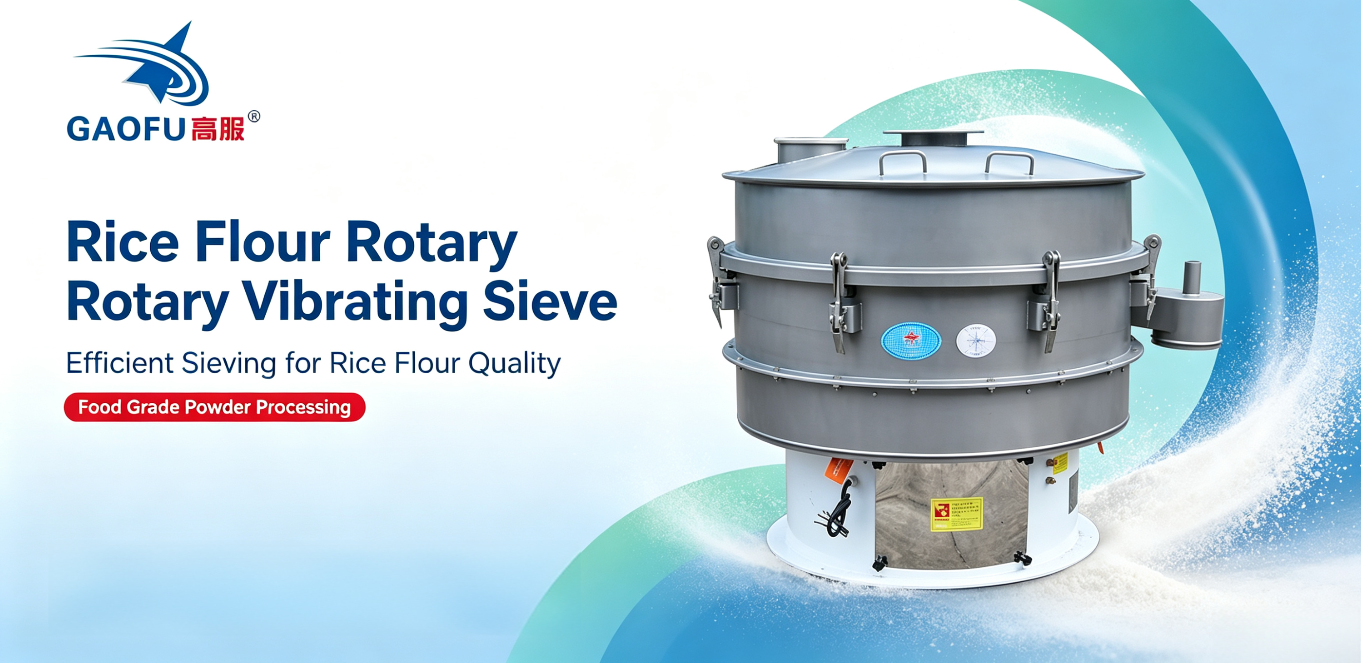
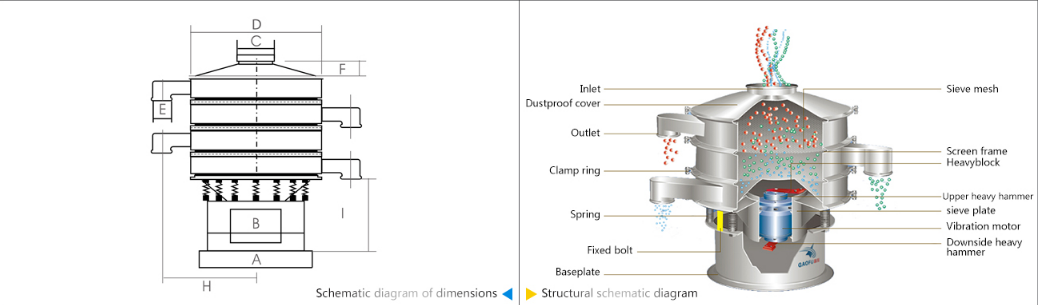
The Gaofu rice flour rotary vibrating sieve uses a vertical vibration motor as the excitation source. Eccentric weights installed at the upper and lower ends of the motor shaft convert the rotational motion into a horizontal, vertical and tilting three‑dimensional compound vibration – known as "three‑dimensional vibration". This compound vibration is transmitted to the screen deck, causing the material to move in a spiral outward trajectory on the screen surface.
The core value of this three‑dimensional motion for rice flour screening lies in two aspects:
First, thorough material loosening. The rice flour continuously tumbles and shifts under three‑dimensional vibration, avoiding accumulation on the screen surface. Fibres do not concentrate and wrap in any single area, and starchy powders do not form adhesive layers locally on the screen surface.
Second, extended screening path and high accuracy. The material travels along a spiral trajectory, giving every particle multiple opportunities to contact the screen. The Gaofu S49 series rotary vibrating sieve can achieve screening accuracy up to 600 mesh (0.02 mm) and filtration precision down to 5 microns. The equipment supports 1 to 5 screen decks, allowing a single feed to complete 2 to 6 grades of classification or filtration simultaneously.
The core contradiction in rice flour screen blinding is: how to ensure high‑precision screening while preventing material from blocking the mesh openings. The Gaofu rice flour rotary vibrating sieve offers two cleaning solutions for different operating conditions.
Solution 1: Bouncing Ball Cleaning System (Standard Configuration)
Food‑grade silicone bouncing balls are placed under the screen deck. During screening, the balls continuously tap the underside of the screen, dislodging adhering rice flour and entangled fibres. This cleaning method is continuous and automatic, requiring no manual intervention, and is suitable for most rice flour screening applications. The bouncing balls are made of food‑grade silicone, non‑toxic and odourless, meeting food production hygiene requirements.
Solution 2: Ultrasonic Cleaning System (Optional)
For ultra‑fine rice flour (above 100 mesh) or more sticky materials, the Gaofu rice flour rotary vibrating sieve can be equipped with an ultrasonic cleaning system. The ultrasonic generator converts electrical energy into high‑frequency (36KHz‑40KHz) electrical waves, which are then converted by a transducer into high‑frequency sinusoidal longitudinal mechanical oscillation waves transmitted to the screen surface.
The ultrasonic energy causes the screen wires to vibrate at high frequency with extremely small amplitude, instantly breaking the surface tension of the powder and causing the rice flour particles in contact with the mesh openings to become suspended. For ultra‑fine rice flour that is highly prone to adhesion, ultrasonics effectively prevents mesh blockage caused by static electricity and adsorption, improving screening efficiency by 50% to 400% compared with ordinary vibrating screens.
The difference between the two cleaning solutions is: bouncing balls are suitable for routine rice flour screening, with controllable costs and simple maintenance; ultrasonics are suitable for high‑mesh, high‑viscosity ultra‑fine powder screening, offering more thorough anti‑blocking performance. The two solutions can be flexibly selected or combined according to material characteristics and process requirements.
Wet‑milled rice flour is the core raw material for fresh wet rice noodles, rice rolls, Cheung fun and similar products. The rice slurry produced by wet milling contains incompletely broken rice grains, fibre fragments and small amounts of impurities. If not filtered, the finished product surface will have a granular feel and a rough texture.
The core value of the Gaofu rice flour rotary vibrating sieve in wet‑milled rice flour filtration lies in two aspects:
Fine filtration to ensure taste. Fresh wet rice noodles require the rice slurry to pass through 80‑120 mesh screens. Through high‑mesh screen configuration, the rotary vibrating sieve effectively intercepts coarse fibres, unmilled rice grains and impurities from the rice slurry, ensuring that the slurry entering the steaming process is fine and uniform.
Continuous operation to support line rhythm. Wet‑milled rice flour production is typically continuous. Once the filtration equipment blinds and stops, the entire line is forced to halt. The bouncing ball or ultrasonic cleaning system keeps the screen clear, allowing the equipment to run 24 hours continuously without frequent stoppages for cleaning.
In the production process of dried rice flour (Guilin rice noodles, Yunnan rice noodles, Jiangxi rice noodles, etc.), the ground dry powder needs to be classified by particle size. Different types of dried rice flour have different fineness requirements – fine rice noodles require a smooth, soft texture, generally using 60‑100 mesh; coarse rice noodles aim for a chewy, springy texture, requiring lower mesh sizes.
The multi‑deck classification design of the Gaofu rice flour rotary vibrating sieve allows a single machine to meet the classification needs of different grades of rice flour. Taking a three‑deck configuration as an example:
Top deck (coarser mesh): intercepts insufficiently ground large particles and fibre impurities;
Middle deck (target mesh): collects the finished rice flour of acceptable particle size;
Bottom deck (finer mesh): separates ultra‑fine powder, which can be used for other purposes or returned for reprocessing.
One feed simultaneously produces multiple particle size grades of rice flour. For manufacturers that need to produce different grades of rice flour, this design greatly reduces equipment investment and process transfer time.
Rice flour is used directly in food processing, so equipment materials and structure must meet clear hygiene requirements. The Gaofu rice flour rotary vibrating sieve incorporates systematic design in the following areas:
Food‑grade stainless steel. All material‑contact parts are made of 304 food‑grade stainless steel, with mirror‑polished surfaces and no hygiene dead corners. For production lines requiring even higher cleanliness, 316L stainless steel is available.
Fully enclosed sealed structure. The equipment has a fully enclosed design with food‑grade silicone seals, and screening takes place inside a sealed chamber. The fully enclosed structure provides three assurances: preventing dust escape, improving the workshop environment; effectively blocking external moisture, preventing secondary moisture absorption of the rice flour during screening; and preventing foreign matter from entering the screening system, ensuring product purity.
Quick screen change design. The equipment uses a mother‑child screen frame structure – the mother screen provides structural support, while the fine screen (working screen) performs the screening. When the fine screen wears out or a different mesh size is needed, only the fine screen needs to be replaced; the mother screen can be used for a long time. Screen changes take only 3 to 5 minutes, greatly reducing production line downtime.
From the perspective of actual production conditions in rice flour processing, the Gaofu rice flour rotary vibrating sieve delivers value in four dimensions:
Quality value – Fibre impurities are effectively intercepted, lumps are naturally broken up, and rice flour is precisely classified by mesh size. Wet‑milled rice flour is fine and uniform, dried rice flour has consistent particle size, and the taste of the finished product is systematically assured.
Efficiency value – The bouncing ball or ultrasonic cleaning mechanism allows the equipment to run continuously for long periods without frequent stoppages for cleaning. Multi‑deck screens complete multi‑stage classification with a single feed, and the overall capacity of the production line is fully utilised.
Hygiene value – Food‑grade 304/316L stainless steel and the dead‑corner‑free design make the equipment easy to clean with no material residue; the fully enclosed structure effectively controls dust escape, helping enterprises meet the hygiene requirements of food GMP and HACCP systems.
Cost value – The mother‑child screen structure extends screen service life; the quick‑change screen design shortens downtime; the fully enclosed structure reduces material loss. The combined effect of these three design features keeps long‑term operating costs under control.
About Gaofu
Xinxiang Gaofu Machinery Co., Ltd. was originally founded in the 1980s. After more than 40 years of development, the company has become a "National Specialized and Sophisticated 'Little Giant' Enterprise", a "National Green Factory", a "National High-tech Enterprise", a "National Intellectual Property Advantage Enterprise", and the "President Unit of the Vibration Association". It also hosts the "Henan Provincial Industrial Design Center", the "Henan Provincial Engineering Technology Research Center for Intelligent Online Screening Systems", and the "Xinxiang Municipal Engineering Technology Research Center for Fine Screening". The company has been granted more than 500 invention, utility model and design patents, has received the "Science and Technology Achievement Award" issued by the Ministry of Industry and Information Technology, and has participated in drafting four "National Standards".
Gaofu's product portfolio covers several series and hundreds of varieties, including vibrating screening equipment, conveying equipment, coal crushing equipment, filtration equipment, and automated material handling systems. Its main products include vibrating screens, screening machines, vibrating sifters, rotary vibrating screens, ultrasonic vibrating screens, linear screens, air flow screens, gyratory screens, roller screens, dewatering screens, bar screens, vacuum feeders, dust-free feeding stations, ton bag feeding stations, feeding systems, automatic powder feeding systems, automatic slag discharge filters, leaf filters, clay filters, toothed roll crushers, coal crushers, and other equipment. These are widely used in many industries such as food, pharmaceuticals, chemicals, metallurgy, building materials, mining, thermal power, and environmental protection, earning the trust and praise of over 10,000 customers worldwide.
Gaofu products are not only popular in Greater China but are also exported to more than 100 countries and regions, including Russia, Canada, the United States, New Zealand, Japan, Brazil, South Africa, etc. The company adheres to its mission: "Enhance material quality and efficiency, meet customer needs", walking side by side with customers for harmonious and win-win cooperation. Today, Gaofu has become an approved supplier to many Fortune 500 companies, including CNPC, Sinopec, Sinochem Group, China Resources Group, Sinopharm Group, COFCO Group, China National Building Material Group, China Aerospace, and Jinchuan Group.
Gaofu Machinery – Global No.1 in Vibrating Screen Sales. In May 2024, Frost & Sullivan, an international authoritative advisory firm, based on its research on the global vibrating screen market and calculated according to global vibrating screen sales volume in 2023, issued a market position confirmation certificate to Gaofu Machinery.