Over 10,000+ customers' choice, Focus on screening industry 40+ years
Pollen is so fine that the outline of a single grain is almost invisible to the naked eye. It is so light that a gentle air current can carry it to every corner of the workshop. It is so delicate that once it absorbs moisture or becomes contaminated, the proteins, amino acids and active enzymes it contains rapidly degrade, losing their nutritional value.
In a pollen processing workshop, the filtration sieve is a checkpoint that every batch of raw material must pass. Its job is to remove impurities, lumps and unbroken pollen grains from the raw material, while allowing the acceptable pollen to pass through. This step seems simple, but in actual production, equipment cleaning gives many workshop supervisors a persistent headache.
Pollen particles typically range from 10 to 50 microns – even finer than flour. During filtration, some fine powder becomes embedded in the edges of the mesh openings, while another portion adheres to the gaps in the screen frames and the corners of the equipment. If the equipment cannot be cleaned thoroughly, the residual pollen will absorb moisture at room temperature, form lumps and breed microorganisms. When the next batch is processed, this "old material" mixes with the "new" – invisible to the eye, but impossible to pass quality tests.
What makes matters more complicated is the wide variety of pollens. Rape pollen, tea pollen, buckwheat pollen, pine pollen – different varieties differ significantly in colour, moisture content and active ingredients. Each time the variety is switched, the filtration equipment must be thoroughly cleaned; otherwise, residual pollen from the previous batch will contaminate the next, affecting product appearance at best and causing the entire batch to be scrapped at worst.
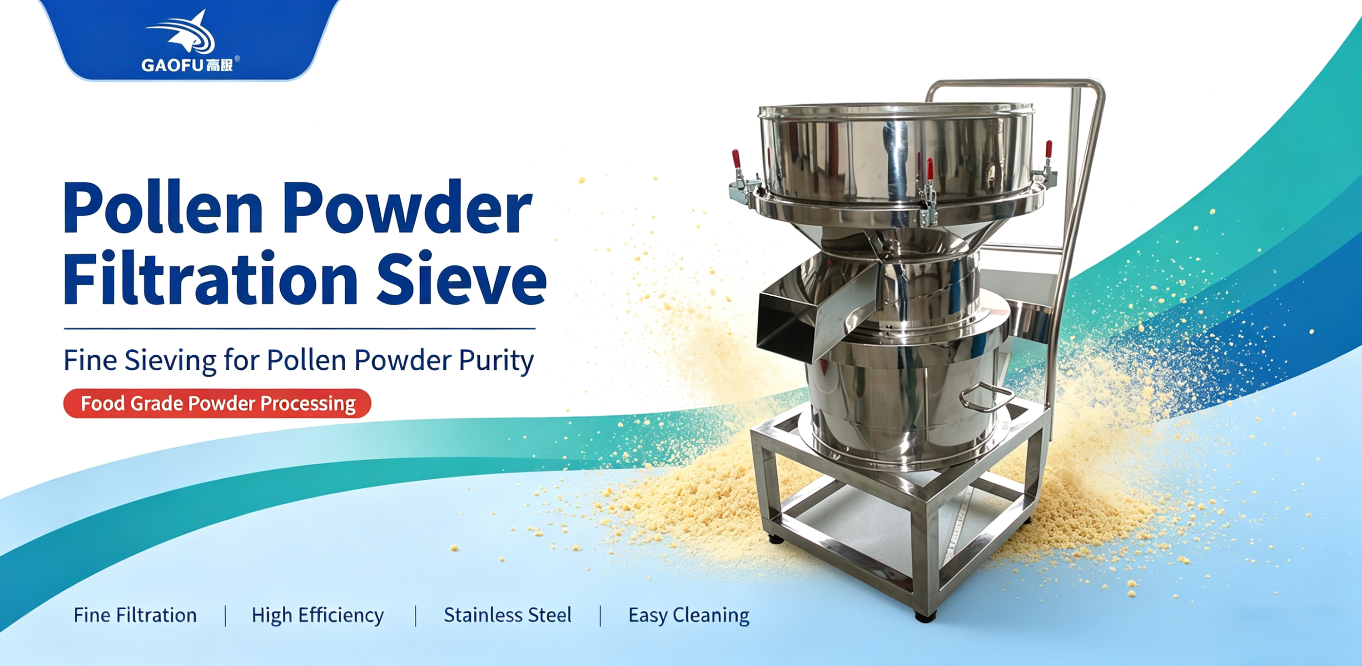
For this reason, the cleaning convenience of pollen filtration equipment is never a "nice‑to‑have" – it is a "must‑have". If the equipment itself is not designed for easy cleaning, even the strictest hygiene management system cannot be effectively implemented. The Gaofu quick‑release pollen powder filtration sieve is a specialised machine designed precisely around this real‑world need.
On traditional pollen filtration equipment, changing the screen or cleaning the interior often consumes a great deal of time. The operator first has to find a special spanner, loosen dozens of fastening bolts one by one, and remove the screen frames layer by layer. After disassembly, the screen mesh must be peeled off from the frame and cleaned separately. Once cleaned, everything must be reassembled in reverse order. The whole process takes at least one to two hours, and sometimes as long as half a day.
If two or three varieties need to be switched in a single day, the time spent on disassembly, cleaning and reassembly consumes most of the shift. The equipment is down, but the workers are not idle – cleaning the screens is labour‑intensive, and the quality of cleaning depends on the operator's diligence.
The design of the Gaofu quick‑release pollen powder filtration sieve completely changes this situation.
The entire screen deck can be pulled out as a whole – no need to remove bolts one by one. The equipment uses a drawer‑type quick‑change screen structure. The operator simply loosens the clamp ring and pulls out the entire screen deck together with the frame. During cleaning, the screen and frame can be handled together in a cleaning area. For reinstallation, the whole deck is pushed back in and the clamp ring is tightened – all in a few minutes.
Screen change time is reduced from "hours" to "3 to 5 minutes". For a pollen processing workshop that needs to switch between multiple varieties every day, this time saving means one extra batch can be processed per day, or the saved time can be used for more thorough quality checks. For plant managers, this is not a minor improvement – it is a major leap in line efficiency.
No special tools required – any operator can handle it. Traditional screen disassembly often requires specialised spanners or torque tools, whereas the quick‑release design uses hand‑tightened locking mechanisms that require no tools at all. Operators do not need special training; they can complete disassembly, cleaning and reassembly by following standard operating procedures. This reduces management complexity and lowers the risk of equipment damage due to improper operation.
If quick release solves the problem of "taking it apart quickly", then a dead‑corner‑free design solves the problem of "washing it cleanly". Neither can be compromised.
Pollen particles are extremely fine. Once they enter crevices and recesses in the equipment, ordinary rinsing cannot reach them. Traditional screen frames often have tiny gaps between the frame and the screen mesh, where pollen grains become trapped and accumulate over time. Over the long term, this "hidden" pollen ferments, becomes mouldy, develops odours and can even become a source of pest infestation.
The Gaofu quick‑release pollen powder filtration sieve systematically eliminates hygiene dead corners through the following design features:
304 stainless steel construction with mirror‑polished surfaces. The equipment has no paint, no coatings, and no risk of peeling. The mirror‑polished surface has low roughness, so material does not readily adhere – even fine pollen particles struggle to stay on such a smooth surface.
All corners are rounded with no right‑angle gaps. Right‑angle gaps are prime spots for material accumulation, whereas rounded corners allow cleaning water to flow smoothly into every area. The internal welds are ground smooth, with no pitted areas to trap debris.
Optimised sealing between screen and frame. In traditional designs, the edges of the screen mesh are often fixed with press strips or adhesives – these areas are the most prone to material accumulation. The Gaofu design uses silicone seal rings to press the screen in place, so there is no direct gap between the screen and the frame, and pollen cannot penetrate into the edge layers.
All detachable parts can be cleaned individually. Every screen deck, every seal ring, and every dust cover can be easily removed and taken to a cleaning station for thorough cleaning. Whether using high‑pressure water jets, steam sterilisation or chemical cleaning, every component can be brought up to hygienic standard.
For pollen processors, this "no dead corner" design means that isolation between batches is truly reliable. The production record can clearly state "equipment cleaned, no residue" – and that carries far more weight in internal quality tracing and external regulatory audits than "visually clean".
Pollen is light, and tends to become airborne during screening. If the equipment is not properly sealed, the workshop will be covered in yellow or brown pollen dust. This not only causes loss of valuable material – pollen is expensive, and every gram that drifts away represents a direct loss – but also affects operator occupational health and workshop cleanliness.
The Gaofu quick‑release pollen powder filtration sieve uses a fully enclosed sealing structure with food‑grade silicone seals, so screening takes place inside a sealed chamber. During operation, pollen powder does not escape into the external environment.
For production lines requiring even higher cleanliness, the equipment can also be fitted with a negative pressure dust extraction port on the top cover, connected to the workshop dust collection system to maintain a slight negative pressure inside the screening chamber. In this way, even the finest pollen particles are firmly "locked" inside the system – they neither contaminate the workshop nor expose operators to dust inhalation risks.
The fully enclosed structure also blocks external moisture and foreign matter. Pollen is highly hygroscopic; once it absorbs moisture, it cakes and deteriorates. The fully enclosed design isolates the screening process from the workshop environment, so the pollen is classified and filtered inside the equipment and then directly enters the next process – completely unaffected by external air humidity throughout.
The value of the quick‑release pollen powder filtration sieve extends beyond operational convenience to production management, quality control and regulatory compliance.
More efficient batch changeovers. In multi‑variety, small‑batch production, the quick‑release design greatly reduces equipment cleaning time. A cleaning job that used to shut down the line for half a day can now be completed within 30 minutes. The effective running time of the line increases, and capacity is released.
Clean‑in‑place operations can be standardised. Quick release means the cleaning process can be broken down into clear steps: remove, clean, inspect, install, verify. Each step has clear operating standards and checkpoints. Management can establish standard operating procedures to ensure that every cleaning achieves the same result. This kind of standardised management is a key focus of GMP audits.
Regulatory compliance with confidence. In food and health food production audits, inadequate equipment cleaning is a common point of deduction. The quick‑release and dead‑corner‑free design ensures that the equipment can be thoroughly cleaned, and the cleaning results can be verified by visual inspection or testing. Inspectors see equipment that is easy to operate and reliable to clean, rather than an awkward situation that requires repeated explanations about "hard‑to‑reach areas".
Reduced material loss. The fully enclosed structure and automatic discharge of impurities increase the passage rate of acceptable pollen, significantly reducing losses from dust dispersion and material retention. For high‑value raw materials like pollen, every gram saved is a cost advantage.
Customer Testimonials
Sinochem Group, China Aerospace Science and Technology Corporation, China National Building Material Group, CNOOC, COFCO, Shuanghui, Yihai Kerry, Yuntianhua, China Nonferrous Metal Mining Group, China State Shipbuilding Corporation, Honjo Chemical, Shandong Yanggu Huatai Chemical, Haohua Technology, Huazhong Pharmaceutical, Union Pharmaceutical, CSPC Pharmaceutical Group, Sanjiu Pharmaceutical, North China Pharmaceutical, Jiudian Pharmaceutical, Limin Co., Ltd., Shaanxi Coal and Chemical Industry Group, Donghai Petrochemical, Feitian Petrochemical, Yanshan Petrochemical, Satellite Chemical, China Pingmei Shenma Group
About Gaofu
Xinxiang Gaofu Machinery Co., Ltd. traces its origins back to the 1980s. After more than 40 years of development, the company has become a "National Specialized, Refined, Distinctive and Innovative 'Little Giant' Enterprise", a "National Green Factory", a "National High-Tech Enterprise", a "National Intellectual Property Advantage Enterprise", as well as the "President Unit of the Vibrating Screen Association". It has also been designated as the "Henan Provincial Industrial Design Center", the "Henan Provincial Intelligent Online Screening System Engineering Technology Research Center", and the "Xinxiang Municipal Fine Screening Engineering Technology Research Center". The company has successfully applied for over 500 patents, including invention patents, utility model patents, and design patents, and has received the "Science and Technology Achievement Award issued by the Ministry of Industry and Information Technology". Gaofu has participated in the drafting and formulation of 4 "National Standards".
Gaofu's product portfolio covers multiple series and hundreds of varieties, including vibrating screening equipment, conveying equipment, coal crushing equipment, filtration equipment, and automated material handling systems. Its main products include blade filters, automatic slag-discharging filters, plate-type enclosed filters, bleaching earth filters, diatomaceous earth filters, bag filters, candle filters, titanium rod filters, and filtration systems. These products are widely used in industries such as food, pharmaceuticals, chemicals, and environmental protection, earning the trust and acclaim of over 10,000 customers worldwide.
Gaofu products are not only best-selling across Greater China but also exported to over 100 countries and regions, including Russia, Canada, the United States, New Zealand, Japan, Brazil, and South Africa. The company practices its mission of "Enhancing material quality and efficiency to meet customer needs", accompanying customers along the way toward harmonious and mutually beneficial partnerships. Gaofu has become a cooperative supplier to numerous Fortune Global 500 companies, including CNPC, Sinopec, Sinochem Group, China Resources Group, Sinopharm Group, COFCO Group, China National Building Material Group, China Aerospace Science and Technology Corporation, and Jinchuan Group.