Over 10,000+ customers' choice, Focus on screening industry 40+ years
To appreciate the value of the tumbler screen, one must first understand the physical world of tapioca starch.
Unlike free‑flowing granular materials, tapioca starch has three distinct characteristics: first, it is lightweight – particles have poor gravitational settling and tend to float; second, it generates static electricity easily – fine particles become charged through friction, causing them to adhere to each other or to the metal screen surface, forming an "electrostatic shield layer"; third, it has a wide particle size distribution – from extremely fine micro‑powders to larger particles, demanding long screening paths and thorough dispersion.
When conventional vibrating screens process such materials, they rely on high‑frequency mechanical impact. However, high‑frequency vibration on tapioca starch brings side effects: intense impact aggravates inter‑particle friction and static generation, quickly blinding the screen mesh; at the same time, fragile starch particles are easily broken during violent bouncing, generating more fines and further worsening screening conditions. This creates a vicious cycle – the more vibration, the more blinding.
For tapioca starch, the most effective screening method actually lies in the traditional – seemingly inefficient – action of hand screening. When an experienced worker shakes a sieve frame, they are not "bouncing" the material; they are "rocking" and "swaying" it. The result: material rolls, disperses, and stratifies on the screen surface without agitation, fines have sufficient time to find mesh openings and pass through with gentle gravity assistance, and static accumulation is minimised due to reduced friction.
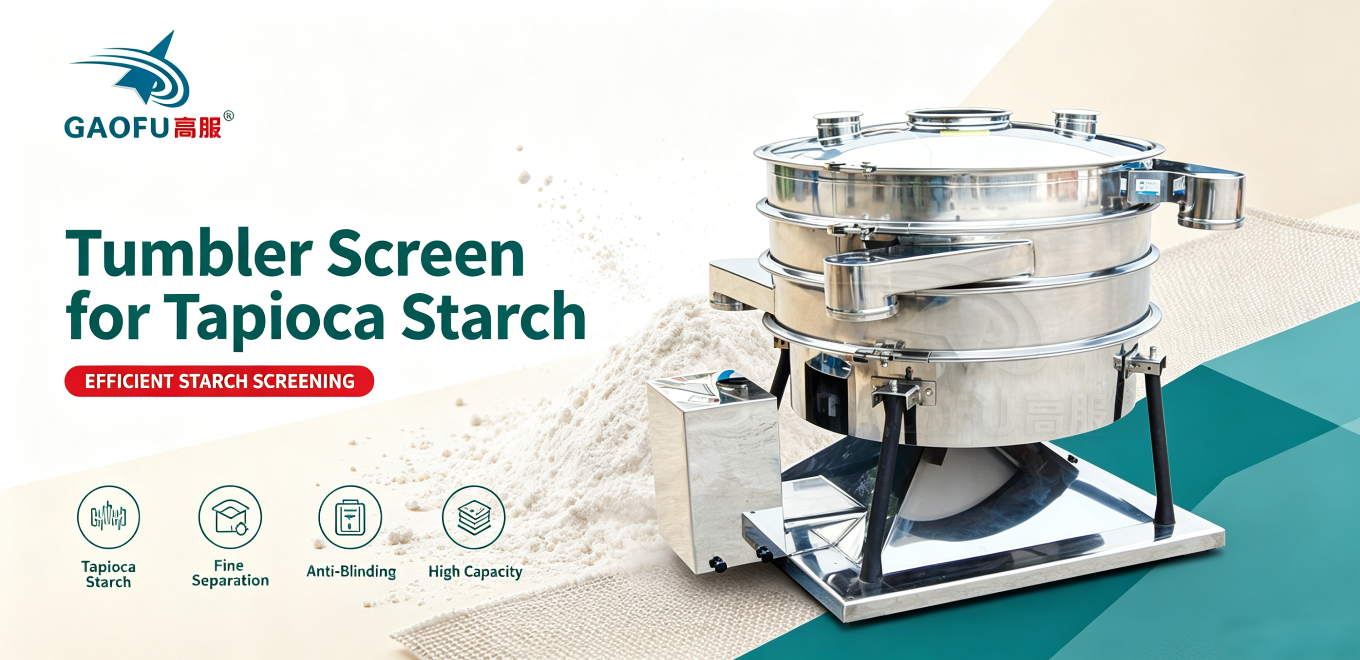
The technological starting point of Gaofu's tumbler screen is to translate this "gentle yet efficient" hand‑screening feel into mechanical language.
1. Non‑linear three‑dimensional motion: from "bouncing" to "spiralling"
The core drive unit of the tumbler screen generates a non‑linear three‑dimensional motion. From a microscopic perspective, material does not simply jump up and down on the screen surface; instead, it follows a spiral trajectory formed by the synthesis of radial displacement and circular motion – spreading from the centre to the periphery in an involute spiral. This spiral motion offers two major advantages: it significantly extends the screening path, far longer than the short‑distance throwing of linear vibrating screens, providing ample time for fines to pass through; at the same time, the material layer naturally stratifies during spiral progression – lighter fines float to the top and gradually sink to contact the mesh, while coarse particles remain on the surface and move to the edge, achieving orderly separation.
2. Low speed and smoothness: precise acceleration control
Unlike vibrating screens with impact accelerations of several Gs, the tumbler screen's acceleration is controlled between 0.5G and 1.5G (adjustable). This gentle acceleration, combined with low‑speed operation (typically 180‑300 rpm), keeps tapioca starch particles in a "controlled rolling" state rather than "uncontrolled bouncing". For materials prone to static, this "rolling" greatly reduces intense friction between particles and against the screen, fundamentally lowering static generation and accumulation at the physical source.
3. The "clever force" of vertical acceleration
Although predominantly a horizontal rocking motion, the tumbler screen subtly superimposes a mild vertical acceleration into its movement path. This vertical acceleration is not intended to throw material high, but to create a micro‑cycle of "compression and release" : when material is gently pressed against the mesh, fines smaller than the openings are "squeezed" through; during the upward phase, the material layer loosens, creating space for the next pass. This rhythmic "press‑and‑release" action significantly improves the instantaneous passage rate of fines.
Based on the above working principles, the tumbler screen produces several noteworthy chain reactions in actual tapioca starch production:
Extended screen life with self‑maintaining performance. Because material rolls forward rather than sliding, screen wear is concentrated on the tops of wire intersections rather than side‑cutting forces. Combined with optional ultrasonic or bouncing‑ball cleaning devices, the screen remains clean continuously, extending screen life by 30%‑50%.
Simultaneous improvement in throughput and accuracy. When conventional vibrating screens pursue high accuracy (e.g., above 120 mesh), they often have to sacrifice throughput. The tumbler screen, with its long spiral path and efficient stratification, maintains high material throughput even at fine meshes, achieving high accuracy and high capacity concurrently. For tapioca starch, using a tumbler screen raises impurity removal rates to over 98%, and the uniformity of finished product fineness is far superior to vibrating screen results.
Low‑energy operation in a closed environment. The fully enclosed structure, combined with low‑speed motors, not only keeps workshop dust concentrations at very low levels but also significantly reduces energy consumption per unit area throughput compared to vibrating screens of equivalent capacity.
Gaofu's GFBD series tumbler screen is not a fixed‑parameter machine – it offers flexible adjustments to suit production needs:
Amplitude and frequency adjustment: By varying eccentric block angles and motor speeds, the spreading speed and residence time of material on the screen can be changed.
Multi‑deck grading configuration: Supports 4‑5 screen decks, simultaneously providing 5‑6 precise particle size fractions to meet market demands for different starch grades.
Optional cleaning systems: Depending on impurity content and moisture levels, customers can choose rotating brush, ultrasonic, or bouncing‑ball cleaning solutions to balance anti‑blinding performance with operating costs.
About Gaofu
Xinxiang Gaofu Machinery Co., Ltd. was originally founded in the 1980s. After more than 40 years of development, the company has become a "National Specialized and Sophisticated 'Little Giant' Enterprise", a "National Green Factory", a "National High-tech Enterprise", a "National Intellectual Property Advantage Enterprise", and the "President Unit of the Vibration Association". It also hosts the "Henan Provincial Industrial Design Center", the "Henan Provincial Engineering Technology Research Center for Intelligent Online Screening Systems", and the "Xinxiang Municipal Engineering Technology Research Center for Fine Screening". The company has been granted more than 500 invention, utility model and design patents, has received the "Science and Technology Achievement Award" issued by the Ministry of Industry and Information Technology, and has participated in drafting four "National Standards".
Gaofu's product portfolio covers several series and hundreds of varieties, including vibrating screening equipment, conveying equipment, coal crushing equipment, filtration equipment, and automated material handling systems. Its main products include vibrating screens, screening machines, vibrating sifters, rotary vibrating screens, ultrasonic vibrating screens, linear screens, air flow screens, gyratory screens, roller screens, dewatering screens, bar screens, vacuum feeders, dust-free feeding stations, ton bag feeding stations, feeding systems, automatic powder feeding systems, automatic slag discharge filters, leaf filters, clay filters, toothed roll crushers, coal crushers, and other equipment. These are widely used in many industries such as food, pharmaceuticals, chemicals, metallurgy, building materials, mining, thermal power, and environmental protection, earning the trust and praise of over 10,000 customers worldwide.
Gaofu products are not only popular in Greater China but are also exported to more than 100 countries and regions, including Russia, Canada, the United States, New Zealand, Japan, Brazil, South Africa, etc. The company adheres to its mission: "Enhance material quality and efficiency, meet customer needs", walking side by side with customers for harmonious and win-win cooperation. Today, Gaofu has become an approved supplier to many Fortune 500 companies, including CNPC, Sinopec, Sinochem Group, China Resources Group, Sinopharm Group, COFCO Group, China National Building Material Group, China Aerospace, and Jinchuan Group.
Gaofu Machinery – Global No.1 in Vibrating Screen Sales. In May 2024, Frost & Sullivan, an international authoritative advisory firm, based on its research on the global vibrating screen market and calculated according to global vibrating screen sales volume in 2023, issued a market position confirmation certificate to Gaofu Machinery.