Over 10,000+ customers' choice, Focus on screening industry 40+ years
Compound seasoning production involves a wide variety of materials – chilli powder, Sichuan pepper powder, pepper powder, cumin powder, curry powder, five‑spice powder, chicken powder, monosodium glutamate (MSG), and more. Each material has different physical characteristics, but the requirements at the feeding stage are consistently demanding:
1. Material diversity demands highly adaptable feeding equipment
Compound seasoning plants typically need to handle multiple powdered materials of varying forms. Chilli powder and Sichuan pepper powder are ultra‑fine, lightweight powders that tend to become airborne; chicken powder and MSG are granular materials with good flowability; some spices contain oils and have a certain degree of adhesion. A single feeding station needs to accommodate multiple material types, placing high demands on equipment adaptability.
2. Hygiene management challenges from frequent product changeovers
Compound seasoning plants typically produce multiple varieties and formulations. Frequent changeovers between different materials require feeding equipment that is easy to clean and prevents cross‑contamination. Whether the equipment structure supports quick disassembly and cleaning, and whether there are any dead corners, are important factors to evaluate during selection.
3. Impact of feeding on overall line efficiency
Feeding efficiency directly affects the output of the entire production line. Traditional manual handling, bag opening, and dumping are not only limited in efficiency but also tend to become a bottleneck in large‑scale production. The performance of automated feeding equipment in increasing throughput per unit time and reducing manual intervention is a key selection criterion.
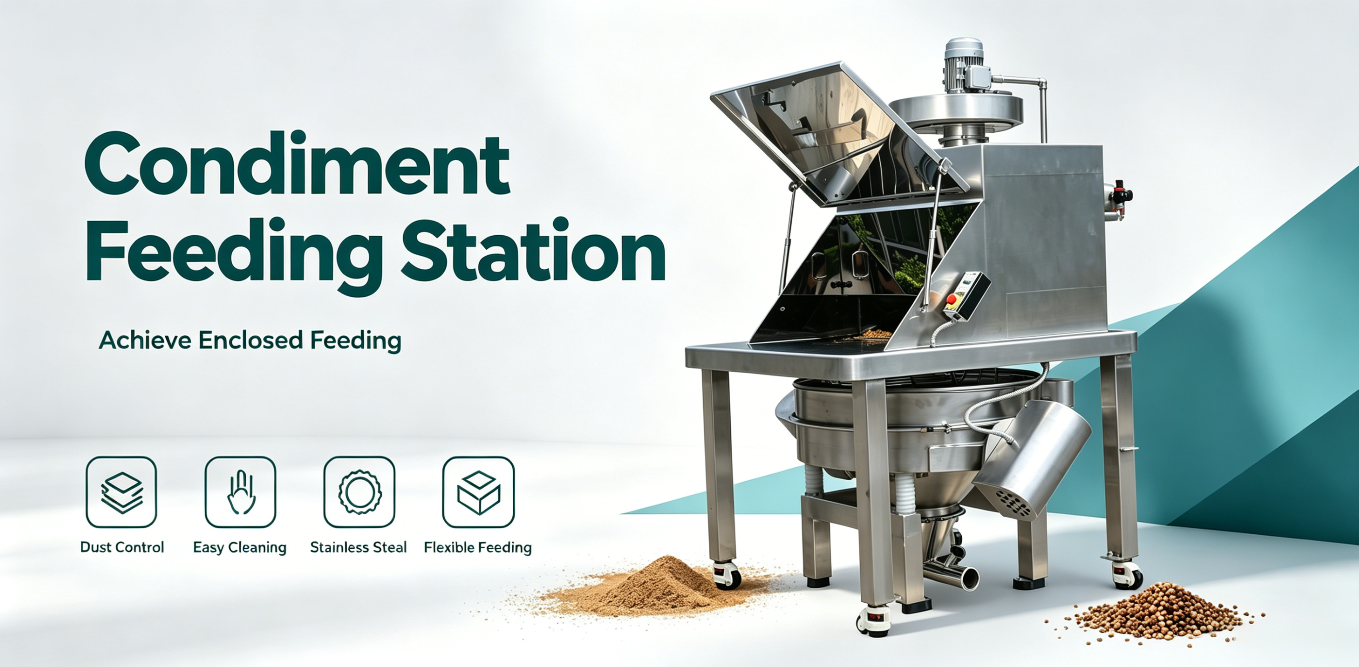
Gaofu Machinery's condiment feeding station integrates three core technologies – negative‑pressure dust collection, vibrating screening, and intelligent control – to provide a systematic solution for enclosed feeding in compound seasoning plants.
1. Negative‑pressure dust collection: no dust dispersion, cleaner workshop
Gaofu's feeding station uses a micro‑negative‑pressure dust collection system that maintains negative pressure during operation. Dust generated when operators open and dump bags is directionally drawn into the filtration system, effectively preventing dust escape. The equipment is equipped with a pulse‑jet cleaning system that automatically cleans the filter elements at regular intervals, achieving 99.9% dust collection efficiency and maintaining dust concentration at ≤0.1 mg/m³ during operation. Collected dust is 100% recovered back into the hopper, with material loss ≤0.5% .
For compound seasoning plants, this means significantly improved cleanliness in the feeding area, effective control of dust cross‑contamination between different materials, and greater confidence in passing environmental inspections and food safety audits.
2. Vibrating screening: intercepting impurities at the source
The feeding station integrates a vibrating screening system (safety screen) . After material is fed, it passes through the screen, effectively intercepting packaging debris, thread ends from bag closures, moisture‑laden lumps, and other foreign matter. Oversize materials and impurities are retained, ensuring that only qualified material proceeds to the next process. This design acts as a "security checkpoint" at the feeding stage, safeguarding the purity of compound seasonings from the outset.
3. Intelligent control: automated operation for improved feeding efficiency
The equipment is equipped with a PLC intelligent control system supporting one‑touch start/stop, feed rate monitoring, and automatic filter cleaning. Feeding efficiency reaches 500‑2,000 bags per hour – 3‑5 times faster than traditional manual feeding, reducing labour costs by over 60% . The station can be connected to positive‑ or negative‑pressure conveying systems for continuous material supply, achieving fully enclosed, automated operation from feeding to conveying.
When selecting a condiment feeding station, compound seasoning plants should evaluate the following five dimensions:
Point 1: Material characteristics determine equipment configuration
Different seasonings have widely varying physical properties, so selection should be tailored to the specific material:
Ultra‑fine, easily airborne powders (e.g., chilli powder, Sichuan pepper powder) : Choose a dust collection system with higher filtration efficiency to ensure effective dust recovery.
Granular materials (e.g., chicken powder, MSG) : Standard configurations are usually sufficient; focus on evaluating the screening system's capacity.
Hygroscopic materials prone to lumping : Consider models with bridging‑breaking vibration devices to prevent feed blockage.
Oil‑containing materials (e.g., certain spice powders) : Pay attention to the smoothness of internal surfaces to prevent material adhesion.
Point 2: Material and hygiene standards – food‑grade is the minimum requirement
Compound seasonings are consumed directly, placing extremely high hygiene standards on production equipment. All parts that contact materials must be made of food‑grade stainless steel , typically 304 or 316L grade, with surface finish meeting easy‑cleaning and no‑residue standards. The overall equipment design should comply with food production hygiene regulations, with no dead corners and support for quick disassembly and cleaning.
Gaofu's feeding station is designed to hygienic standards – easy to clean, residue‑free, and compliant with food industry clean production requirements.
Point 3: Capacity matching – the right model makes all the difference
Choose the appropriate model based on your line's feeding volume. Gaofu's feeding station covers 500‑2,000 bags per hour , with flexible configurations for different capacity needs. It is advisable to allow some capacity margin for future production expansion.
Point 4: Line integration capability – equipment is not an island
A feeding station is not a standalone unit – it is an integral part of the complete production line. Evaluate whether the station can be easily connected to downstream conveying, mixing, and packaging equipment. Gaofu's feeding station can be connected to positive‑ or negative‑pressure conveying systems to supply material to the production line, achieving fully enclosed, automated "feeding – screening – conveying" operation.
Point 5: Supplier credentials – brand strength is a long‑term guarantee
The reliable operation of screening and feeding equipment depends on the supplier's technical expertise and after‑sales support. Consider the supplier's industry experience, patent portfolio, industry service track record, and relevant certifications. Gaofu Machinery was founded in 1984 and has over 40 years of R&D and manufacturing experience in screening and conveying.
About Gaofu Machinery
Xinxiang Gaofu Machinery Co., Ltd. was originally founded in the 1980s. After more than 40 years of development, the company has become a "National Specialized and Sophisticated 'Little Giant' Enterprise", a "National Green Factory", a "National High-tech Enterprise", a "National Intellectual Property Advantage Enterprise", and the "President Unit of the Vibration Association". It also hosts the "Henan Provincial Industrial Design Center", the "Henan Provincial Engineering Technology Research Center for Intelligent Online Screening Systems", and the "Xinxiang Municipal Engineering Technology Research Center for Fine Screening". The company has been granted more than 500 invention, utility model and design patents, has received the "Science and Technology Achievement Award" issued by the Ministry of Industry and Information Technology, and has participated in drafting four "National Standards".
Gaofu's product portfolio covers several series and hundreds of varieties, including vibrating screening equipment, conveying equipment, and automated material handling systems. Its main products include one-stop solutions such as automatic feeding systems, powder feeding systems, pneumatic conveying systems, weighing and batching systems, minor ingredient batching systems, water supply systems, oil supply systems, fluid conveying systems, central kitchen powder feeding systems, powder conveying systems, and top-loading feeding systems. The food system production lines mainly include:
Bakery production lines: bread production line, cake production line, shortbread production line, croissant production line, toast production line, pizza production line, biscuit production line, hamburger production line;
Dough product production lines: steamed bun production line, stuffed bun production line, twisted roll production line, sesame paste baked bun production line, steamed dumpling production line, dumpling production line, youtiao (fried dough stick) production line, stuffed pancake production line.
Gaofu products are not only popular in Greater China but are also exported to more than 100 countries and regions, including Russia, Canada, the United States, New Zealand, Japan, Brazil, South Africa, etc. They are widely used in many industries such as food, pharmaceuticals, chemicals, metallurgy, building materials, mining, thermal power, and environmental protection, earning the trust and praise of over 10,000 customers worldwide. The company adheres to its mission: "Enhance material quality and efficiency, meet customer needs", walking side by side with customers for harmonious and win-win cooperation. Today, Gaofu has become an approved supplier to many Fortune 500 companies, including CNPC, Sinopec, Sinochem Group, China Resources Group, Sinopharm Group, COFCO Group, China National Building Material Group, China Aerospace, and Jinchuan Group.